From Screening to Site Control: Phytic‑Acid Mediated P‑Tuning of M–N Coordination to Balance Iodine Adsorption and Stability in Zn–I2 Batteries
Published in Materials
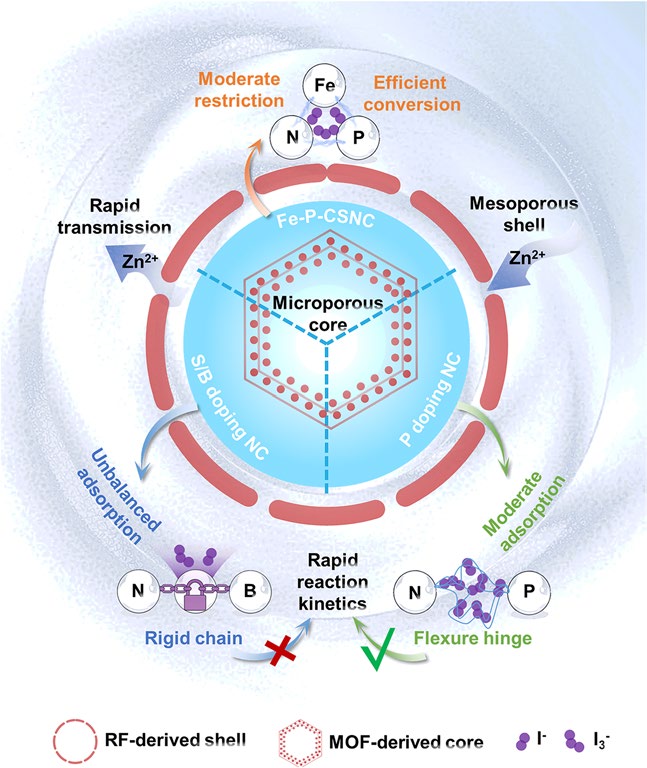
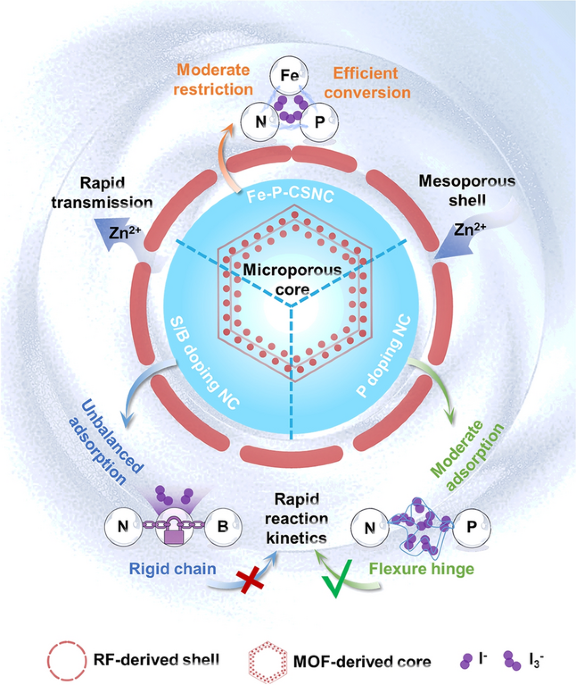

As demand grows for safe, low-cost, and sustainable energy-storage technologies, aqueous zinc–iodine batteries have attracted increasing attention for large-scale energy storage. However, soluble polyiodide shuttling, sluggish iodine redox kinetics, and excessive adsorption on catalytic sites can lead to site poisoning and poor reversibility. Researchers from Yangzhou University, the Canadian Light Source at the University of Saskatchewan, Huzhou Normal University, and the Shanghai Synchrotron Radiation Facility, led by Professor Huan Pang and collaborators, have developed a phytic-acid-assisted strategy that precisely regulates single-atom active sites, achieving a balance between polyiodide confinement and reversible iodine conversion.
Why This Cathode Matters
Conventional porous carbon hosts provide limited interaction with soluble polyiodides, while excessively strong adsorption on heteroatom or single-atom sites can trap iodine intermediates and slow their subsequent conversion. Through systematic screening of B, S, and P dopants, the researchers identified phosphorus as an optimal dopant for achieving moderate adsorption. This strategy suppresses polyiodide shuttling while maintaining reversible iodine redox reactions, overcoming the conventional trade-off between adsorption strength and catalytic reversibility.
Innovative Design and Mechanism
The researchers developed a phytic-acid-assisted in-situ synthesis strategy to construct Fe-, Co-, and Ni-based P-doped core–shell single-atom catalysts. Phytic acid serves simultaneously as a phosphorus source and etching agent, enabling P doping, hierarchical cavity formation, and atomic dispersion of transition-metal sites in a one-pot process. In the optimized Fe–P-CSNC, neighboring P atoms induce electronic redistribution and geometric distortion around Fe–Nx sites, tuning the Fe electronic structure and providing moderate adsorption toward I3⁻/I2 species. Meanwhile, the porous core–shell architecture confines polyiodides and provides efficient ion-transport pathways.
Outstanding Performance
The optimized Fe–P-CSNC cathode achieves an oxidation Tafel slope of only 118 mV dec-1 and delivers 146 mAh g-1 at 5 A g-1. Its capacitive contribution reaches 87%, reflecting efficient charge-storage kinetics. More importantly, the electrode exhibits exceptional durability, showing negligible capacity decay over 20,000 cycles at 2 A g-1 with nearly 100% Coulombic efficiency. Even at 0.5 A g-1, it maintains stable cycling over 1000 cycles with a capacity decay rate of only 0.05% per cycle. After 24 h of rest, the battery retains 91.3% of its capacity, compared with 83.6% for undoped carbon.
Applications and Future Outlook
The Fe–P-CSNC cathode demonstrates practical potential beyond conventional coin-cell testing. Pouch cells show no obvious capacity degradation after 100 cycles, while three cells connected in series can continuously power a commercial LED array. More broadly, this work establishes moderate adsorption as an effective design principle for conversion-type batteries: adsorption should be strong enough to suppress intermediate shuttling, yet sufficiently moderate to enable rapid desorption and reversible conversion. The combination of phytic-acid-mediated P doping, core–shell confinement, and single-atom electronic regulation offers a promising strategy for durable Zn–I₂ batteries and other advanced conversion-type energy-storage systems.

Editor of Nano-Micro Letters, which is an Open-Access, peer-reviewed journal reported papers that have at least one dimension ranging from a few sub-nanometers to a few hundreds of micrometers. The journal is published by Springer Nature and indexed by SCI, EI, SCOPUS, Pubmed, etc. The 2025 JCR Impact Factor is 38.5. The 2025 CiteScore is 58.9.
Follow the Topic
-
Nano-Micro Letters
Nano-Micro Letters is a peer-reviewed, international, interdisciplinary and open-access journal that focus on science, experiments, engineering, technologies and applications of nano- or microscale structure and system in physics, chemistry, biology, material science, and pharmacy.