From Slime to Stone: The Engineered Architecture of Biofilms
Published in Microbiology and Sustainability

1. The Regulated Formation of Mineral Scaffolds
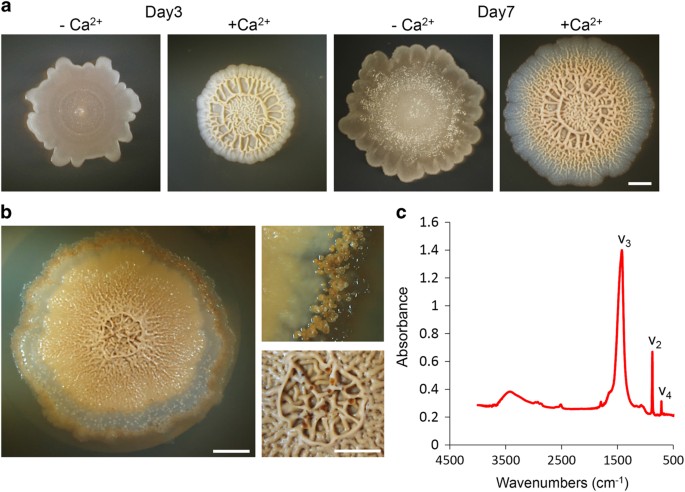
The concept of the biofilm matrix expanded significantly with the discovery that bacteria actively construct their own mineral foundations. As demonstrated in our study, "Spatio-temporal assembly of functional mineral scaffolds within microbial biofilms" (npj Biofilms and Microbiomes, 2016), species like Bacillus subtilis do not passively calcify.
Instead, localized accumulation of calcium carbonate within the colony triggers synchronized calcite deposition. By analyzing mineralization-deficient mutants, this work proved that these crystal networks are genetically coordinated structures that directly dictate the biofilm's macro-morphology and structural robustness.
2. Mapping the "Mineral Shield" via Micro-CT
If calcite provides the structural framework, how does it functionally serve the community? The answer came through advanced, non-destructive imaging in the follow-up paper, "Micro-CT X-ray imaging exposes structured diffusion barriers within biofilms" (npj Biofilms and Microbiomes, 2018).
Using high-resolution micro-computed tomography, we mapped the spatial distribution of these minerals in living biofilms. They discovered a highly structured, dense calcium carbonate lamina acting as a literal diffusion barrier. This mineral shield limits permeability, keeping antibiotics and environmental hazards out. Crucially, inhibiting the enzymatic pathways behind this biomineralization compromised the shield, rendering the biofilms vulnerable and revealing a potential therapeutic target.
3. Harnessing Synthetic Consurtia for Living Materials
Today, we explored this natural defense mechanism as an engineering platform. Rather than fighting biofilm mineralization, we aim to control it and design resistant functional structures, as outlined in our recent research published in Cell Reports Physical Sciences: Synthetic bacterial communities as synergistic anti-corrosion agents.
This current work establishes a design framework for programmable mineralized environments. The formation of synthetic consortia and subsequent metabolic cooperation enable the embedded bacteria to perform complex tasks such as autonomous self-healing, localized carbon capture, and self-repair.
An illustration of a defined defect (a pit or crevice) on the metal surface exposed to seawater. The synthetic consortia are shown specifically attached within this defect, beginning to produce the protective shield.

Follow the Topic
-
npj biofilms and microbiomes
npj Biofilms and Microbiomes considers research that explores the biology, ecology, and communal function of biofilms, microbial populations, and communities, as well as derived applications across the medical, environmental, and engineering sciences.

What are SDG Topics?
An introduction to Sustainable Development Goals (SDGs) Topics and their role in highlighting sustainable development research.
Continue reading announcement


Please sign in or register for FREE
If you are a registered user on Research Communities by Springer Nature, please sign in