Genes, Milk, and Nitrogen: Decoding How Cows Manage Waste at the Genomic Level
Published in Genetics & Genomics, Agricultural & Food Science, and Zoology & Veterinary Science

Explore the Research
 Research Communities by Springer Nature
What do we really know about dairy and chronic diseases?
Dairy fats, inflammation and the food matrix
Published in Dairy Science and Management
October 2025
The Study at a Glance
Researchers analyzed more than 347,000 milk test-day records from 52,000 Iranian Holstein cows, using genomic data from 2,187 bulls and over 41,000 SNP markers.
By applying a single-step genome-wide association study (ssGWAS) combined with random regression models, they tracked how genetic effects on MUN changed over time across the lactation cycle—revealing the dynamic nature of nitrogen metabolism in dairy cows.
What They Found
-
Genetic control of MUN varies by lactation stage—only three SNPs overlapped between early, mid, and late lactation.
-
Seventeen candidate genes were identified, including PGLYRP3, S100A9, ABCB11, CYP1A1, and SLC5A11, linked to nitrogen metabolism, immune response, and nutrient transport.
-
Many of these genes lie near quantitative trait loci (QTLs) associated with milk composition, fertility, and health traits—highlighting how nitrogen efficiency connects to multiple aspects of dairy performance.
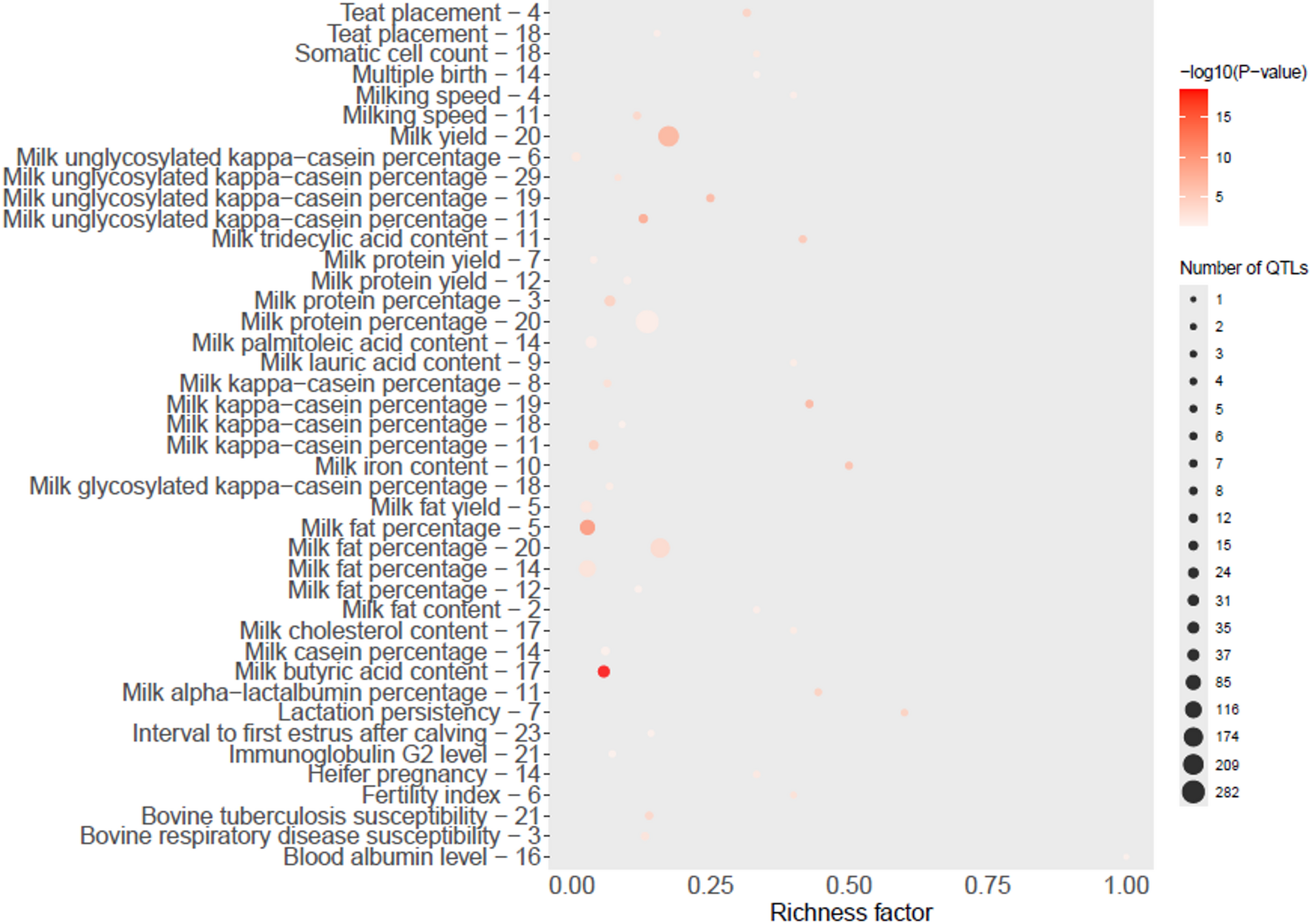
This figure shows enriched QTLs associated with MUN across lactation stages. Traits such as milk protein content, fertility, and disease resistance share common genomic regions — suggesting that nitrogen efficiency is intertwined with both productivity and animal health.
Figure 2 from Mortazavi et al. (2025), Dairy Science and Management. Shared under CC BY-NC-ND 4.0. https://doi.org/10.1186/s44363-025-00015-9
Why It Matters
Understanding the genetic architecture of MUN can help breeders select cows that use nitrogen more efficiently, reducing nitrogen losses and improving sustainability. This approach can help cut emissions from manure and urine without sacrificing milk yield or fertility — a major step toward climate-smart dairy production.
Looking Ahead
Mortazavi et al. recommend that future research should:
-
Validate the identified candidate genes through functional and expression studies
-
Explore genotype–environment interactions to assess how management and diet influence nitrogen efficiency
-
Incorporate MUN into multi-trait genomic selection programs to balance production, fertility, and sustainability
Full Paper
Mortazavi, M., Zandi, M.B., Pahlavan, R., Eskandari Nasab, M., Mulim, H.A., & Rojas de Oliveira, H. Genome-wide association analysis based on random regression models for milk urea nitrogen in Iranian Holstein cattle. Dairy Sci. Manag. 2, 12 (2025). https://doi.org/10.1186/s44363-025-00015-9

I’m a vet epidemiologist and infodemiologist, basically a disease detective with Wi-Fi 😁, on a mission to use AI 🤖 to outsmart outbreaks before they even RSVP to the party 🎉🦠.
Follow the Topic
-
Dairy Science and Management
This is an open access peer-reviewed journal that aims to publish innovative research about the management of dairy animals, the production of dairy products and the related food security considerations.

Related Collections
With Collections, you can get published faster and increase your visibility.
Climate change and dairy: strategies for thermotolerance, methane reduction and sustainable grazing
Dairy production is not only vital for global food security but also significantly contributes to greenhouse gas (GHG) emissions, particularly methane. By focusing on strategies for thermotolerance, methane reduction, and sustainable grazing, we can enhance the resilience of milk cattle and ensure the sustainability of dairy systems in the face of climate challenges. Climate change poses a formidable threat to agricultural productivity, particularly in regions where dairy farming is a cornerstone of rural economies. Uniting four journals and scientific communities, this Collection is a part of the Climate Change and Livestock super Collection which highlights innovative, climate-smart approaches to safeguarding animal health and welfare across aquaculture, porcine, dairy and poultry.
Improving our understanding of thermotolerance in dairy animals can lead to better management practices that enhance animal welfare, productivity, and ultimately, food security. Research into dietary interventions and feed additives has shown promise in reducing methane emissions from enteric fermentation, highlighting the potential for improved feed efficiency and reduced environmental impact. Genetic selection for thermotolerant traits could become more sophisticated, enabling the development of breeds that are better adapted to a changing climate. Additionally, innovative approaches to grazing management, such as agroforestry systems and rotational grazing, could further enhance the sustainability of dairy production while promoting carbon sequestration. In light of these considerations, we invite researchers to contribute to this special Collection by submitting original research articles and reviews. Topics of interest include but are not limited to:
- Strategies for enhancing thermotolerance in dairy cattle
- Innovative practices in grazing management
- Methane reduction techniques in dairy farming
- The impact of climate change on dairy productivity
- Genetic selection for climate resilience in dairy animals
- Sustainable feed practices for reduced GHG emissions
- Economic implications of climate-smart dairy practices
- Policy frameworks supporting sustainable dairy management
This Collection supports and amplifies research related to SDG 13: Climate Action and SDG 15: Life on Land.
All submissions in this Collection undergo the journal’s standard peer review process. Similarly, all manuscripts authored by a Guest Editor(s) will be handled by the Editor-in-Chief. As a newly launched open access publication, this journal has waivers to cover article-processing charges (APCs). For more information about receiving a waiver, please contact alex.waite@springernature.com before submitting a manuscript. For additional support please visit OA funding and support, or email OAfundingpolicy@springernature.com or the Editor-in-Chief.
Publishing Model: Open Access
Deadline: Feb 15, 2027