Halide‑Based Solid Electrolytes for Advanced All‑Solid‑State Batteries: Design, Interfaces, and Electrochemical Performance
Published in Materials
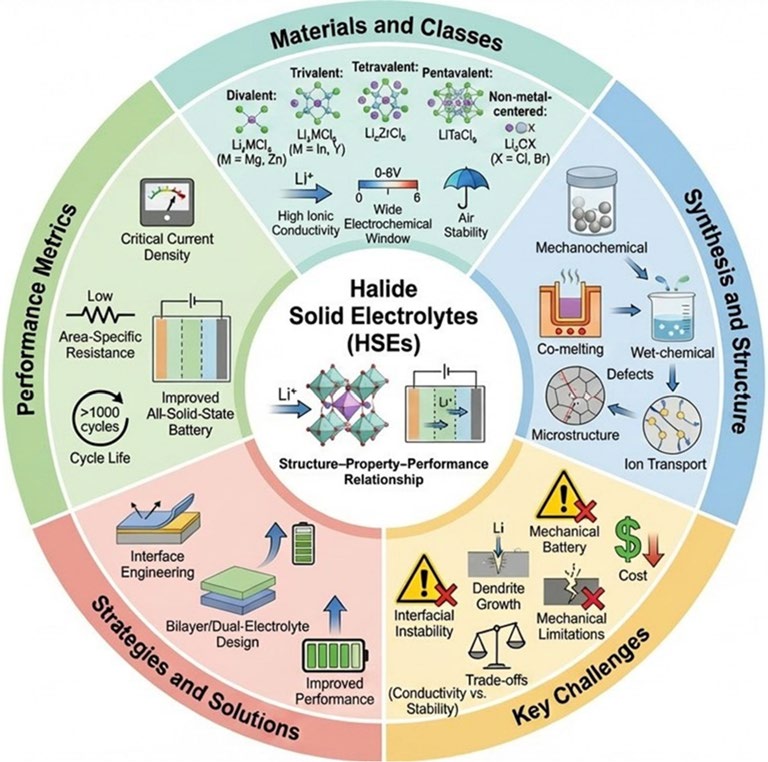



As the global demand for safer, higher-energy-density batteries surges for electric vehicles and grid storage, conventional liquid-electrolyte lithium-ion batteries face fundamental safety and performance ceilings. Now, researchers from the University of Puerto Rico, led by Dr. Shivaraju Guddehalli Chandrappa, Dr. Gerardo Morell, and Prof. Ram S. Katiyar, have delivered a comprehensive roadmap for halide-based solid electrolytes (HSEs) — a transformative materials class that bridges the long-standing gap between oxide and sulfide solid electrolytes.
Why Halide Electrolytes Matter
Traditional solid electrolytes each carry critical trade-offs: oxides are brittle and require high-temperature sintering; sulfides release toxic H2S and degrade in air; polymers suffer from low room-temperature conductivity. HSEs overcome these limitations by combining moderate-to-high ionic conductivity (10-4 to >10-3 S cm-1), wide electrochemical stability windows (>4 V vs. Li/Li⁺), and enhanced air stability — enabling direct integration with high-voltage cathodes without protective coatings.
Innovative Classification and Design
The review systematically classifies HSEs into five families based on their central metal chemistry — divalent, trivalent, tetravalent, pentavalent, and non-metal-centered frameworks. Key breakthroughs include:
- Trivalent systems like Li3InCl6 and Li3ScCl6 achieving ~1–3 mS cm-1 conductivity through disordered Li⁺ sublattices and vacancy engineering
- High-entropy designs such as Li2In0.2Sc0.2Zr0.2Hf0.2Ta0.2Cl6 reaching 4.69 mS cm-1 with oxidation stability up to 5.5 V
- Oxyhalide innovations like Li3Ta3O4Cl10 pushing ionic conductivity to 9 mS cm-1 at 30°C
Outstanding Performance
When paired with high-voltage NCM811 and LiCoO2 cathodes in bilayer configurations, HSE-based all-solid-state batteries deliver exceptional metrics: 70% capacity retention over 1,600 cycles at 4C, operation up to 5.5 V, and energy densities approaching 400–500 Wh kg-1. Fluoride-doped variants further enable direct compatibility with lithium metal anodes, achieving stable stripping/plating for 1,000+ hours.
Synthesis and Interface Engineering
The review critically evaluates mechanochemical, co-melting, and wet-chemical synthesis routes — establishing explicit correlations between processing methods, microstructural defects, and device-level performance metrics including critical current density (CCD) and area-specific resistance (ASR). Bilayer and dual-electrolyte architectures, combining HSE catholytes with sulfide anolytes, emerge as powerful strategies to decouple oxidative and reductive stability requirements.
Applications and Future Outlook
Beyond conventional Li-ion systems, HSEs demonstrate expanding versatility in post-lithium chemistries: stabilizing sulfur cathodes in Li–S batteries, modifying air electrodes in Li–O2 cells, and enabling high-voltage Na-ion solid-state batteries with 90% capacity retention over 300 cycles.
This work establishes a coherent framework for the rational design of scalable, high-performance halide solid electrolytes — opening promising avenues for next-generation energy storage systems combining intrinsic safety, fast charging, and ultra-high energy density.
Stay tuned for more groundbreaking research from this collaborative team at the University of Puerto Rico!

Editor of Nano-Micro Letters, which is an Open-Access, peer-reviewed journal reported papers that have at least one dimension ranging from a few sub-nanometers to a few hundreds of micrometers. The journal is published by Springer Nature and indexed by SCI, EI, SCOPUS, Pubmed, etc. The 2025 JCR Impact Factor is 38.5. The 2025 CiteScore is 58.9.
Follow the Topic
-
Nano-Micro Letters
Nano-Micro Letters is a peer-reviewed, international, interdisciplinary and open-access journal that focus on science, experiments, engineering, technologies and applications of nano- or microscale structure and system in physics, chemistry, biology, material science, and pharmacy.