High-Entropy Amorphous Catalysts for Water Electrolysis: A New Frontier
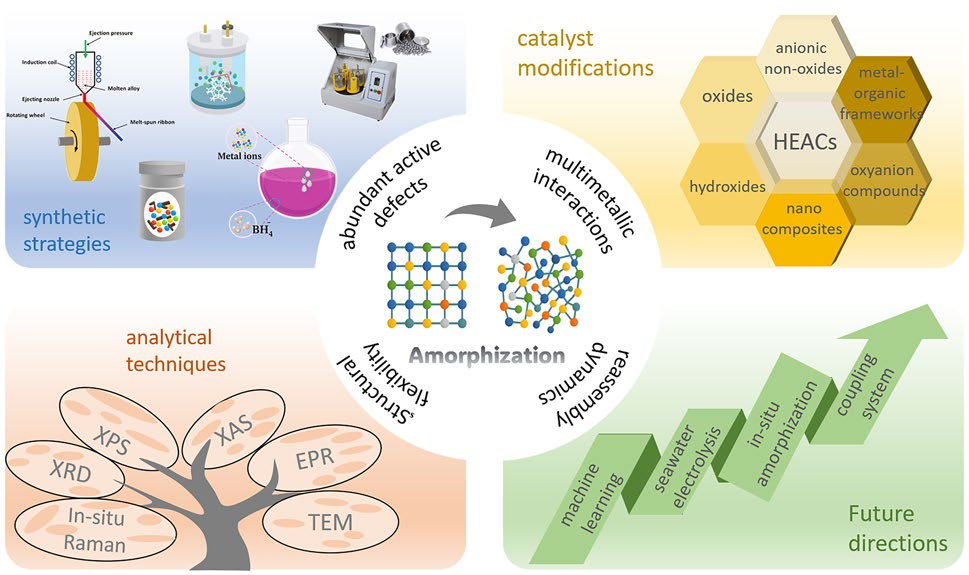
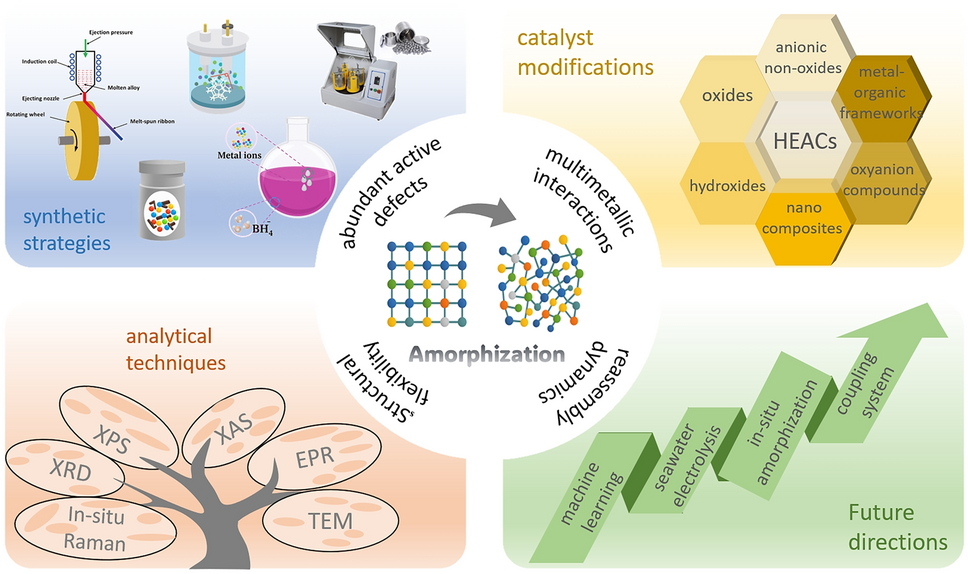

A research team led by Zhijie Chen and Bing-Jie Ni presents a comprehensive review that positions high-entropy amorphous catalysts (HEACs) as a promising, versatile platform for next-generation water electrolysis. The paper synthesizes structural principles, synthetic routes, mechanistic understanding, performance benchmarks, and practical prospects for HER, OER and overall water splitting.
Why HEACs matter
- Activity and durability synergy: Combining multielement (high-entropy) composition with amorphous structural disorder creates abundant, unsaturated active sites and flexible coordination environments that boost intrinsic activity while tolerating harsh operational conditions.
- Broad operability: HEACs show strong performance across pH regimes and in challenging media such as seawater and industrial wastewater thanks to adaptive surface reconstruction.
- Design space: The multicomponent “cocktail” enables tunable electronic structure and adsorption energetics not achievable in unary/binary catalysts.
Key structural and mechanistic insights
- Abundant defects & flexible coordination: Short-range order, high defect densities, and varied local coordinations expose more active centers and facilitate alternative reaction pathways.
- Multimetallic synergy: Charge redistribution and orbital hybridization among constituent metals tune d-band positions and intermediate binding, optimizing HER/OER steps.
- In-situ reconstruction: Under electrochemical bias many HEACs transform to amorphous–crystalline core–shell or oxy(hydr)oxide surface phases that act as the true active layers while retaining an amorphous core for stability.
Innovative synthetic strategies & architectures
- Diverse, scalable methods: Electrodeposition, hydro/solvothermal synthesis, melt-spinning +dealloying, ball milling and solution chemical reduction are reviewed with their roles in controlling amorphization, composition homogeneity and morphology.
- Nanocomposites & heterostructures: Integrating HEACs with conductive supports (carbon, MXene) or constructing crystalline–amorphous interfaces enhances conductivity, mass transfer and operational robustness.
Applications, benchmarks and outlook
- Performance highlights: Representative HEACs achieve low overpotentials and favorable Tafel slopes for both HER and OER, with several examples demonstrating ampere-level stability in alkaline and saline media.
- Future directions: The authors call for DFT–machine-learning integration for predictive design, deeper operando studies of non-oxide anionic HEACs (for seawater electrolysis), engineering in-situ amorphization interfaces, and coupling water splitting with value-added redox chemistries.
Challenges and opportunities
Scalability, precise control of amorphous site chemistry, conductivity limitations, and reproducible prediction of adsorption energetics on disordered surfaces remain open challenges — yet the review argues these are addressable through high-throughput computation, operando characterization and smart compositional design.
This review delivers a clear roadmap: by embracing controlled disorder and multielement design, HEACs can unlock efficient, durable and scalable electrolyzers. Look out for more experimental and ML-guided advances from this growing community.

Editor of Nano-Micro Letters, which is an Open-Access, peer-reviewed journal reported papers that have at least one dimension ranging from a few sub-nanometers to a few hundreds of micrometers. The journal is published by Springer Nature and indexed by SCI, EI, SCOPUS, Pubmed, etc. The 2025 JCR Impact Factor is 38.5. The 2025 CiteScore is 58.9.
Follow the Topic
-
Nano-Micro Letters
Nano-Micro Letters is a peer-reviewed, international, interdisciplinary and open-access journal that focus on science, experiments, engineering, technologies and applications of nano- or microscale structure and system in physics, chemistry, biology, material science, and pharmacy.