How Fractional Mathematics Reveals the Power of Vaccination Against Pneumonia
Published in Mathematics



Pneumonia is often considered a common respiratory infection, yet its burden remains substantial, particularly among vulnerable populations. The disease is caused by various microorganisms, with Streptococcus pneumoniae being a major bacterial pathogen. Although medical interventions have mitigated its impact, outbreaks and persistent transmission continue in many regions. This reality motivated our research: to understand pneumonia dynamics better using a mathematical framework that reflects real-world biological complexities.
Traditional epidemiological models typically rely on integer-order derivatives, which assume that disease progression depends solely on the current state of the system. However, biological processes often exhibit memory effects, where past exposures, immune responses, and interventions influence future outcomes. To address this limitation, we adopted a fractional-order modeling approach using the Caputo-Fabrizio fractional derivative, which allows for the inclusion of memory effects without mathematical singularities.
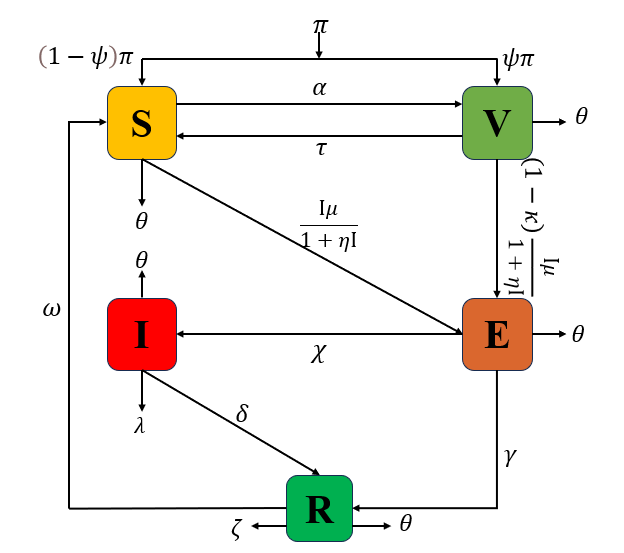
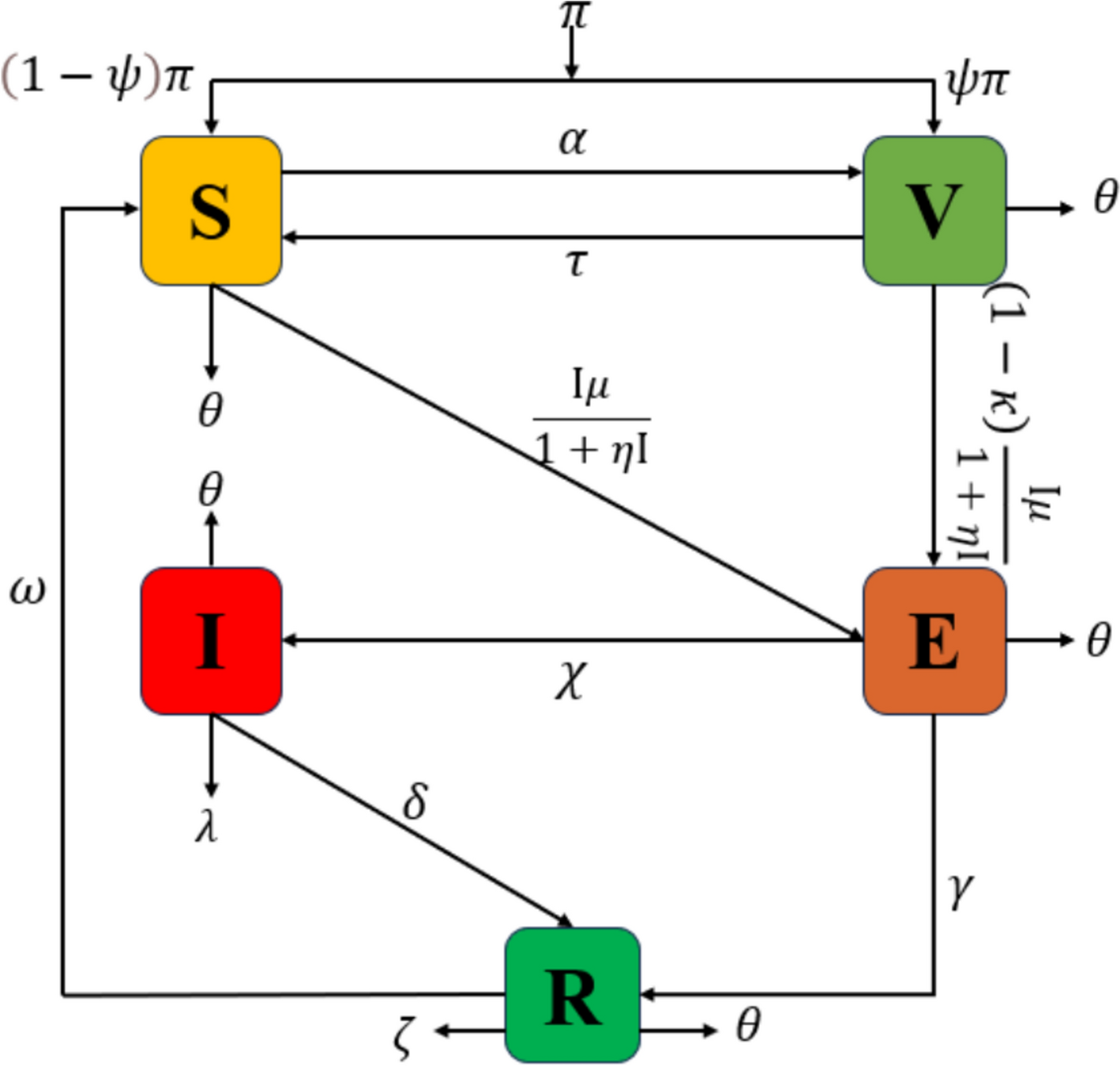
We developed a Susceptible-Vaccinated-Exposed-Infected-Recovered (SVEIR) model to represent the dynamics of pneumonia transmission. Vaccination was explicitly included as a key intervention, allowing us to analyze its direct impact on disease spread. This model was designed not only to simulate infection trends but also to rigorously study the stability properties and long-term behavior of the disease.
A central component of our analysis is the basic reproduction number. This threshold parameter measures the average number of secondary infections per infected individual. We derived the reproduction number both with and without vaccination, enabling a direct comparison of intervention scenarios. To complement the theoretical analysis, we obtained numerical solutions using the Lagrange interpolation method and performed simulations in MATLAB. These simulations allowed us to observe how variations in vaccination rates, transmission parameters, and recovery rates affect disease dynamics. The numerical results consistently supported the analytical findings, showing an apparent reduction in infection spread as vaccination coverage increased.
A key insight emerged from the comparative analysis between vaccinated and unvaccinated populations. Even a modest increase in vaccination rates significantly reduced the peak and duration of infections. Once vaccination reached a critical threshold, pneumonia transmission gradually subsided. This highlights the importance of mathematical modeling in setting quantitative targets for public health interventions.
Beyond the technical results, this study emphasizes the importance of bridging mathematical theory with public health practice. Fractional calculus is often considered complex, yet our work demonstrates its practical relevance in epidemiology. By incorporating memory effects, fractional models provide a more realistic description of disease dynamics and intervention outcomes.
This research was also a collaborative effort that combined expertise in mathematical modeling and epidemiological interpretation. One challenge we faced was ensuring that the results remained understandable and meaningful to applied researchers and policymakers while maintaining mathematical rigor. Achieving this balance is crucial for translating mathematical insights into real-world impact.
Moving forward, this modeling framework can be extended to incorporate additional features such as waning immunity, seasonality, or stochastic effects. We hope this work will foster further interdisciplinary collaborations and demonstrate how advanced mathematics can contribute to effective disease control strategies. By sharing the story behind this paper, we aim to demonstrate how mathematical innovation and public health priorities can work together to address serious global challenges, such as pneumonia.

Follow the Topic
-
Discover Public Health
This is an open access journal publishing research from all fields relevant to public health.

Related Collections
With Collections, you can get published faster and increase your visibility.
The Economics of Longevity: Health Expenditure and Societal Implications for Public Health Systems
The relationship between health investment and life expectancy has long been a focal point in public health research and policy. As nations grapple with rising healthcare costs and varying health outcomes, understanding how financial allocations influence population health becomes increasingly critical. Numerous studies have illustrated that increased spending on health services often correlates with improvements in life expectancy; however, the complexities of this relationship are not fully understood. Factors such as socioeconomic status, healthcare accessibility, and the efficiency of health systems play significant roles in determining how investments translate into health outcomes.
At the national level, health investments primarily encompass government expenditure on healthcare systems, public health initiatives, and health infrastructure. Nations that allocate substantial resources toward healthcare often experience better health outcomes and increased life expectancy among their populations. For instance, countries with robust healthcare funding tend to provide more comprehensive services, including preventive care, chronic disease management, and health promotion programs, all of which contribute to enhanced population health. However, it is crucial to consider how these investments are distributed across different segments of the population. Inequities in health spending can exacerbate existing disparities, leading to significant differences in life expectancy among various demographic groups. Effective health investment strategies must address these disparities to ensure that improvements in life expectancy are equitable and inclusive.
The motivation for this Collection arises from the urgent need to bridge the gap between health expenditures and tangible improvements in life expectancy. Recent global health crises and ongoing disparities in health outcomes across different populations have underscored the necessity for a deeper exploration of how resource allocation affects health dynamics. This Collection seeks to provide a platform for researchers and practitioners to discuss empirical evidence, theoretical frameworks, and innovative approaches to understanding these critical interactions. By fostering dialogue around effective health investment strategies, we aim to contribute to the development of more equitable and efficient health systems worldwide.
The purpose of this Collection is to gather comprehensive research that elucidates the dynamics between health investment and life expectancy across diverse contexts. We welcome contributions that analyze historical trends, comparative studies, and policy evaluations, as well as those that explore the implications of financial investments on health equity. By highlighting interdisciplinary perspectives and fostering collaboration, this Collection aspires to advance the discourse on optimizing health investments for improved population health outcomes.
Topics of interest include, but are not limited to:
- Economic evaluations of health interventions
- Policy impacts on health spending and life expectancy
- Health equity and investment disparities
- Longitudinal studies on health expenditures and population health
This Collection supports and amplifies research related to SDG 3.
Keywords: health expenditure; healthcare economics; life expectancy; economic evaluation; population health; health investment; health policy
Publishing Model: Open Access
Deadline: Dec 31, 2026
Digital Frontiers in Public Health: Data-driven Solutions and Technologies for Efficiency, Effectiveness, and Equity
In recent years, the landscape of public health has been transformed by unprecedented access to high-quality data, advances in data storage and processing, and a growing willingness to share information across jurisdictions. The global response to the COVID-19 pandemic exemplified how coordinated data use and technological innovation can accelerate decision-making, enhance surveillance, and save lives. These developments mark a new era in which the application of modern data analytics in evidence-driven public health practices is not only possible but essential.
Building on this momentum, contemporary innovations are contributing to significant improvements in the three Es of public health: efficiency, effectiveness, and equity. Improved efficiency enables resources to be allocated and managed in a manner that generates the maximum attainable outputs; enhanced effectiveness ensures that public health policies, interventions, and practices achieve the expected health outcomes; and strengthened equity promotes fair access to healthcare and public health services across all populations. Together, these dimensions reflect the evolving priorities and capabilities of modern public health systems.
This Collection, “Digital Frontiers in Public Health: Data-driven Solutions and Technologies for Efficiency, Effectiveness, and Equity,” invites contributions that explore these themes through empirical studies, methodological advancements, case studies, and policy analyses. We seek manuscripts that highlight innovative data applications, cross-sector collaborations, digital health initiatives, and strategies that enhance equity through technology and data integration, as well as collaborative public health practices.
Topics of interest include, but are not limited to:
- Applications of novel data linkage and analytics methods in public health
- The role of participation and co-creation in addressing public health issues
- Digital and technological innovations in public health
- Complete or partial assessments of triple Es in public health
- Economic evaluations of public health interventions
By showcasing diverse approaches from around the world, this Collection aims to provide a comprehensive overview of how data-driven innovations are reshaping public health practice today, and in the future. Researchers, practitioners, and policymakers are encouraged to share their insights and experiences to contribute to this critical dialogue on the future of public health.
This Collection supports and amplifies research related to SDG 3.
Keywords: digital applications; data sharing; data infrastructure; economic evaluations; health equity; public health; policy analysis; health informatics
Publishing Model: Open Access
Deadline: Sep 30, 2026