How the leopard got its spots: Revisiting Turing’s Chemical Basis of Morphogenesis
Published in Mathematics
Explore the Research

 Cassyni
Cassyni Research Seminars
Every paper has a story. Share it as a citable video publication.
Speakers
- Dr. John J. Tyson — Virginia Tech
Abstract
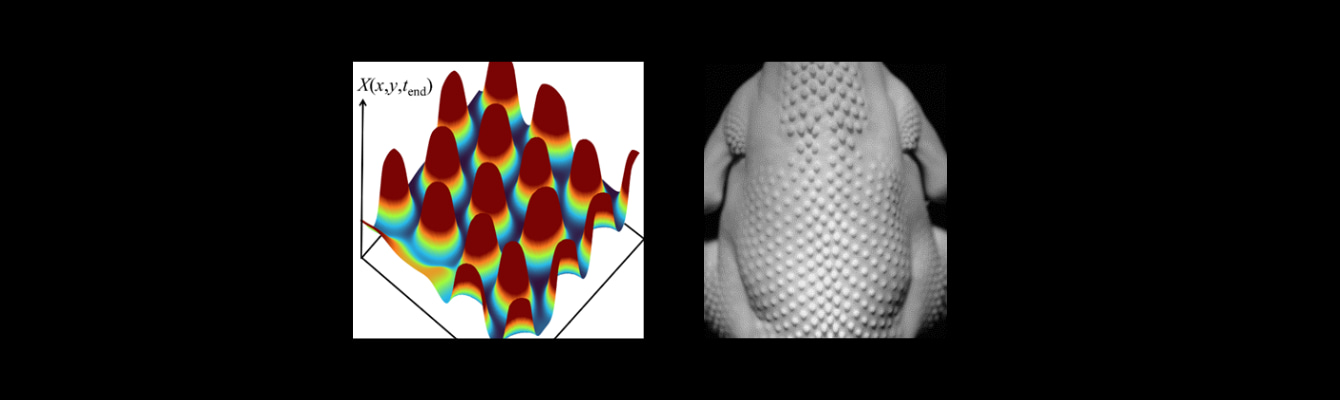
In a 1952 paper, Alan Turing showed that biochemicals, reacting and diffusing in a field of cells, could—in principle—spontaneously organize themselves into a stable spatial pattern of high and low concentrations. Turing suggested that these spatial patterns might possibly provide a mechanism for ‘morphogenesis’—the development of biological forms, such as tentacles, leaf whorls, feather primordia, and animal coat patterns. Although Turing’s paper is a classic of theoretical biology, it is notoriously difficult to read and understand. In this talk, I briefly review Turing’s life and his role in deciphering the German Enigma machine in WWII. Then I describe Turing’s analysis of spontaneous pattern formation in a modern context, to make it more accessible to biologists, biochemists and mathematicians. I will illustrate Turing’s predictions with simulations in one and two spatial dimensions and discuss briefly how they may be relevant to our present understanding of pattern formation in specific circumstances.
Looking for more in the field?
Explore more events from MathBioNexus and Springer Nature's Mathematics & Statistics.

Research Seminars by Springer Nature - giving you access to the latest research talks, direct from authors and editors.