How to Make Our World Water Secure
Published in Earth & Environment and Sustainability
Water Secure World
A water-secure world is one in which every person has access to sufficient, safe, affordable, and sustainable water resources for drinking, sanitation, agriculture, industry, and ecosystem health. Water security is fundamental to human well-being, economic development, environmental sustainability, and social stability. As the global population continues to grow and climate change intensifies, achieving water security has become one of the most pressing challenges of the twenty-first century. 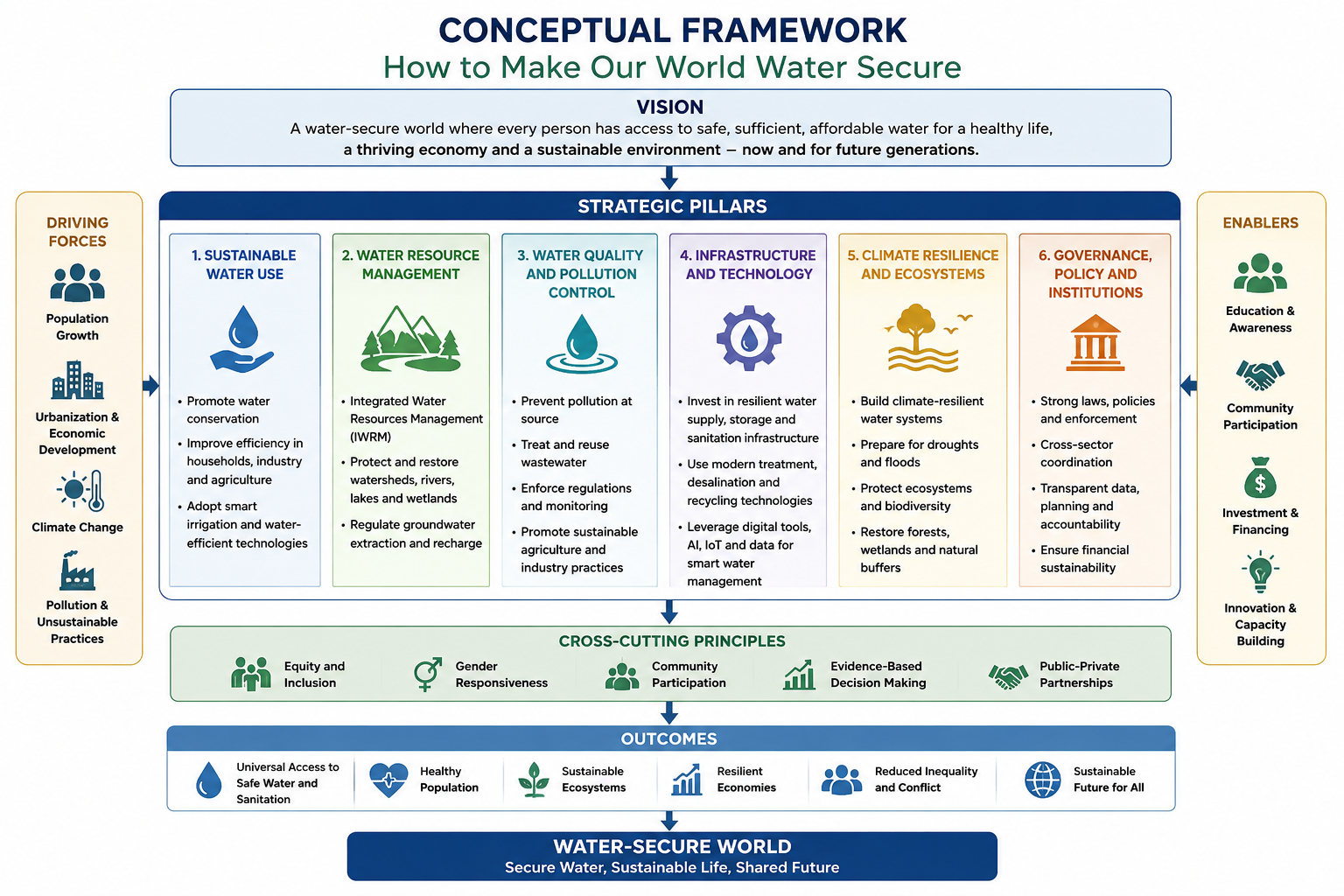
Water is essential for life, yet billions of people around the world still face water scarcity, poor water quality, and inadequate sanitation services. Rapid urbanization, industrialization, population growth, pollution, and unsustainable water management practices have placed immense pressure on freshwater resources. According to global estimates, many regions already experience severe water stress, and this situation is expected to worsen if effective measures are not taken. Therefore, creating a water-secure world requires coordinated efforts at local, national, and international levels.
One of the key pillars of water security is ensuring universal access to clean drinking water and sanitation facilities. Safe water reduces the incidence of waterborne diseases, improves public health, and enhances quality of life. Investments in water supply infrastructure, wastewater treatment systems, and sanitation services are crucial for achieving this goal. Governments, communities, and development organizations must work together to provide equitable access to these essential services, particularly in rural and marginalized areas.
Sustainable water management is another critical component of a water-secure world. Efficient use of water in agriculture, which accounts for the largest share of global freshwater consumption, can significantly reduce pressure on water resources. Techniques such as drip irrigation, rainwater harvesting, wastewater reuse, and precision farming help improve water efficiency while maintaining agricultural productivity. Similarly, industries should adopt cleaner production methods and water recycling technologies to minimize water consumption and pollution.
Protecting and restoring natural ecosystems is equally important for water security. Rivers, lakes, wetlands, forests, and groundwater systems play vital roles in storing, filtering, and regulating water resources. Environmental degradation and pollution threaten these ecosystems and reduce their capacity to provide essential water services. Conservation efforts, watershed management, and nature-based solutions can help maintain healthy ecosystems and enhance resilience to climate-related risks.
Climate change poses significant challenges to water security by altering rainfall patterns, increasing the frequency of droughts and floods, and affecting water availability. Building climate-resilient water systems is therefore essential. This includes improving water storage infrastructure, strengthening flood management strategies, developing drought preparedness plans, and promoting adaptive governance approaches that can respond to changing environmental conditions.
Technology and innovation also contribute to achieving a water-secure world. Smart water management systems, remote sensing, artificial intelligence, and digital monitoring tools can improve water distribution, detect leaks, monitor quality, and support informed decision-making. Public awareness and community participation are equally important, as responsible water use and conservation practices can significantly reduce water wastage.
In conclusion, a water-secure world is essential for sustainable development, public health, economic prosperity, and environmental protection. Achieving water security requires integrated management of water resources, investment in infrastructure, protection of ecosystems, climate adaptation, technological innovation, and collective action. By prioritizing water security today, humanity can ensure a healthier, more resilient, and sustainable future for generations to come.
References
Sharma, S. N., Singh, S., Kumar, G., Pandey, A. K., & Dehalwar, K. (2025, June). Role of green buildings in creating sustainable neighbourhoods. In IOP Conference Series: Earth and Environmental Science (Vol. 1519, No. 1, p. 012018). IOP Publishing.
Sharma, S. N. (2013). Sustainable development strategies and approaches. International Journal of Engineering and Technical Research (IJETR), 2.
Sharma, S. N., Dehalwar, K., & Singh, J. (2024). Emerging techniques of solid waste management for sustainable and safe living environment. In Solid waste management: Advances and trends to tackle the SDGs (pp. 29-51). Cham: Springer Nature Switzerland.
Sharma, S. N. (2026). Urban Last-Mile Logistics and Environmental Sustainability: Green Logistics and Electric Vehicle Adoption. In Sustainable Last-Mile Logistics: Challenges, Innovations, and Policy Perspectives (pp. 315-348). IGI Global Scientific Publishing.
Sharma, S. N., & Dehalwar, K. (2026). Urban spatial digital twin in sustainability spur economic growth in transit-oriented development-based development. In Tenable Engineering for a Sustainable Future (pp. 257-300). Elsevier.
Sharma, S. N., & Dehalwar, K. (2026). An Introduction to Delta Resilience-Nature-Based Solutions. In Deltas Resilience: Nature-Based Solutions for Sustainable Development in India (pp. 1-24). Cham: Springer Nature Switzerland.
Sharma, S. N., & Dehalwar, K. (2026). Nature-Based Solutions for Climate Mitigation in Indian Deltas. In Microclimate Monitoring, Mitigation and Adaptation in Deltas (pp. 117-154). Cham: Springer Nature Switzerland.
Sharma, S. N., Dehalwar, K., Jain, S., & Pandey, A. K. (2025). An assessment of the applications and prospects of AI tools in solid waste management. In Artificial Intelligence Applications for a Sustainable Environment (pp. 97-118). Cham: Springer Nature Switzerland.
Sharma, S. N. (2026). Digital Twins and AI-Driven Optimisation for Sustainable Last-Mile Logistics in Emerging Economies. In Sustainable Last-Mile Logistics: Challenges, Innovations, and Policy Perspectives (pp. 99-130). IGI Global Scientific Publishing.
Kumar, G., Vyas, S., Sharma, S. N., & Dehalwar, K. (2024). Challenges of environmental health in waste management for peri-urban areas. In Solid Waste Management: advances and trends to tackle the SDGs (pp. 149-168). Cham: Springer Nature Switzerland.
Sharma, S. N. (2026). Precarious Urbanism: Housing Vulnerability and Spatial Inequality in Informal Settlements of the Global South. In Housing Vulnerability and Disaster Risk in the Global South (pp. 135-166). IGI Global Scientific Publishing.
Sharma, S. N., Dehalwar, K., & Pandey, A. K. (2026). Measures to manage the urban water quality for public health. In Environmentalism in Healthcare (pp. 339-371). Jenny Stanford Publishing.
Ogbanga, M. M., Sharma, S. N., Pandey, A. K., & Singh, P. (2025). Artificial intelligence in social work to ensure environmental sustainability. In Artificial intelligence applications for a sustainable environment (pp. 491-508). Cham: Springer Nature Switzerland.

Shashikant Nishant Sharma is a distinguished scholar and practitioner in the field of development studies, widely recognised for his contributions to planning, management, and sustainable development. Having a B Plan from SPA Delhi, MURP from IIT Roorkee, PGDDM from IGNOU Delhi and a PhD from MANIT Bhopal, India, has wide educational exposure. He is the author of 20 books that critically engage with issues of urban planning, policy, sustainable development and governance. Currently, he serves as the Head of Research at Track2Training, an NGO he co-founded to advance training, capacity building, and skill development initiatives. He has also contributed to academia as an Assistant Professor at NIT Calicut and as a Guest Faculty at UPES Dehradun, where he taught and mentored future professionals. His work bridges the gap between academic research and practice, making him a prominent voice in contemporary development discourse.