Information Security with Smart Hydrogels: Photo‑Patterning and Multi‑Stimuli Responsive Structural Color
Published in Materials

Introduction: The Need for Sophisticated Information Encryption
In the modern digital age, information security and anti-counterfeiting technologies are more critical than ever. Traditional printing methods and static security labels are increasingly vulnerable to sophisticated forgery. Photonic crystals, which produce vibrant structural colors through the periodic arrangement of nanostructures rather than chemical pigments, have emerged as a powerful alternative. These "structural colors" are fade-resistant and can be designed to respond to external stimuli, providing a dynamic layer of security.
However, many existing photonic crystal systems are limited by high manufacturing costs and a lack of color diversity within a single substrate. To address these challenges, a research team led by Professor Bingtao Tang has developed a novel multi-color patterning method using smart anti-opal hydrogels. Their work, published in Nano-Micro Letters, introduces a "film formation first, then patterning" approach that significantly enhances information capacity and encryption complexity.
Material Design: The Anti-Opal Hydrogel Framework
The core of this technology is an anti-opal structural color hydrogel (ASCH). Unlike standard opal structures (which are made of spheres), an anti-opal structure consists of an ordered array of air voids within a solid matrix.
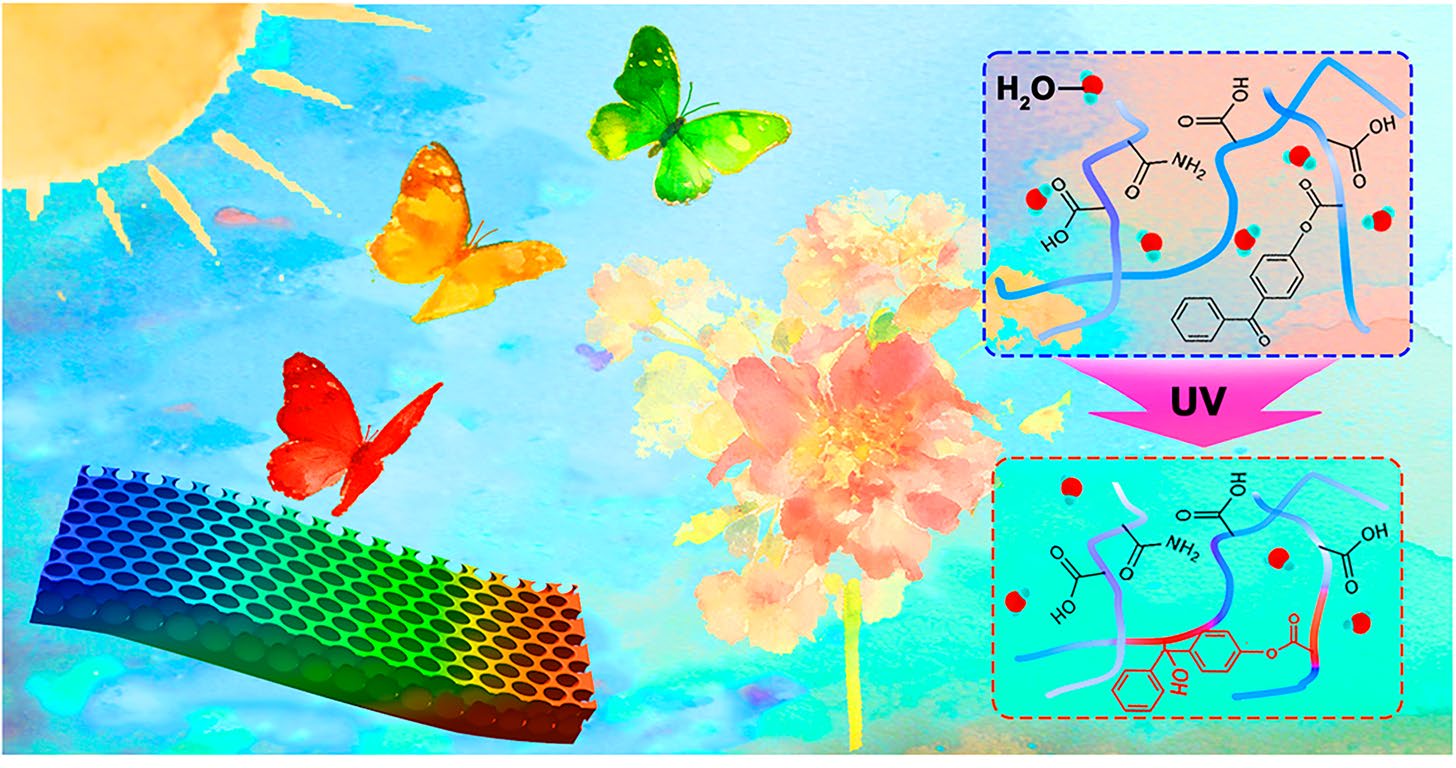
In this study, the researchers used a silica (SiO2) opal template to create an ordered porous network within a responsive poly(acrylamide-co-acrylic acid) hydrogel. This hydrogel is "smart" because its volume changes in response to various environmental stimuli, such as pH levels, solvent composition, and temperature. As the hydrogel swells or shrinks, the lattice constant of the internal air-void array changes, causing the reflected structural color to shift across the visible spectrum.
The Mechanism of Photo-Patterning: Light-Induced Crosslinking
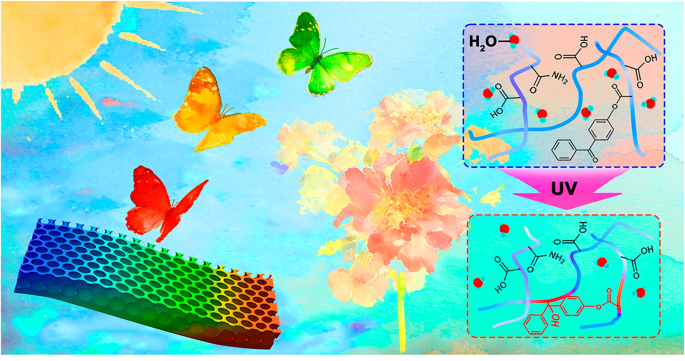
The most significant innovation of this research is the use of UV light to control the crosslinking density of the hydrogel film after it has been formed.
- Selective Swelling Control: The hydrogel precursor contains photo-initiators that allow for further crosslinking when exposed to UV light. By using a photomask or a programmed UV source, the researchers can create regions with different crosslinking densities on a single film. Areas with a high crosslinking degree have a "tight" network that restricts swelling, while areas with low crosslinking can swell more freely.
- High-Resolution Multi-Color Output: When the film is immersed in a stimulus (like a specific pH buffer), each region swells to a different extent, reflecting a different color. This allows for the creation of complex, multi-colored patterns with a minimum line width of just 15 micrometers. Because the color is determined by the light dose during the "patterning" phase, the researchers can "print" high-resolution images and codes without using any ink.
Multi-Stimuli Responsiveness and Dynamic Encryption
The structural color of the hydrogel is not static; it is a "living" response to the environment. The ASCH films demonstrate sensitivity to multiple triggers:
- pH Sensing: The presence of acrylic acid groups makes the hydrogel highly sensitive to pH changes. A pattern might be invisible at a neutral pH but reveal a vibrant, multi-colored QR code when exposed to an acidic or alkaline solution.
- Solvent Response: The hydrogel responds differently to various ethanol-water mixtures. This can be used for "liquid-authenticated" security, where the correct message only appears when the film is wetted with a specific solvent.
- Mechanical and Thermal Tuning: The elastic nature of the hydrogel allows the color to be tuned by physical stretching or temperature changes.
This multi-stimuli responsiveness enables a "layered encryption" strategy. Information can be hidden in plain sight and only "decrypted" when the correct sequence of environmental triggers is applied.
Information Capacity and Security Applications
By combining high-resolution photo-patterning with dynamic color shifts, this technology vastly increases information density. A single hydrogel film can store multiple "pages" of information that are revealed under different conditions. For example, a film could display a brand logo under normal light, a serial number when wetted, and a hidden warning code when the pH is altered.
The "film formation first" approach also simplifies the manufacturing process. Large-scale hydrogel films can be produced and stored, then customized with specific patterns using simple UV exposure whenever needed. This makes the technology highly adaptable for high-end packaging, identity documents, and secure data storage.
Conclusion and Future Outlook
The development of photo-patternable smart hydrogels marks a significant milestone in the field of photonic materials and information security. By leveraging the principles of light-induced crosslinking and anti-opal structural colors, the researchers have created a platform that is both highly secure and aesthetically striking.
Future research will likely focus on integrating these hydrogels with flexible electronic circuits or smartphone-based detection systems to create "smart" labels that can be verified instantly by consumers. As the battle against forgery continues, materials that can "think" and "react" like these smart hydrogels will be at the forefront of protecting global information and trade.

Editor of Nano-Micro Letters, which is an Open-Access, peer-reviewed journal reported papers that have at least one dimension ranging from a few sub-nanometers to a few hundreds of micrometers. The journal is published by Springer Nature and indexed by SCI, EI, SCOPUS, Pubmed, etc. The 2024 JCR Impact Factor is 36.3. The 2024 CiteScore is 53.1.
Follow the Topic
-
Nano-Micro Letters
Nano-Micro Letters is a peer-reviewed, international, interdisciplinary and open-access journal that focus on science, experiments, engineering, technologies and applications of nano- or microscale structure and system in physics, chemistry, biology, material science, and pharmacy.



Please sign in or register for FREE
If you are a registered user on Research Communities by Springer Nature, please sign in