Integrated Performance Metrics of Porous Carbon Toward Practical Supercapacitor Devices
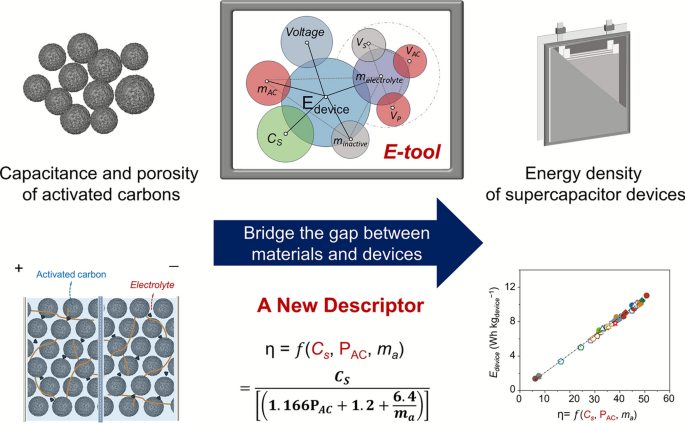

As the demand for high-performance electrochemical energy storage continues to grow, the limitations of conventional material-level capacitance measurements in predicting practical device energy densities become more pronounced. Now, researchers from the State Key Laboratory of Physical Chemistry of Solid Surface at Xiamen University and Imperial College London, led by Professor Qiulong Wei, have presented a breakthrough study establishing clear relationships between activated carbon properties and supercapacitor device performance. This work offers valuable insights into the development of next-generation supercapacitor technologies that can bridge the gap between laboratory innovations and practical applications.
Why Integrated Performance Metrics Matter
- Bridging Materials to Devices: Most reported capacitance values are measured solely at the material level, which are difficult to directly translate into achievable energy densities for practical supercapacitor devices.
- Electrolyte Optimization: Both the specific capacitance and porosity of activated carbon materials collectively determine the optimal amount of electrolyte required for maximizing device-level energy density.
- Predictive E-Tool: A novel computational E-tool is developed for directly predicting device energy density at an early stage of material-level electrochemical testing, accelerating development from advanced mechanisms to practical products.
- New Descriptor: A new descriptor η that integrates capacitance and porosity of activated carbon electrode displays a linear relationship with device energy density, enabling quick evaluation of supercapacitor performance.
Innovative Design and Features
- Systematic Electrolyte Investigation: Practical supercapacitor pouch cells are assembled to reveal the relationships between the capacitance and porosity of activated carbon materials and the optimal amount of electrolyte at the device level.
- Pore Volume Analysis: The total pore volume includes the pore volume of activated carbon material, pores between stacked particles, and pores of the separator, with electrolyte volume sufficient to fill all pores enabling the highest energy density.
- Concentration Optimization: Electrolyte concentration of 1.0 M (2Q charge quantity) is identified as the most effective configuration, enabling both superior rate capability and high energy density without excessive ion redundancy.
- Comprehensive Database: The E-tool is validated using 43 activated carbon materials from reported literature, demonstrating reliable prediction with less than 1% error compared to practical supercapacitor devices.
Applications and Future Outlook
- High Energy Density Devices: The assembled supercapacitor pouch cell achieves 7.80 Wh kg_device-1, significantly higher than commercial 100F cylindrical supercapacitors (4.73 Wh kg_device-1), primarily due to optimized electrolyte management and lower packaging mass.
- Material Design Guidelines: Clear guidelines are provided for activated carbon materials, emphasizing the balance of specific capacitance and porosity for increasing energy density of practical supercapacitor devices.
- AI-Driven Development: The established theoretical model provides a foundation for further AI-driven big data analysis of active materials for supercapacitors, enabling accelerated materials discovery and optimization.
- Industrial Translation: The conversion factor of approximately 0.35 for supercapacitors highlights the importance of considering all device components rather than just active material properties, facilitating more transparent performance reporting in the field.
This comprehensive study bridges the critical gap between material-level properties and device-level performance in supercapacitor development. It highlights the importance of interdisciplinary research in materials science, electrochemistry, and engineering design to drive innovation in this field. Stay tuned for more groundbreaking work from Professor Qiulong Wei at Xiamen University!

Editor of Nano-Micro Letters, which is an Open-Access, peer-reviewed journal reported papers that have at least one dimension ranging from a few sub-nanometers to a few hundreds of micrometers. The journal is published by Springer Nature and indexed by SCI, EI, SCOPUS, Pubmed, etc. The 2024 JCR Impact Factor is 36.3. The 2024 CiteScore is 53.1.
Follow the Topic
-
Nano-Micro Letters

Nano-Micro Letters is a peer-reviewed, international, interdisciplinary and open-access journal that focus on science, experiments, engineering, technologies and applications of nano- or microscale structure and system in physics, chemistry, biology, material science, and pharmacy.
Please sign in or register for FREE
If you are a registered user on Research Communities by Springer Nature, please sign in