Interface Contact Optimization via Phosphomolybdic Acid Enables 24.9% Efficiency in MoOX-Based Silicon Solar Cells
Published in Chemistry and Electrical & Electronic Engineering
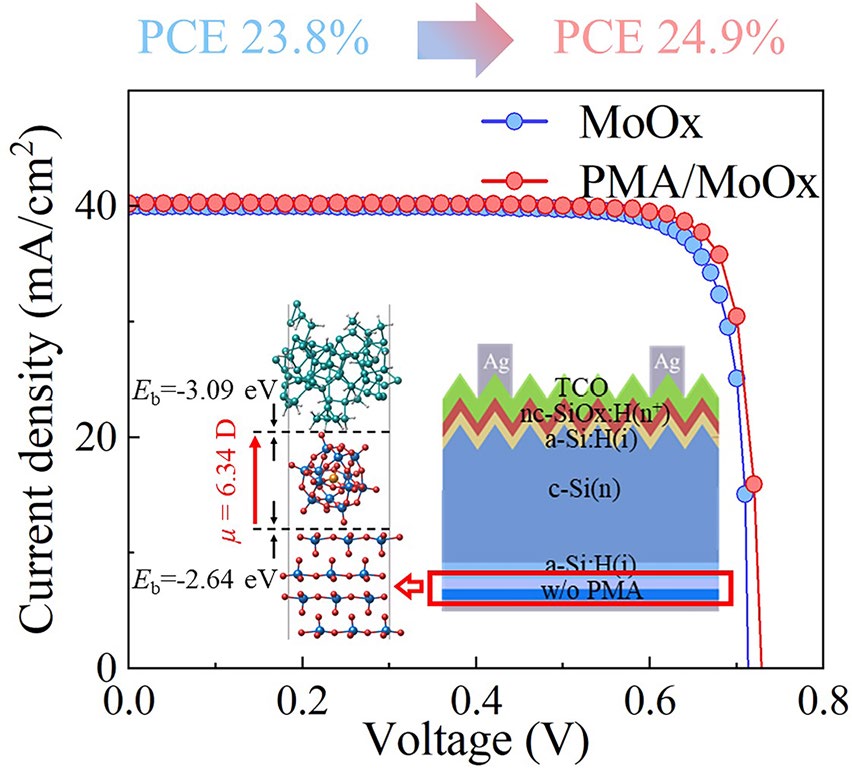

As crystalline silicon photovoltaics continue to dominate the solar market, efficient, low-cost, and dopant-free carrier-selective contacts are increasingly important for pushing device performance higher. Molybdenum oxide (MoOx) is an attractive hole-transport material because of its high work function, but oxygen vacancies and weak interfacial interactions with hydrogenated amorphous silicon can limit carrier selectivity and transport. Researchers from Beijing University of Technology, led by Professors Qian Kang, Zilong Zheng, and Yongzhe Zhang, developed an ultrathin phosphomolybdic acid (PMA) interlayer that simultaneously improves defect passivation, energy-level alignment, and charge transport, enabling 24.9% power conversion efficiency in MoOx-based silicon solar cells.
Why This Silicon Solar Cell Matters
MoOx can induce strong band bending at crystalline silicon interfaces without conventional p-type doping, but oxygen-vacancy defects can reduce its work function, while weak interactions at the i-a-Si:H/MoOx interface hinder carrier transport. The researchers introduce PMA as a molecular-scale bridge between the two materials. Rather than acting simply as an additional layer, PMA strengthens interfacial bonding, passivates oxygen-vacancy defects, increases the effective work function, and enhances band bending for more selective hole extraction.
Innovative Design and Mechanism
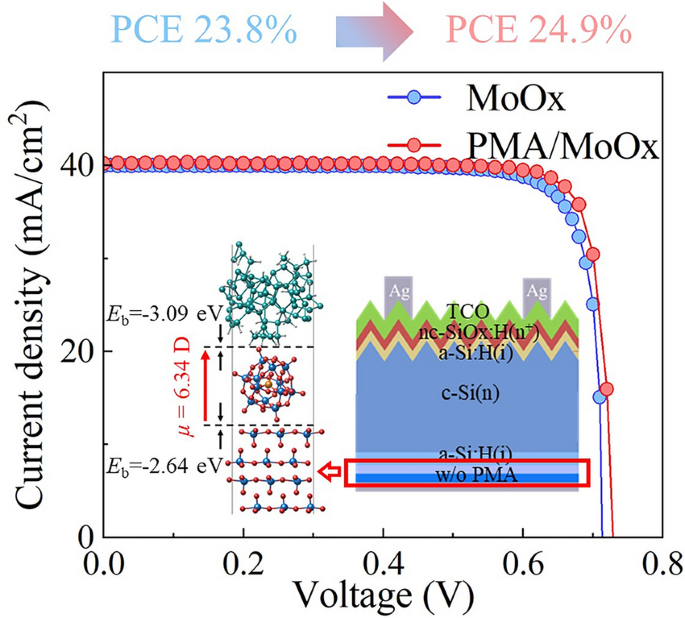
The key innovation is an approximately 1-nm-thick PMA interlayer inserted between i-a-Si:H and MoOx. First-principles calculations show that PMA forms stronger interactions with both components, with bonding energies of 3.1 eV with i-a-Si:H and 2.6 eV with MoOx, compared with only 1.4 eV for the pristine MoOx/i-a-Si:H interface. This molecular bridge enhances interfacial coupling and facilitates hole transport. Meanwhile, PMA reduces the Mo5+/Mo6+ ratio from 0.18 to 0.14, indicating oxygen-vacancy passivation. The work function increases from 5.0 to 5.1 eV, while the interfacial dipole rises dramatically from 1.63 to 6.34 D, strengthening band bending and field-effect passivation.
Outstanding Performance
The optimized PMA/MoOx device increases the open-circuit voltage from 713 to 730 mV and the fill factor from 83.7% to 84.9%, achieving a champion efficiency of 24.9%, compared with 23.8% for the MoOx control. The modification introduces negligible optical penalties, with visible-light transmittance remaining above 95%. Electrical improvements are equally significant: minority-carrier lifetime increases from 1.18 to 2.44 ms, saturation current density decreases from 40.0 to 14.9 fA cm-2, and contact resistivity falls by 24%, from 140 to 106 mΩ cm2. The built-in potential also increases from 722 to 741 mV, while simulations predict efficiency improvement from 23.9% to 24.7%.
Applications and Future Outlook
The PMA/MoOx architecture provides a promising route toward dopant-free passivating contacts for high-efficiency crystalline silicon photovoltaics. Its solution-processable, ultrathin PMA layer preserves optical transparency while addressing both defect-induced recombination and inefficient interfacial charge transport. More broadly, the molecular-scale interfacial bridging concept offers a strategy for engineering transition-metal-oxide interfaces by simultaneously tuning chemical bonding, defect chemistry, work function, band bending, and carrier transport. This approach could support scalable and cost-effective photovoltaic manufacturing while extending to other optoelectronic devices requiring precisely engineered interfaces.

Editor of Nano-Micro Letters, which is an Open-Access, peer-reviewed journal reported papers that have at least one dimension ranging from a few sub-nanometers to a few hundreds of micrometers. The journal is published by Springer Nature and indexed by SCI, EI, SCOPUS, Pubmed, etc. The 2025 JCR Impact Factor is 38.5. The 2025 CiteScore is 58.9.
Follow the Topic
-
Nano-Micro Letters
Nano-Micro Letters is a peer-reviewed, international, interdisciplinary and open-access journal that focus on science, experiments, engineering, technologies and applications of nano- or microscale structure and system in physics, chemistry, biology, material science, and pharmacy.