Is Area a Vector? Rethinking Surface Geometry from the Ground Up
Published in Physics

Explore the Research

 Zenodo
The Vectorial Nature of Area
For decades, students and professionals alike have taken for granted that area is a scalar quantity—something measurable, two-dimensional, and devoid of direction. Yet, in physics and differential geometry, we often find ourselves referring to surface elements with a defined direction, such as in Gauss's law where surface normals are invoked to express flux. Why do we need this direction, and where does it actually come from?
In my recent paper, The Vectorial Nature of Area, I propose a fundamental re-examination of this idea: what if area is inherently a vector—not merely a magnitude with an assigned normal—but a quantity born from a constructive, directional process in space?
---
The Problem with the Conventional View
In physics textbooks and vector calculus lectures, we frequently see the expression:
> ∬ S F · dA = flux through surface S
Here, dA is often described as a vector "area element"—a small piece of surface with direction normal to the surface and magnitude equal to the infinitesimal area. However, this treatment is superficial: the vector nature is imposed, not derived. There's no explanation of how a surface element comes to possess a direction.
This leads to confusion when students ask: if area is a scalar, why do we assign it a vectorial direction in surface integrals? And how is this direction chosen?
---
A Constructive Alternative: Area as a Vector Born in Space
Rather than treating direction as an external attribute, my approach examines how area itself can emerge from motion in space, just like a curve emerges from the motion of a point, or a surface from the motion of a line.
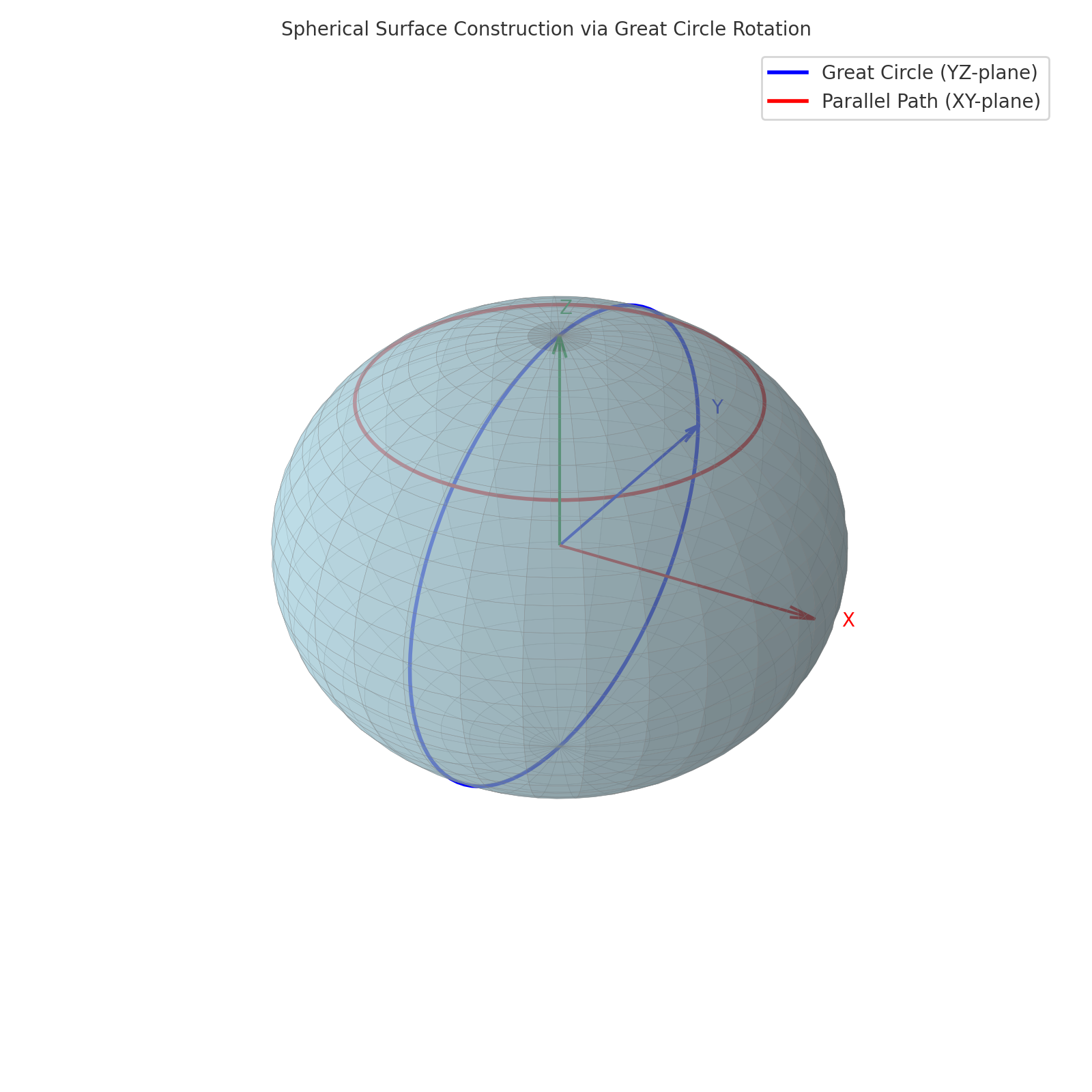
Let’s take a simple example: imagine a radial vector rotating around a fixed axis. As it sweeps through space, it generates a surface (a disk, for instance). The direction of the generated area is not arbitrary—it is inherently linked to the direction of motion, forming a right-handed triad:
the initial vector,
the direction of its movement,
and the resulting vector normal (area direction)
In this sense, area is not merely a region—it is a consequence of a spatial process.
---
Two Types of Area: Interacting vs. Constructed
The distinction is key:
Interacted Area: A passive surface already present, like a wall or a membrane, which we use for integration (e.g., in electromagnetism).
Constructed Area: A surface generated actively by sweeping a vector or path—whose direction and extent emerge naturally from its generating process.
This constructive approach helps us justify the direction of dA not as an imposed convention, but as a real geometric outcome—one that reflects the space-building process itself.
---
Why Does This Matter?
1. Conceptual Clarity: It reconciles the gap between mathematical formalism and physical intuition, especially for students.
2. Geometrical Foundations: It suggests a new lens to look at surface integrals, boundary orientation, and dimensional emergence.
3. Pedagogical Impact: It invites educators to rethink how we introduce geometry, vectors, and integrals in multi-variable calculus and physics.
This idea is not just a theoretical musing—it has direct implications for how we understand divergence, flux, and even field theory.
---
Read the Full Paper
🔗 The Vectorial Nature of Area – Zenodo
---
About the Author
Mohamed F. Gaballah is an independent researcher based in Egypt. His work focuses on foundational questions in geometry, dimensional analysis, and the philosophy of space in mathematical physics. He believes that geometric intuition is a powerful yet underutilized tool in theoretical development.
---
📝 If you find this idea thought-provoking or challenging, I invite you to read the full paper and share your feedback. Let’s rethink space—vector by vector.




Please sign in or register for FREE
If you are a registered user on Research Communities by Springer Nature, please sign in