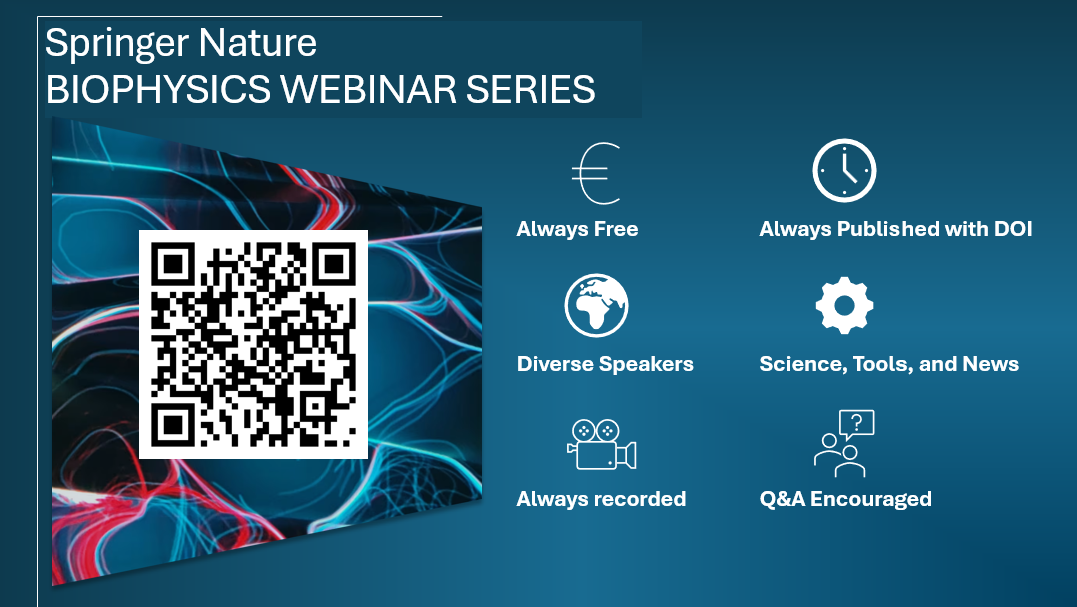
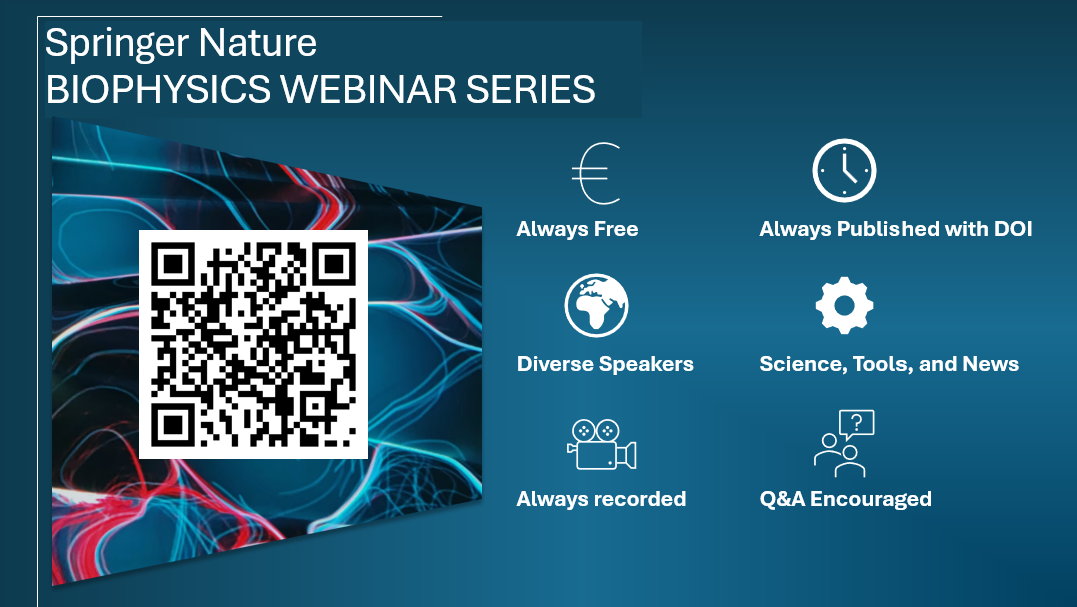
Join the Springer Nature Biophysics Webinar Series
Why join?
- ✅ Always free to attend
- ✅ Fully recorded — watch live or on your schedule
- ✅ Citable with a DOI — get academic credit and share your engagement
- ✅ Connect with leading researchers, important global societies in biophysics, emerging voices, and cutting-edge tools shaping modern biophysics
Whether you're exploring molecular mechanisms, developing new analytical approaches, or seeking interdisciplinary insight, this series delivers high-impact science in an accessible format. Our webinars span all elements of biophysics including techniques/approaches, fluorescence spectroscopy, NMR spectroscopy, membrane biology, bioenergetics, mechanobiology, structural biology and more
⭐ Featured Webinars
🧬 Molecular-scale data, tools & infrastructure (MOSBRI)
Explore the future of molecular biophysics research with insights into the Molecular Biophysics Database (MBDB) and the eSPC analysis suite—tools that enable cross-technique data analysis (including MST, DSF, DLS, CD, BLI, and more). Get real insights into how these techniques can enhance and streamline your work into structural biology.
👉 Ideal for: researchers working with biomolecular interactions, structural biology, or multi-method datasets. https://cassyni.com/events/WDEKqUE7E9UHZGf7kgHVgh?cb=0.12cl
🚀 Future Leaders of Biophysics
Discover the next generation of scientific leaders as early-career researchers present cutting-edge work and emerging ideas shaping the field. See how you can submit to Springer Nature journals and have your work showcased and explored by other biophysicists.
👉 Ideal for: staying ahead of trends, networking, and identifying collaborators or rising talent. https://cassyni.com/events/F1vuBGPCVdQ3jeEZrSyqEV?cb=0.tj2f
🌍 Latin American Federation of Biophysical Societies: Special Collection in Biophysical Reviews
A special edition of the Biophysics Webinars showcasing research deriving from Latin American countries. Presentations on molecular modelling, antimicrobial peptides in the context of membrane biology, and more
👉 Ideal for: researchers in health biophysics, those interested in broadening their world outlook within biophysics
https://cassyni.com/events/UVut4UyuPK2fNyaqekJRuX?cb=0.vw0u
📅 Be part of the community
From quantum biology to advanced imaging metamaterials and global research initiatives, this series brings together diverse perspectives across biophysics.
👉 Subscribe and start watching today:
https://cassyni.com/s/springer-nature-biophysics

Senior Publisher for Springer Nature biophysics and biochemistry journals. BA in Modern Languages and MA in Translation Studies.
Follow the Topic
-
Journal of Fluorescence
Journal of Fluorescence serves as an international forum for original, peer-reviewed articles advancing the field of fluorescence spectroscopy
-
Journal of Bioenergetics and Biomembranes
This is an international journal devoted to the publication of original research that contributes to fundamental knowledge in the areas of bioenergetics, biomembranes, and transport.
-
Biophysical Reviews
This journal aims to publish critical and timely reviews from key figures in the field of biophysics.
-
Cell Biochemistry and Biophysics
This journal aims to publish papers on the nature of the biochemical and biophysical mechanisms underlying the structure, control and function of cellular systems
-
European Biophysics Journal
This is an international journal that focuses on the study of biological phenomena using physical methods and concepts.
-
The Journal of Membrane Biology
This journal focuses on publishing high-quality scientific research related to membrane biology, biochemistry, and biophysics.
-
Plasmonics
This is a peer-reviewed journal that advances and reports on the interactions of free-metal electrons, Plasmons, and their applications.
-
Biomolecular NMR Assignments
This journal is a dedicated forum for publishing sequence-specific resonance assignments for proteins and nucleic acids.
-
Journal of Biomolecular NMR
This journal focuses on innovative applications of nuclear magnetic resonance spectroscopy in the study of biopolymer structures and dynamics.
-
Advanced Metamaterials
Advanced Metamaterials is an Open Access journal which publishes broadly on the topic of metamaterials, which are receiving a great deal of attention worldwide for their wide variety of applications and boasting a large degree of multifunctionality.










Related Collections
With Collections, you can get published faster and increase your visibility.
Bioenergetic phenotypes in metabolic genetic diseases
Inherited diseases represent a vast group of pathologies resulting from variants in specific genes encoding different proteins, which directly or indirectly affect metabolic pathways or impair mitochondrial and cellular functions. Thus, genetic diseases, depending on which gene is involved, may generate subtle, mild, or severe metabolic phenotypes, caused by enzyme malfunction, structural or functional alterations in proteins or cofactors, or disruptions in cellular signaling or transport mechanisms. The consequences of deranged metabolic pathways can include: - The accumulation of compounds that may become toxic; - A deficiency or absence of the final products of metabolic pathways, leading to a shortage of essential substrates or disruptions in energy production; - The activation of alternative metabolic pathways, potentially producing secondary metabolites that are normally absent and may also be toxic. Emerging literature shows that bioenergetic defects, characterized by reduced energy availability or increased oxidative stress, lead to profound changes in fundamental processes such as mitochondrial biogenesis, mitophagy, and mitochondria–endoplasmic reticulum communication, with pathological consequences at both the cellular and organismal levels.
This Special Collection invites original research articles, reviews, and perspectives aimed at elucidating the mechanistic links between genetic variants and bioenergetic dysfunction. Contributions addressing how specific mutations directly or indirectly impact energy production systems, as well as studies exploring molecular and metabolic pathway alterations associated with these defects, are particularly encouraged.
Depending on where you are located, you may be able to publish open access at no additional cost to you. Researchers at many institutions such as Italy, France, Portugal, Spain, Germany and United Kingdom can publish open access in the journal at no additional cost.
Check your eligibility prior to submission here: Open access funding | Journal of Bioenergetics and Biomembranes | Springer Nature Link
Publishing Model: Hybrid
Deadline: Dec 31, 2026
Plasmon-enhanced sensing and catalysis
Plasmon-enhanced sensing and catalysis harnesses the unique light-matter interactions of metallic nanostructures to enable high-sensitivity detection and efficient chemical transformations. This special collection invites contributions that advance the fundamental understanding and practical application of plasmonic effects, including but not limited to:
1. Novel plasmonic materials and nanostructures for enhanced spectroscopic sensing (SERS, TERS, SEIRA, enhanced fluorescence, etc.)
2. Plasmon-enhanced fluorescence for bioimaging, immunoassays, and molecular detection
3. Plasmonic biosensing (e.g., LSPR-based biosensors, fiber-optic plasmonic sensors, point-of-care devices)
4. Plasmon-driven and plasmon-mediated catalytic reactions
5. Hot carrier dynamics and energy transfer mechanisms
6. Hybrid plasmonic–photonic, plasmonic–2D material or wearable systems
7. Single-particle and single-molecule sensing
8. Plasmon-enhanced electrochemistry and photocatalysis
9. Theoretical and computational modelling of plasmonic enhancement
10. Emerging applications in biological analysis, environmental monitoring, and energy conversion
Both original research articles and comprehensive reviews are welcome. Studies that bridge experimental and theoretical approaches, or that demonstrate significant advances in sensitivity, selectivity, or catalytic efficiency, are particularly encouraged.
Publishing Model: Hybrid
Deadline: Mar 31, 2027