
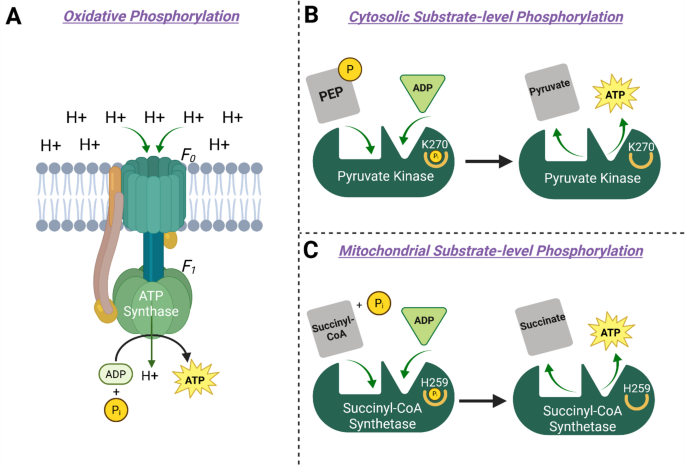

Most cells produce the majority of their energy through oxidative phosphorylation (OxPhos), or oxygen dependent cell respiration. When cells experience hypoxia or OxPhos insufficiency, they compensate by shifting ATP production to cytosolic and mitochondrial substrate-level phosphorylations with lactate and succinate produced as end products, respectively.
Why this research is valuable
Biochemists know that the complete oxidation of glucose through glycolysis, the TCA cycle, and the electron transport chain (ETC) yields a large amount of energy with carbon dioxide and water produced as end products. They also know that when this process is inhibited, most of the glucose is quickly diverted to lactic acid fermentation, an oxygen independent mechanism involving cytosolic substrate level phosphorylation for ATP production with lactate produced as end product. Less recognized is the simultaneous increase in succinic acid fermentation within the mitochondrial matrix, another oxygen independent mechanism involving substrate level phosphorylation for ATP production with succinate produced as end product. Together these fermentation pathways can effectively compensate for reduced ATP production through OxPhos.
We are most interested in glutamine-driven mitochondrial substrate level phosphorylation (mSLP) as an underappreciated and understudied route for oxygen independent ATP production in cancer. We found it surprising that succinate accumulation was observed under various conditions of hypoxia or OxPhos insufficiency in a broad range of biological disciplines including cancer. Also surprising was minimal reference to the evolutionary conserved mechanism of SLP.
What we did
Considering that most organisms and cell types have a TCA cycle, complete or otherwise, we initiated a literature review looking specifically for information on mSLP. We searched for key terms, including but not limited to mitochondrial substrate-level phosphorylation, succinate, fermentation, and related terms across a wide range of fields. We set out to understand how succinate, and its well-known counterpart lactate, behave as extracellular markers of how cells produce energy when the traditional pathway, OxPhos, isn’t sufficient.
This approach meant we were forced to become acquainted with many unique sets of metabolic machinery that are typically outside of our focus on cancer cells. We first had to understand how these systems normally functioned, and then what caused these systems to produce lactate and succinate at concentrations significantly higher than those seen under normal metabolic situations. Our goal was to consolidate these seemingly disconnected literatures and show how they all pointed toward one conserved and often forgotten energy generation pathway.
What it means going forward
The broader implication of this research ties back to our core expertise: mitochondrial substrate-level phosphorylation deserves recognition as an evolutionary conserved source of energy generation in cancer cells, on par with its well-known lactate counterpart. While the glucose-to-lactate pathway is well known, much less is known about the glutamine-to-succinate pathway, despite the similarity in underlying principles.
This matters critically for cancer research, where we seek to diminish a tumor’s energy supply and its ability to divide as a core therapeutic strategy. That all major cancers produce elevated levels of lactate and succinate is compelling evidence that cancer is a disorder of chronic OxPhos insufficiency driven mostly by SLP for ATP production. Consequently, the simultaneous restriction of cSLP and mtSLP, while transitioning the body to non-fermentable fuels, becomes a logical strategy for managing cancer.
Follow the Topic
-
Journal of Bioenergetics and Biomembranes
This is an international journal devoted to the publication of original research that contributes to fundamental knowledge in the areas of bioenergetics, biomembranes, and transport.

Related Collections
With Collections, you can get published faster and increase your visibility.
Bioenergetic phenotypes in metabolic genetic diseases
Inherited diseases represent a vast group of pathologies resulting from variants in specific genes encoding different proteins, which directly or indirectly affect metabolic pathways or impair mitochondrial and cellular functions. Thus, genetic diseases, depending on which gene is involved, may generate subtle, mild, or severe metabolic phenotypes, caused by enzyme malfunction, structural or functional alterations in proteins or cofactors, or disruptions in cellular signaling or transport mechanisms. The consequences of deranged metabolic pathways can include: - The accumulation of compounds that may become toxic; - A deficiency or absence of the final products of metabolic pathways, leading to a shortage of essential substrates or disruptions in energy production; - The activation of alternative metabolic pathways, potentially producing secondary metabolites that are normally absent and may also be toxic. Emerging literature shows that bioenergetic defects, characterized by reduced energy availability or increased oxidative stress, lead to profound changes in fundamental processes such as mitochondrial biogenesis, mitophagy, and mitochondria–endoplasmic reticulum communication, with pathological consequences at both the cellular and organismal levels.
This Special Collection invites original research articles, reviews, and perspectives aimed at elucidating the mechanistic links between genetic variants and bioenergetic dysfunction. Contributions addressing how specific mutations directly or indirectly impact energy production systems, as well as studies exploring molecular and metabolic pathway alterations associated with these defects, are particularly encouraged.
Depending on where you are located, you may be able to publish open access at no additional cost to you. Researchers at many institutions such as Italy, France, Portugal, Spain, Germany and United Kingdom can publish open access in the journal at no additional cost.
Check your eligibility prior to submission here: Open access funding | Journal of Bioenergetics and Biomembranes | Springer Nature Link
Publishing Model: Hybrid
Deadline: Sep 30, 2026