Laser‑Driven Single‑Step Synthesis of Monolithic Prelithiated Silicon‑Graphene Anodes for Ultrahigh‑Performance Zero‑Decay Lithium‑Ion Batteries

As the demand for high-energy-density lithium-ion batteries continues to grow, the limitations of conventional silicon-based anodes in terms of initial coulombic efficiency, structural instability, and complex prelithiation methods become more pronounced. Now, researchers from the School of Chemistry and Department of Materials Science and Engineering at Tel Aviv University, led by Professor Fernando Patolsky, have presented a breakthrough laser-driven, ambient, solid-state, in situ prelithiation technique for silicon-graphene composite anodes. This work offers valuable insights into the development of next-generation lithium-ion batteries that can overcome these limitations.
Why Laser-Driven Prelithiation Matters
- Single-Step Simultaneous Process: The method simultaneously synthesizes and integrates prelithiated silicon nanoparticles into a robust graphene matrix using simple precursors, eliminating the need for multi-step post-processing.
- In Situ Solid-State Prelithiation: Prelithiation is achieved through interfacial solid-state reactions between silicon and common lithium salt precursors during the ultrafast photothermal graphitization of phenolic resin, without requiring reactive lithium metal or exotic precursors.
- Exceptional Cycling Stability: Prelithiated silicon nanoparticles/laser-induced graphene anodes exhibit >98% capacity retention after 2000+ cycles at 5 A g-1, with negligible capacity decay compared to non-lithiated counterparts.
- Ultrahigh Performance: The anodes deliver over 1700 mAh g-1 with initial coulombic efficiency above 97%, and maintain 83% retention after 4500 cycles, far surpassing previously reported nano-Si-based prelithiated anodes.
Innovative Design and Features
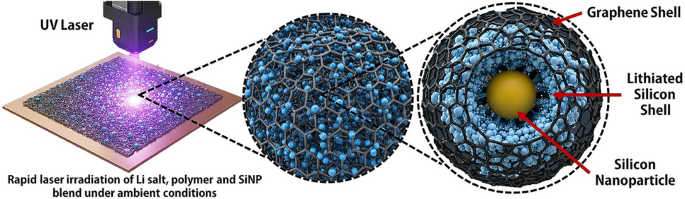
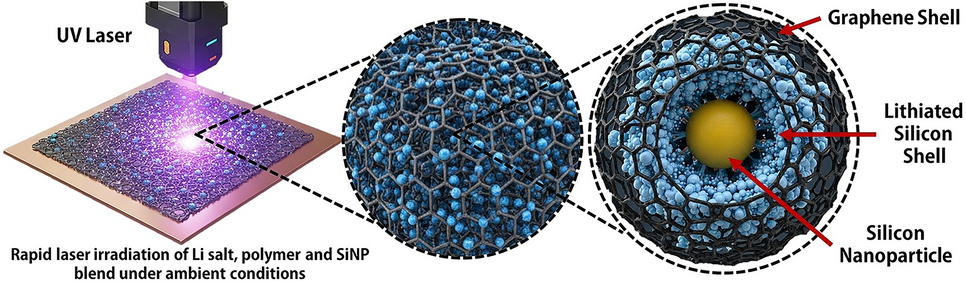
- Ambient Laser Processing: The ternary blend of phenolic resin, silicon nanoparticles, and common lithium salts is subjected to rapid, low-power laser irradiation under ambient atmosphere, producing self-standing, air-stable, prelithiated composites.
- Unique Microenvironment Chemistry: The extreme localized temperatures (>2000 K) and pressures (>1 GPa) generated during laser-induced graphene formation trigger in situ chemical reactions that prelithiate the silicon surface and form stable covalent interfaces.
- Core-Shell Nanostructure: The resulting composite features partially lithiated silicon nanoparticles with a thin lithium silicate shell (~10 nm thickness) embedded within a porous, conductive laser-induced graphene matrix, preserving the crystalline silicon core for high lithiation capability.
- Additive-Free Architecture: The self-standing composite requires no binders, conductive additives, or post-processing, simplifying electrode fabrication and reducing material costs compared to conventional silicon-based anodes.
Applications and Future Outlook
- Ultrafast Charging Capability: The prelithiated anodes retain up to 63% of their maximum capacity at 10 A g-1, demonstrating exceptional rate performance for high-power applications.
- Universal Lithium Salt Compatibility: The method universally employs common lithium salts (LiOH, Li2CO3, LiNO3, LiF, LiClO4), with LiOH showing optimal performance due to alkaline-promoted precursor densification and enhanced interfacial contact.
- Scalable Manufacturing: Large-format (20 cm length) fabrication is demonstrated with potential for roll-to-roll integration, offering a clear pathway toward industrial-scale production with fabrication rates exceeding hundreds of cm2 per hour.
- Full Cell Validation: Full cells paired with LiFePO4cathodes exhibit exceptional cycling stability with no measurable capacity degradation over 500 cycles at 1C rate, validating practical applicability for next-generation lithium-ion battery systems.
This comprehensive study establishes a new paradigm for simultaneous silicon anode fabrication and prelithiation through laser-driven in situ processing. It highlights the importance of interdisciplinary research in materials science, photonics, and electrochemistry to drive innovation in this field. Stay tuned for more groundbreaking work from Professor Fernando Patolsky at Tel Aviv University!

Editor of Nano-Micro Letters, which is an Open-Access, peer-reviewed journal reported papers that have at least one dimension ranging from a few sub-nanometers to a few hundreds of micrometers. The journal is published by Springer Nature and indexed by SCI, EI, SCOPUS, Pubmed, etc. The 2024 JCR Impact Factor is 36.3. The 2024 CiteScore is 53.1.
Follow the Topic
-
Nano-Micro Letters
Nano-Micro Letters is a peer-reviewed, international, interdisciplinary and open-access journal that focus on science, experiments, engineering, technologies and applications of nano- or microscale structure and system in physics, chemistry, biology, material science, and pharmacy.

Please sign in or register for FREE
If you are a registered user on Research Communities by Springer Nature, please sign in