Layered Defect-Filling co-Assembled Carbazole-Based SAMs Deliver 20% Organic Solar Cells and 17% Mini-Modules
Published in Chemistry, Electrical & Electronic Engineering, and Materials

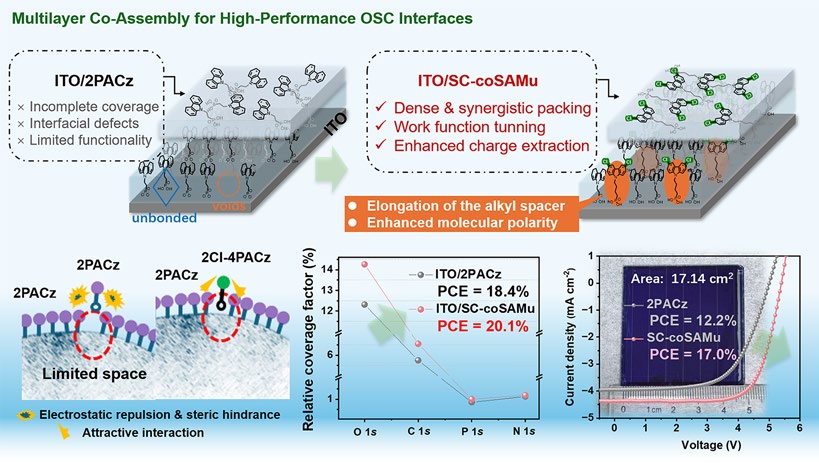

Organic solar cells (OSCs) offer a promising pathway toward lightweight, flexible, and solution-processable photovoltaics, but translating high laboratory efficiencies into larger devices remains challenging. One key obstacle lies at the buried interface between the electrode and the photoactive layer, where incomplete molecular coverage and interfacial defects can hinder charge extraction and increase energy losses. Researchers from Chalmers University of Technology, Shandong University, Jianghan University, Karlstad University, Uppsala University, Aalborg University, and collaborating institutions have developed a layered molecular co-assembly strategy that improves interface quality and enables organic solar cells to achieve 20.1% power conversion efficiency, alongside 17.0% efficiency in mini-modules.
Why This Interface Matters
Self-assembled monolayers (SAMs) are widely used as hole-transport layers in organic solar cells because they can tune electrode work functions and facilitate selective charge extraction. However, conventional single-component SAMs often form imperfect, quasi-monolayer structures, leaving uncovered regions and defects that promote charge recombination. These problems become particularly serious when devices are scaled up, as interfacial nonuniformity can substantially reduce performance. Rather than simply increasing the amount of conventional SAM material, this study addresses the underlying challenge by engineering molecular organization and interfacial coverage.
Innovative Design and Mechanism
The researchers combined two carbazole-based molecules, 2PACz and its chlorine-substituted analogue 2Cl-4PACz, to construct a multilayered, co-assembled hole-transport interface. In the sequential-casting strategy, 2PACz first forms a chemisorbed bottom layer on the indium tin oxide (ITO) electrode, primarily controlling its work function. Subsequently deposited 2Cl-4PACz occupies interfacial voids, strengthens molecular packing, and improves compatibility with the organic donor polymer. The two molecules interact through enhanced π–π stacking and complementary molecular polarity, creating a more cohesive and electronically coupled interface. The resulting structure improves energy-level alignment, promotes favorable vertical phase separation in the photoactive layer, and suppresses trap-assisted recombination, enabling more efficient hole extraction and collection.
Outstanding Performance
The optimized sequentially assembled interface enabled a D18:L8-BO organic solar cell to reach 20.1% power conversion efficiency, compared with approximately 18% for the conventional 2PACz-based reference. The device also achieved a fill factor exceeding 81%, reflecting improved charge transport and reduced interfacial losses. Importantly, the benefits extended across several donor–acceptor systems, including PM6:L8-BO, PM6:BTP-eC9, and PM6:Y6, demonstrating the broader applicability of the molecular design strategy. Most notably, a mini-module comprising six series-connected subcells, with an active area of 17.14 cm2, achieved 17.0% efficiency, substantially outperforming the 12.2% efficiency of the reference module. This represents an approximately 39% relative improvement, highlighting the importance of interface engineering for maintaining performance during device scaling.
Applications and Future Outlook
This work demonstrates that carefully controlled molecular layering can address a major bottleneck in scalable organic photovoltaics without requiring fundamental changes to the photoactive materials themselves. By combining energy-level regulation, defect passivation, and improved molecular packing within a single interface, the strategy provides a versatile route toward more efficient large-area solar cells. Its effectiveness across multiple active-layer systems also suggests potential applicability to other metal-oxide electrodes and optoelectronic devices in which interfacial defects limit performance. Future efforts to optimize deposition processes, ensure uniform coverage over larger areas, and improve manufacturing reproducibility could further advance this approach toward practical, scalable organic photovoltaic technologies.
Follow the Topic
-
Nano-Micro Letters
Nano-Micro Letters is a peer-reviewed, international, interdisciplinary and open-access journal that focus on science, experiments, engineering, technologies and applications of nano- or microscale structure and system in physics, chemistry, biology, material science, and pharmacy.