Can a Study set a New Standard in Chronic Pain Understanding and Data Capture?
Published in Bioengineering & Biotechnology, Neuroscience, and Research Data


The "Why"
Chronic pain is challenging to study due to its subjective nature and the limitations of current assessment tools. Paper diaries, while easy to use, can lead to errors as they depend on patients’ memories. This is called the “parking lot” effect, where patients may fill out their diary entries in the parking lot or waiting room right before a visit. Since the data is not logged when the episode occurs, the data is susceptible to recall errors and becomes questionable in terms of its accuracy. And if sessions are logged in a compliant manner, there is no way to verify if they were reported at that exact time and date. The transition to electronic diaries (eDiary) has been driven by this need for greater accuracy, compliance, and data security in clinical trials. Regulatory bodies like the FDA have also emphasized the importance of patient-reported outcomes (PRO) and ePRO for supporting clinical claims. Traditional pain studies with devices typically have patients report pain at a baseline visit, and one at some pre-defined timepoint or timepoints in the future. If pain decreases by a certain amount, such as 50% from baseline, a patient is considered to have responded to therapy. This can work for typical neuromodulatory devices that are in the “on” state continuously, such as Spinal Cord Stimulators or Peripheral Nerve Stimulators. However, if a device is used “on-demand” for pain therapy, the typical study designs mentioned would not allow for the appropriate data capture to truly understand its effect on patient pain levels. With these limitations in mind, Neuros Medical created a patented data collection and analysis system that could transform the understanding of chronic pain through the robust data that were captured[1,2]. This ePRO collection and analysis methodology was utilized in the pivotal QUEST-IDE trial to assess the ability of High Frequency Nerve Block (HFNB) delivered through the Altius® High Frequency Stimulation System (HFSS) in reducing chronic post-amputation pain.
The "How"
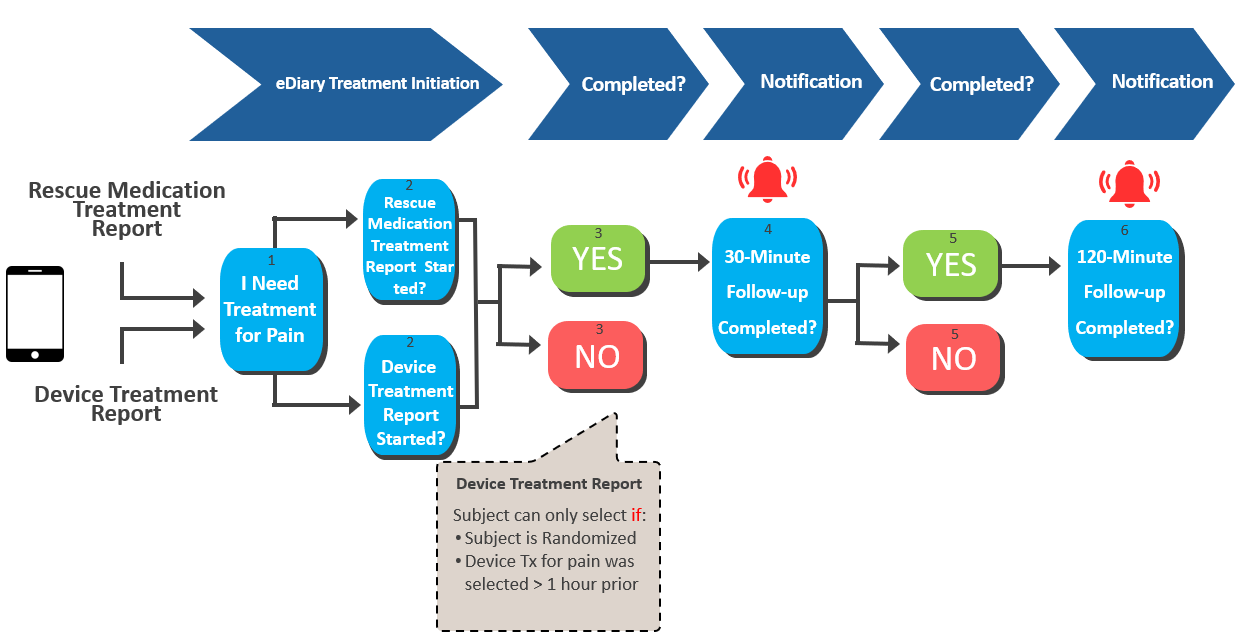
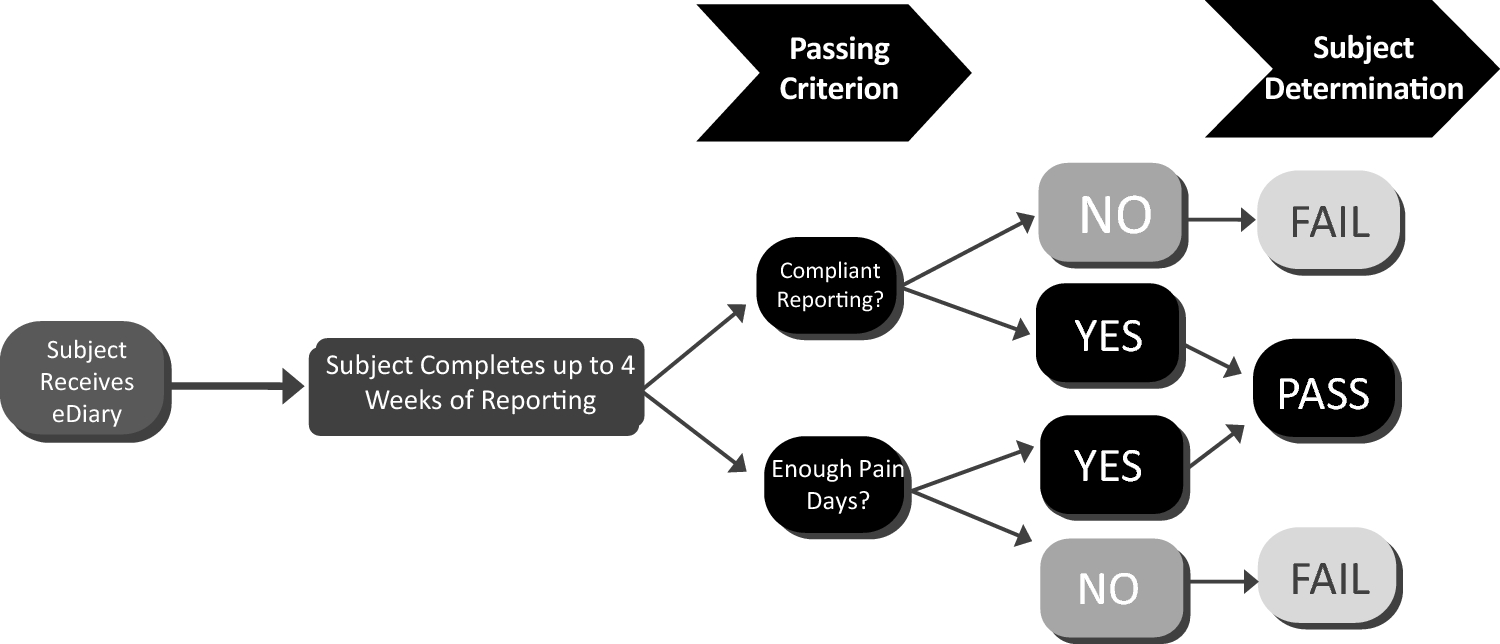
As the patients in the QUEST Study used Altius HFSS to treat their pain any time of the day or night, their eDiary needed to be equally flexible to capture all these uses. Treatment Report sessions were available to patients whenever they used the device. Patients reported their pain levels in “real-time” at the start of a treatment report session and were prompted by alarms from the eDiary to report their pain at 30-minutes and 120-minutes after treatment. At the end of each day, patients were given alarms to complete a summary pain report. Patients also reported their pain medication use and prosthetic use. Over the course of the entire study, 607 patients reported 1.8 million datapoints across 198,000 reports with high levels of compliance (77%-82% depending on report type). The 170 patients who were included in primary and secondary effectiveness and safety endpoints analyses reported their pain continuously from enrollment to their Month-12 visit. These data were then combined with data captured during study visits to complete our statistical analysis around the QUEST Study Endpoints (Fig. 1).
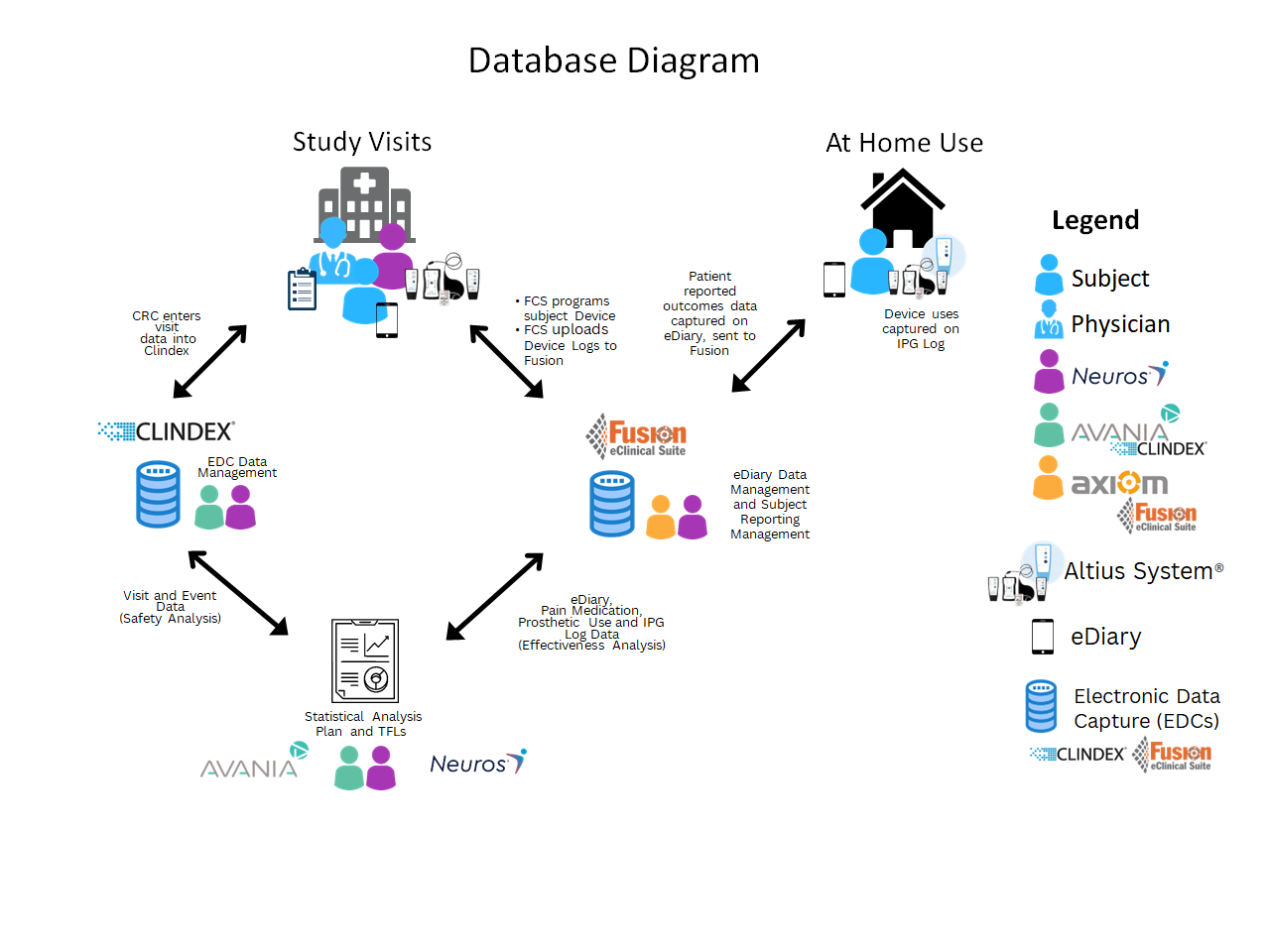
Fig.1: Diagram for QUEST data flows. Subjects report on their eDiary (At Home Use) where reports were submitted to the Fusion database. Fusion also contained electronic copies of IPG logs gathered at programming visits (Study Visits). Within Fusion, IPG sessions were paired with eDiary sessions. Data from these paired session reports were then used for the primary and key secondary endpoint analyses. End-of-Day Reports provided additional medication and prosthetic use information for secondary endpoint and supplemental analyses. Additional data were captured at study visits via case report forms and entered into Clindex EDC. These data were then used to analyze all primary safety endpoints and other event data. Adapted from [1].
The "Future"
Neuros’ patented data collection and analysis system captured the unique capabilities of Altius® to significantly reduce patient pain, decrease opiate usage, and improve quality of life (details published elsewhere) [3]. We also feel the implications of this data system extend beyond the QUEST study, such as:
- Capturing Pain Complexity: Our data system can capture the intricate details of a patient's pain journey, ensuring even subtle changes are recorded.
- Linking Treatment to Progress: By accurately associating treatments with long-term alterations in pain profiles, the system provides a clear picture of impact over time.
- Blueprint for Chronic Pain Clinical Trials: Serving as a model for future research, our system lays the groundwork for conducting large, multi-center, double-blinded, randomized, active-sham controlled trials. These studies, along with their repeated measurements, can pave the way for a new era of pain management research.
We hope this manuscript and study serve to engage the chronic pain community and broader medical and research communities around what is possible as we strive to relieve pain and restore lives.
References
- Iorio, M., Legaspi, R., Syed Shah, N. et al. Learning pains: system design, management, and lessons learned using electronic patient reported outcomes in the QUEST study of chronic post-amputation pain. Discov Health Systems 3, 26 (2024). https://doi.org/10.1007/s44250-024-00091-9
- Iorio M, Syed Shah N. System and method for quantifying qualitative patient-reported data sets (U.S. Patent No. 11,878,172). U.S. Patent and Trademark Office; 2024.https://image-ppubs.uspto.gov/dirsearch-public/print/downloadPdf/11878172
- Kapural L, Melton J, Kim B, Mehta P, Sigdel A, Bautista A, Petersen EA, Slavin KV, Eidt J, Wu J, Elshihabi S, Schwalb JM, Garrett HE Jr, Veizi E, Barolat G, Rajani RR, Rhee PC, Guirguis M, Mekhail N. Primary 3-Month Outcomes of a Double-Blind Randomized Prospective Study (The QUEST Study) Assessing Effectiveness and Safety of Novel High-Frequency Electric Nerve Block System for Treatment of Post-Amputation Pain. J Pain Res. 2024;17:2001-2014
https://doi.org/10.2147/JPR.S463727

Follow the Topic
-
Discover Health Systems
This journal takes a multidisciplinary approach to address systems-level research and discussions relating to health systems, services and informatics, reflecting health outcomes, including from business and health policy perspectives.

Related Collections
With Collections, you can get published faster and increase your visibility.
Improving Domestic resource mobilisation to support health financing transition in Sub-Saharan Africa
It is generally acknowledged that recent improvements in health outcomes in Africa have been attributed to the increase in development assistance for health, especially over the past three decades. With development assistance for health in Sub-Saharan Africa on the decline, increased domestic resource mobilization for health will be needed to sustain progress or even avoid disruptions, given recent and likely future declines in external support.
There is also a general recognition that bridging the funding gap in the face of declining donor aid funding will depend crucially on governments in Africa increasing domestic funding and planning transitions towards greater domestic health spending. Arguably, recent events in the global health financing architecture have only added impetus to a situation that has been unfolding for several years. Despite high-level political and policy statements, domestic financing remains very low in many African countries.
Thus, one question that confronts national health authorities and health financing policy experts is, are there plausible scenarios over the short and medium term to transition towards increased domestic financing in anticipation of declining development assistance for health, with minimal disruptions to the progress made so far? Rather than focusing on aspirational targets, such as the share of total government spending allocated to the health sector, it is essential to examine how well countries are performing, given their level of income and other spending drivers. Bringing new evidence on the potential of African countries to increase domestic resources for health into one collection would greatly add value to the debate.
This collection will feature empirical papers that will hopefully examine the extent to which countries can increase domestic resources for health. The scope of empirical papers covers the following pertinent dimensions of health financing, including revenue mobilization, risk pooling, and strategic purchasing:
(a) Quantifying the potential for domestic resource mobilization for health
(b) Modelling future health spending and costs in the short to medium term, incorporating scenarios about anticipated changes in external health financing.
(c) Estimating the efficiency or effectiveness of health spending.
(d) Evaluating the impact of strategic purchasing on health system performance
(e) Description and evaluation of levels and patterns of development assistance for health in sub-Saharan Africa.
(f) Evaluation of effective strategies that countries are implementing to increase domestic financing for health.
Publishing Model: Open Access
Deadline: Nov 26, 2026