Livestock and Climate: Looking Beyond Carbon Tunnel Vision
Published in Agricultural & Food Science and Zoology & Veterinary Science


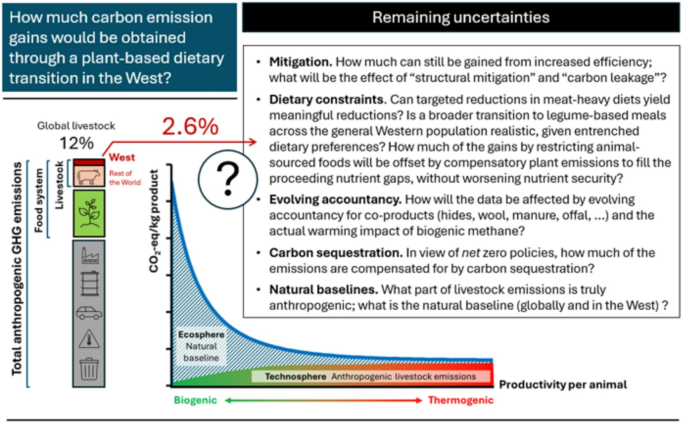

Public discussion about livestock and climate change is often reduced to a simple proposition: livestock emit greenhouse gases, therefore eating less meat and dairy is an obvious climate solution. A recent peer-reviewed review by Leroy and colleagues (2026), together with a subsequent commentary by several of its authors, challenges this reductionist framing.
I find their central argument persuasive, but it is important to state it carefully. Livestock production has genuine environmental impacts, and reducing avoidable emissions remains necessary. The issue is whether greenhouse gas emissions—particularly when represented through a single carbon-equivalent metric—provide enough information to judge the overall sustainability of livestock systems.
They do not. Livestock systems interact with climate, nutrition, land use, biodiversity, soil carbon and food security in ways that differ markedly among regions and production systems. The problem with “carbon tunnel vision” is therefore not that carbon is unimportant. It is that one environmental indicator can become a substitute for understanding the whole system.
The headline number needs context
The review identifies approximately 12% of global anthropogenic greenhouse gas emissions as the most authoritative estimate of livestock’s contribution. That is substantial. But a global percentage says relatively little about where emissions occur, how efficiently food is produced or where mitigation opportunities are greatest.
The regional differences reported by Leroy et al. are striking. Livestock production in Asia accounts for 5.2% of global anthropogenic GHG emissions, Central and South America for 3.1%, the West—Europe, North America, Australia and New Zealand—for 2.6%, and Africa for 1.3%. Within the West, the EU27 accounts for about 1%. The review also notes that the BRICS countries collectively account for 5.3%.
Regional differences extend beyond total emissions to emissions intensity. For beef, Leroy et al. report approximately 12–16 kg CO₂e per kg carcass weight in Europe and North America, compared with about 53 kg in Latin America and South Asia and 72 kg in sub-Saharan Africa. The review relates these differences to factors including feed quality, genetics, management and productivity, while emphasizing that livestock in many regions also perform functions beyond food production.
This heterogeneity is precisely why a global average should not automatically become a universal prescription. The sources of emissions, opportunities for mitigation and consequences of changing livestock production differ substantially among regions and production systems.
The same context is needed when considering consumer choices. The review estimates annual emissions savings of approximately 0.2 tonnes CO₂e from a flexitarian diet, 0.5 tonnes from a vegetarian diet and 0.8 tonnes from a vegan diet, against an overall Western individual footprint of roughly 9–15 tonnes CO₂e per year. Dietary change can therefore reduce emissions, but its contribution needs to be considered alongside housing, transport, travel, energy use and consumption.
Theoretical dietary savings are also not the same as durable reductions at population scale. The review points to difficulties in maintaining restrictive dietary patterns over time. The relevant question is therefore not simply whether changing diets can reduce emissions, but how large, sustained and practically achievable those reductions are relative to other opportunities for mitigation.
Food cannot be reduced to carbon
Carbon accounting also becomes incomplete when food is treated primarily as an emissions source rather than as a source of nutrition.
Removing meat, milk or eggs does not remove the human requirement for the nutrients they provide. Those foods must be replaced, and their replacements require their own land, inputs, production and supply chains. As Leroy and colleagues argue, the environmental consequences of dietary change therefore depend partly on what replaces the displaced animal-source foods.
This is particularly important because foods are not nutritionally interchangeable. The review discusses potential inadequacies in vitamins B2, B6 and B12, iodine, calcium, zinc and selenium under some low-emission dietary patterns and gives particular attention to iron adequacy among premenopausal women, especially during pregnancy and lactation.
None of this means that nutritionally adequate vegetarian or vegan diets are impossible. Nor does it mean that pulses and alternative proteins have no role. The point is more fundamental: nutritional adequacy cannot be assumed simply because a dietary scenario performs well on a carbon metric. Nutritional quality, digestibility, consumer acceptance and practical substitution all matter.
A climate-efficient food system that fails to provide adequate nutrition would hardly qualify as sustainable. Food policy must therefore ask not only how much carbon a food produces, but also what nutritional function it performs and what would realistically replace it.
Land is not interchangeable
The same problem appears in discussions of land use. Grazing land is sometimes treated as though removing livestock would automatically free that land for crop production, carbon sequestration or ecological restoration. In reality, much grazing occurs on land constrained by soils, climate, topography or water availability.
Ruminants have a distinctive role in such landscapes because they can convert vegetation that humans cannot directly consume into food. That does not make every grazing system environmentally beneficial, but it does mean that the ecological function of grazing cannot be understood simply from the area of land occupied.
Soil carbon further complicates the calculation. Leroy et al. review evidence that particular grazing practices, including improved or adaptive management, can increase soil-carbon stocks under some conditions, especially on degraded land. Yet sequestration depends on the starting condition of the soil, climate, vegetation and management. It should therefore neither be excluded automatically from livestock assessments nor assumed to occur universally.
The climate performance of grazing cannot be separated from the ecological context in which grazing occurs.
Afforestation is not automatically restoration
The authors extend the same reasoning to tree planting. Reforestation can provide major climate and biodiversity benefits where forests have been lost. But planting trees on naturally open ecosystems is not necessarily restoration.
Grasslands and savannas are ecosystems in their own right. Converting them to forest, particularly through poorly designed or monocultural planting, can alter biodiversity, soil processes and fire dynamics. In fire-prone landscapes, the consequences may be particularly important.
This is not an argument against trees. It is an argument against treating tree cover as an ecological objective independent of place. Agroforestry and silvopastoral systems also demonstrate that livestock and woody vegetation need not be mutually exclusive.
The relevant question is therefore not simply “trees or grazing?” It is which land use is appropriate for that particular ecosystem, and what environmental functions would be gained or lost by changing it?
Methane shows why the metric matters
Few issues illustrate the limitations of single-metric thinking better than livestock methane.
Methane is a powerful greenhouse gas, but its atmospheric behaviour differs fundamentally from that of long-lived carbon dioxide. Conventional 100-year Global Warming Potential (GWP100) and the alternative GWP* (“GWP-star”) consequently describe different aspects of methane’s climate effect.
Leroy et al. note that, under GWP*, a sustained annual reduction of approximately 0.3% in herd methane emissions could stabilize that herd’s future contribution to global temperature. This does not mean that methane emissions cease to matter. Rather, it illustrates why a stable or declining methane source cannot be interpreted in exactly the same way as a continuously accumulating source of fossil CO₂.
The review therefore argues for considering GWP100 and GWP* together rather than treating one as a universal replacement for the other. The choice of metric—and the question it is intended to answer—needs to be transparent.
The origin of the carbon also matters. Carbon emitted as ruminant methane largely belongs to the biogenic carbon cycle: atmospheric CO₂ is incorporated into plants, consumed by animals and partly returned as methane before ultimately being oxidized back to CO₂. Fossil-fuel combustion, by contrast, introduces carbon that had been stored outside the active carbon cycle for geological timescales.
Recognizing this distinction does not make biogenic methane harmless. It means that climate accounting should represent its behaviour accurately.
The subsequent Dublin Declaration Desk commentary goes further by questioning how much methane currently attributed to livestock represents genuinely additional anthropogenic forcing rather than methane that would also arise from wild herbivores and other natural processes. This is a stronger and more debatable proposition than the basic distinction between biogenic and fossil carbon, but it raises an important accounting question: what baseline should be used when estimating the additional climate impact attributable to livestock?
Improving livestock remains part of climate action
None of these arguments removes the need to reduce livestock’s environmental impacts. Both the peer-reviewed review and the subsequent commentary point toward practical mitigation rather than inaction.
Better genetics, veterinary care, feeding, herd management, manure handling and waste reduction can improve productivity while reducing emissions. Grazing management can also be improved where ecological conditions permit. The appropriate intervention will inevitably differ among intensive production systems, mixed crop–livestock farms and extensive pastoral systems.
This is where the concept of carbon tunnel vision becomes most useful. The problem is not carbon accounting itself; we need it. The problem arises when carbon becomes the overriding criterion through which food, diets and landscapes are judged.
A lower-carbon option is not automatically a better food-system outcome if the comparison ignores nutritional replacement, land suitability, soil carbon, biodiversity or the consequences of alternative land uses. Conversely, the nutritional and ecological functions of livestock cannot become excuses for avoiding emissions reduction.
The debate therefore should not be reduced to whether livestock are inherently “good” or “bad” for the planet. More useful questions are: What is being produced, where and how? What are the emissions? What nutritional function does the food provide? What happens to the land, soil and biodiversity? What realistic alternatives exist—and what happens if we adopt them?
Complex food systems rarely yield simple answers. Looking beyond carbon tunnel vision is not an argument for climate inaction. It is an argument for better science—and for climate solutions that recognize the full complexity of livestock, food systems and the landscapes on which they depend.
This commentary reflects my perspective on the arguments presented in Leroy et al. (2026) and the subsequent Dublin Declaration Desk commentary by several of the review’s authors. The primary scientific source is Leroy, F., Beal, T., Dunshea, F. R., Ederer, P., Lee, M. R. F., Manzano, P., Mitloehner, F. M., Place, S. E., del Prado, A., Pulina, G., Ridoutt, B. & Rowntree, J. E. (2026). “Carbon tunnel vision and sustainable meat production in the West: A disproportionate focus on dietary greenhouse gas emissions?” Food Science of Animal Resources, 46, Article 69.


