September 2026 Highlights from the Health & Clinical and Life Sciences Research Communities
Published in Cancer, Ecology & Evolution, and Neuroscience

September brought a broad mix of research to the Health & Clinical and Life Sciences Research Communities. This month, I would like to highlight World Alzheimer's Day by bringing attention to a post focusing on Alzheimer's research as well as some of the blogs I enjoyed reading the most.
World Alzheimer’s Day
World Alzheimer’s Day, held on 21 September, aims to raise awareness of Alzheimer’s disease and other forms of dementia, while highlighting the importance of research, earlier detection and better support for people affected by the condition.
In this month’s Research Communities round-up, we’re highlighting some of the latest research exploring Alzheimer’s disease, including earlier detection and personalised approaches and the understanding of the biological mechanisms behind the disease and why it affects people differently.
What if Alzheimer’s disease could be identified earlier, before noticeable symptoms develop?
The AD-RIDDLE project is exploring how emerging tools such as digital cognitive assessments, blood-based biomarkers and personalised approaches to prevention could be integrated into everyday healthcare. Bringing together 27 organisations, the five-year project is testing these approaches in real-world healthcare settings across six European countries.
In this Behind the Paper post, @Cindy Birck from Alzheimer Europe explains how AD-RIDDLE’s flexible toolbox could support everything from raising awareness and assessing dementia risk to earlier detection, diagnosis and personalised prevention and treatment, and how the project is investigating which tools work best in different healthcare settings.
Read the full post to discover how AD-RIDDLE is working towards earlier, more personalised approaches to Alzheimer’s disease.
Understanding what drives neuropsychiatric symptoms in Alzheimer’s disease
Neuropsychiatric symptoms are common in Alzheimer’s disease and related dementias, but the biological mechanisms behind them are not yet fully understood. By using large autopsy datasets and high-resolution single-cell models, the researchers are exploring how gene expression varies across different cell types, and how these cellular pathways may influence neuropsychiatric symptoms and disease progression. The ultimate aim is to identify biomarkers and therapeutic targets that could support more precise approaches to diagnosis and treatment.
 Neuropsychiatric symptoms are common in Alzheimer’s disease and related dementias, but the biological mechanisms behind them are not yet fully understood. By using large autopsy datasets and high-resolution single-cell models, the researchers are exploring how gene expression varies across different cell types, and how these cellular pathways may influence neuropsychiatric symptoms and disease progression. The ultimate aim is to identify biomarkers and therapeutic targets that could support more precise approaches to diagnosis and treatment.
In this upcoming Neuroscience Seminar, researchers from the PsychAD Consortium will showcase selected findings from a new Nature Portfolio collection, exploring everything from cellular states and genetic drivers to how the ageing brain changes across the lifespan.
Join the live webinar on 13 October or catch up with the recording afterwards to discover the latest insights from the PsychAD Consortium.
Why does Alzheimer’s pathology affect people differently?
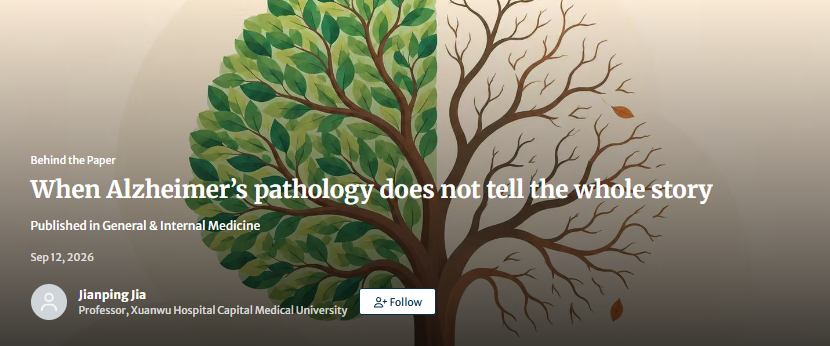
Why do some people remain cognitively healthy despite substantial Alzheimer’s-related pathology, while others with similar levels of pathology develop dementia much sooner? A 15-year study of more than 3,000 older adults explored whether cognitive resilience could help explain this difference.
 Why do some people remain cognitively healthy despite substantial Alzheimer’s-related pathology, while others with similar levels of pathology develop dementia much sooner? A 15-year study of more than 3,000 older adults explored whether cognitive resilience could help explain this difference.
@Jianping Jia discusses in their paper from Nature Medicine that both Alzheimer’s pathology and a person’s ability to maintain cognitive function despite that pathology contributed to future dementia risk. Their findings suggest that looking at resilience alongside amyloid and tau pathology could provide a more complete picture of Alzheimer’s disease progression.
Read the full Behind the Paper to discover how cognitive resilience was measured and what these findings could reveal about the different paths Alzheimer’s disease can take.
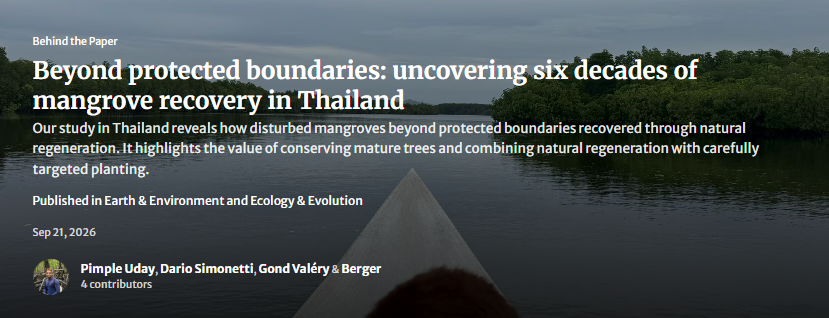
How Thailand’s mangroves recovered beyond protected areas
@Pimple Uday, @Dario Simonetti, @Gond Valéry& @Berger explain their Nature Communications Earth & Environment publication study which explores six decades of landscape change in southern Thailand, finding that more than 90% of mangrove gain between 1987 and 2025 came through natural regeneration.
The study also revealed that mature trees left behind after earlier disturbances may play a surprisingly important role in supporting biodiversity as forests recover. These findings challenge how restoration success is measured and highlight the importance of understanding a landscape’s history before deciding where planting is needed.
Read the full Behind the Paper to discover the unexpected story of Thailand’s recovering mangroves and the people, partnerships and challenging fieldwork behind the research.
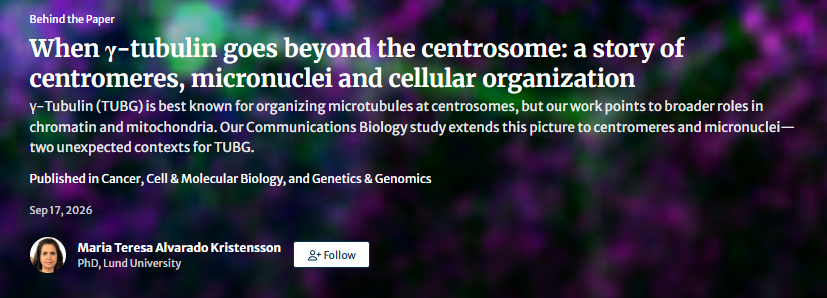
When a familiar protein reveals unexpected biology
γ-Tubulin (TUBG) is best known for organizing microtubules at the centrosome, but @Maria Teresa Alvarado Kristensson explains how they found it playing a much broader role in cellular organization including in centromeres and micronuclei.
Using live-cell imaging, the study, published in Communications Biology, revealed dynamic relationships between TUBG, centromeres, DNA and replication-associated signals, raising new questions about how cellular structures communicate across different compartments. The findings add to a growing picture of TUBG as more than a microtubule-organizing protein.
Read the full Behind the Paper to discover how an unexpected observation about TUBG and chromatin led to new questions about its role in cell biology.
That’s a wrap on September’s highlights! Explore the full posts to discover the stories, people and research behind these findings.
Explore more:
- September Highlights from the Humanities and Social Sciences Communities from @Yuanxin Zhang

Helping researchers connect, collaborate, and communicate their work. Specialising in Medicine and Life Science and passionate about making science more visible and accessible.
Follow the Topic
-
Communications Biology
An open access journal from Nature Portfolio publishing high-quality research, reviews and commentary in all areas of the biological sciences, representing significant advances and bringing new biological insight to a specialized area of research.
-
Nature Medicine
This journal encompasses original research ranging from new concepts in human biology and disease pathogenesis to new therapeutic modalities and drug development, to all phases of clinical work, as well as innovative technologies aimed at improving human health.
-
ISRCTN: The UK’s Clinical Study Registry
A primary clinical trial registry recognised by WHO and ICMJE that accepts studies involving human subjects or populations with outcome measures assessing effects on human health and well-being, including studies in healthcare, social care, education, workplace safety and economic development.
-
Communications Earth & Environment
An open access journal from Nature Portfolio that publishes high-quality research, reviews and commentary in the Earth, environmental and planetary sciences.




Related Collections
With Collections, you can get published faster and increase your visibility.
Ecological resistance and resilience under global change
Publishing Model: Open Access
Deadline: Apr 07, 2027
Clinical Research in Respiratory Medicine
Publishing Model: Hybrid
Deadline: Feb 18, 2027