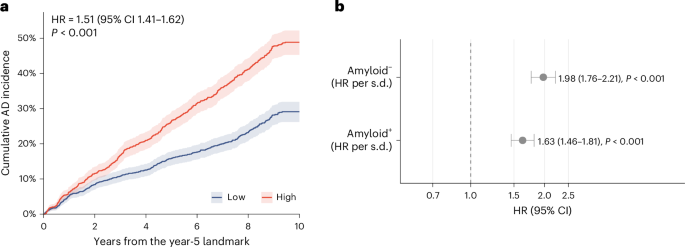

Alzheimer’s disease is one of the most common causes of dementia, gradually affecting memory, thinking and the ability to live independently. For many years, researchers have studied the disease by focusing on changes that occur inside the brain, particularly the accumulation of amyloid-β and tau proteins.
These biological changes are now recognized as important features of Alzheimer’s disease. Advances in biomarkers have allowed researchers to detect Alzheimer’s-related changes years before symptoms become apparent, opening new opportunities for early diagnosis and treatment.
However, these advances have also revealed a fundamental clinical puzzle.
During our clinical work and research, we repeatedly encountered individuals whose biological signs of Alzheimer’s disease did not seem to match their cognitive abilities. Some older adults showed substantial Alzheimer’s-related pathology but remained cognitively healthy for many years, sometimes even decades. They continued to function independently despite biological evidence of disease.
In contrast, others with a similar level of pathology experienced much faster decline and developed dementia within only a few years.
Why do people with similar biological changes follow such different clinical paths?
This question became the starting point of our study.
Looking beyond pathology alone
Alzheimer’s pathology remains central to understanding the disease. Greater accumulation of amyloid-β and tau is strongly associated with a higher risk of cognitive decline and dementia. Yet pathology alone does not fully explain the diversity of clinical outcomes that we observe.
The contrast between individuals with similar pathology but different cognitive trajectories suggested that another factor may influence how the brain responds to disease-related changes.
One possible explanation is cognitive resilience — the ability to maintain cognitive function despite the presence of Alzheimer’s pathology.
Turning resilience into something we could measure
Measuring resilience, however, is not simple.
A person with a high cognitive score at a single point in time is not necessarily resilient. Cognitive performance is influenced by many factors, including age, education, baseline ability and underlying disease burden.
What interested us was not simply who performed better at one moment. Instead, we wanted to understand who was able to maintain cognitive function over time despite having a similar level of pathology.
We therefore asked a different question: given the amount of Alzheimer’s pathology present in the brain, was this person’s cognitive decline faster or slower than expected?
To answer this question, we followed 3,119 older adults participating in the China Cognition and Aging Study for up to 15 years. We repeatedly measured Alzheimer’s-related pathology using cerebrospinal fluid biomarkers and tracked changes in cognitive performance over time.
By comparing each individual’s cognitive trajectory with what would be expected based on their pathology burden, age and sex, we quantified cognitive resilience. This approach allowed us to examine Alzheimer’s disease risk through two complementary perspectives: the burden of pathology and the ability to maintain cognition despite that burden.
Two dimensions shape future Alzheimer’s risk
Our findings showed that both pathology and resilience contributed to future Alzheimer’s disease risk.
As expected, individuals with greater pathological burden had a higher risk of developing Alzheimer’s disease dementia. However, cognitive resilience also provided important information. Individuals who maintained cognitive function better than expected for their level of pathology had a lower risk of future dementia.
The combination of these two dimensions provided a more complete picture than either factor alone. Individuals with low pathology and high resilience had the lowest risk of dementia. In contrast, those with high pathology and low resilience had the highest risk (Fig. 1).
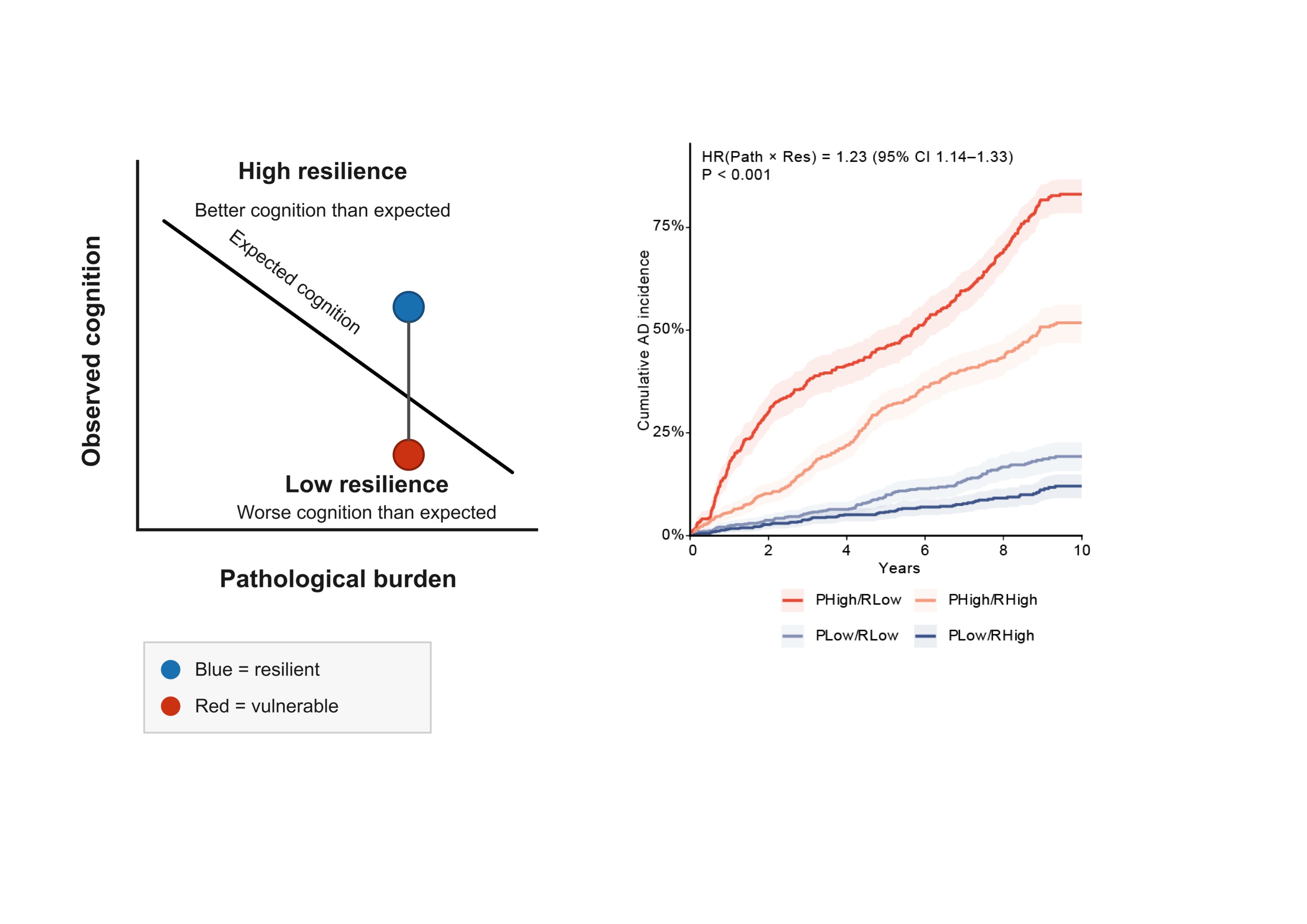
The group that most closely reflected the original clinical question was the group with substantial Alzheimer’s pathology but preserved cognition. Their trajectories suggested that biological changes in the brain do not inevitably lead to the same clinical outcome in every person.
Testing whether the finding was robust
Whenever an observational study identifies a characteristic associated with better outcomes, an important question remains: could this simply reflect early disease changes that were not fully captured?
We therefore performed multiple sensitivity analyses to examine whether our findings were robust to alternative explanations.
We also evaluated the relationship between pathology, resilience and dementia risk in an independent cohort. The overall pattern remained consistent, supporting the idea that pathology and resilience represent complementary aspects of Alzheimer’s disease risk.
Rethinking Alzheimer’s disease risk
Modern Alzheimer’s research has understandably focused on reducing pathological burden, particularly amyloid and tau. These efforts have led to major advances in disease-modifying therapies.
Our findings do not challenge the importance of targeting pathology. Instead, they suggest that understanding Alzheimer’s disease requires looking beyond pathology alone.
The future of an individual may depend not only on how much disease-related change accumulates in the brain, but also on how effectively the brain maintains function in response.
Cognitive resilience is unlikely to be determined by a single factor. It may reflect the combined influence of lifelong experiences, including education, vascular health, lifestyle, genetics and brain network organization. Understanding these contributors may reveal new ways to predict risk and support cognitive health.
Toward a more complete picture of Alzheimer’s disease
The observation that motivated this study remains the question we find most compelling:
Why does one person remain cognitively healthy despite Alzheimer’s pathology, while another person with similar pathology develops dementia?
The answer may reveal mechanisms that are just as important as understanding the pathology itself.
Our study suggests that Alzheimer’s disease dementia emerges from the interaction between pathological burden and cognitive resilience.
Pathology remains fundamental.
But it does not tell the whole story.
The poster figure was created by ChatGPT with oversight from the authors.

Follow the Topic
-
Nature Medicine
This journal encompasses original research ranging from new concepts in human biology and disease pathogenesis to new therapeutic modalities and drug development, to all phases of clinical work, as well as innovative technologies aimed at improving human health.

Related Collections
With Collections, you can get published faster and increase your visibility.
Clinical Research in Respiratory Medicine
Publishing Model: Hybrid
Deadline: Feb 18, 2027
Cancer Prevention and Control
Publishing Model: Hybrid
Deadline: Feb 19, 2027