Quarterly Highlights from the Health & Clinical Research and Life Sciences Communities (April to June 2026)
Published in Cancer, Microbiology, and Protocols & Methods

Welcome to the second quarterly roundup of 2026 from the Health & Clinical Research and Life Sciences Research Communities!
Some of the most read posts from April to June include the work on the origins of complex life, the future of cancer immunotherapy, the hidden impact of antibiotic resistance, the importance of recovery in human health, and the surprisingly creative names scientists give their lab equipment.
Nicknames for lab instruments
Have you ever thought that lab equipment often seems to have a personality of its own? @Vivien Marx explores the tradition of naming laboratory instruments, computers, fridges and chromatography columns. Inspired by her reporting for Nature Methods, Vivien shares stories from researchers around the world whose beloved lab ‘colleagues’ bear names ranging from Disney characters and footballers to baked goods and fictional villains. Along the way, she reveals how these nicknames do more than raise a smile - they help scientists organise workflows, troubleshoot equipment and build a sense of community in the lab.
Read the full post to discover some of the most memorable instrument names and the stories behind them. Do you have any nicknames for your inanimate colleagues? Share them in the comments!
Could recovery matter more than stress for long-term health?
Why do some people bounce back from life's challenges while others experience a gradual decline in health and resilience? @Torsak Tippairote explores a new framework for understanding stress, aging and chronic disease. Published in Biogerontology, the work argues that the key factor may not be stress exposure itself, but the body's ability to complete recovery. By focusing on the role of mitochondrial function, bioenergetic capacity and the concept of Exposure-Related Malnutrition, the paper offers a fresh perspective on why resilience can falter long before disease becomes apparent.
Read the full post to discover how a recovery-centred view of biology could alter the way researchers and clinicians think about health, aging and disease prevention.
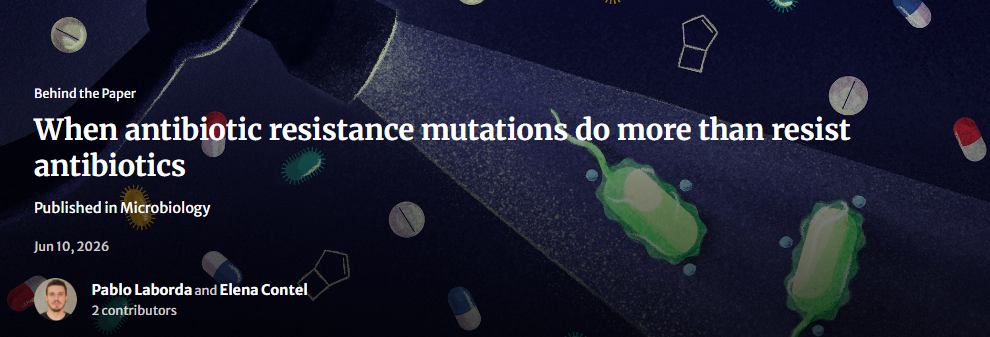
What if antibiotic resistance helps bacteria do more than survive drugs?
What if antibiotic resistance mutations were helping bacteria in ways that had nothing to do with antibiotics? In this fascinating Behind the Paper post, @Pablo Laborda and @Elena Contel share how a puzzling clinical observation led them to uncover an unexpected role for resistance mutations in Pseudomonas aeruginosa. Published in Nature Communications, the research reveals that mutations associated with carbapenem resistance can also alter how bacteria interact with airway mucus and epithelial cells, potentially influencing the course of infection itself.
Follow the authors' journey from an unexplained observation to a broader understanding of host–pathogen interactions and discover why resistance mutations may be about much more than evading antibiotics.
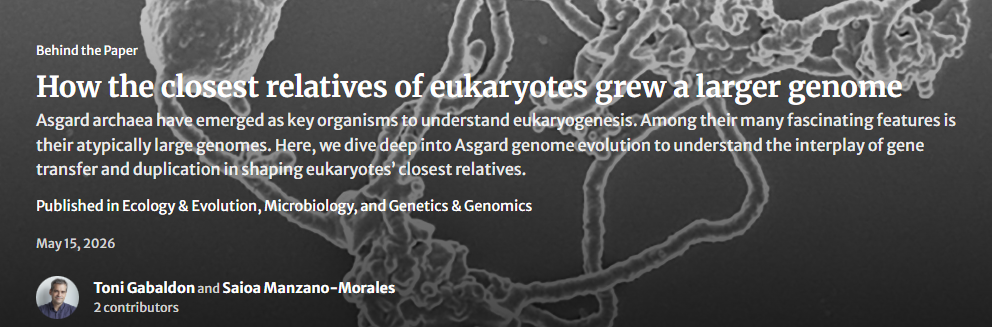
The ancient microbes offering clues to the origins of complex life
How did the closest known relatives of eukaryotes acquire their unusually large genomes? In this Behind the Paper post, @Toni Gabaldon and @Saioa Manzano-Morales explore the evolutionary history of Asgard archaea, a fascinating group of microorganisms that are helping researchers unravel the origins of complex life. Published in Nature Communications, the study reveals that gene duplication, rather than horizontal gene transfer, was the primary driver of genome expansion in these organisms. The findings place Asgard archaea in a middle ground between prokaryotes and eukaryotes, offering new clues about the evolutionary steps that may have paved the way for the emergence of plants, fungi and animals.
Read the full post to discover how studying these ancient microbes is reshaping our understanding of one of biology’s greatest mysteries.
Could personalised mRNA vaccines change the future of cancer treatment?
In this Behind the Paper post, @Saber and @Parham Kaboli explore how advances in mRNA vaccine design are helping to shape the future of personalised cancer treatment. Published in Cellular Oncology, their review examines the challenges of turning strong immune responses into lasting clinical benefits, highlighting innovations in antigen selection, vaccine engineering and adaptive treatment strategies. The post discusses targeting cryptic neoantigens, redesigning vaccines as tumours evolve and offers an accessible overview of a rapidly advancing field with the potential to transform cancer immunotherapy.
Read the full post to discover how researchers are working to make personalised cancer vaccines more effective, scalable and clinically impactful.
Thank you to all the researchers who continue to share the stories behind their work. These posts offer valuable insights into the discoveries, challenges and moments of curiosity that shape research, and we look forward to highlighting more of them in the months ahead!
Explore more:
- January to March 2025 - Quarterly Highlights from Health & Clinical Research and Life Sciences Communities
- April 2026 - Highlights from Health & Clinical Research and Life Sciences Communities
- May 2026 - Highlights from Health & Clinical Research and Life Sciences Communities
- June Highlights from Mathematics, Physical and Applied Sciences Communities

Helping researchers connect, collaborate, and communicate their work. Specialising in Medicine and Life Science and passionate about making science more visible and accessible.
Follow the Topic
-
Nature Methods
This journal is a forum for the publication of novel methods and significant improvements to tried-and-tested basic research techniques in the life sciences.
-
Nature Communications
An open access, multidisciplinary journal dedicated to publishing high-quality research in all areas of the biological, health, physical, chemical and Earth sciences.
-
Biogerontology
Biogerontology is a peer-reviewed journal dedicated to exploring the biological basis and mechanisms of ageing, with an aim of promoting healthy old age.
-
Cellular Oncology
Cellular Oncology publishes scientific contributions from various biomedical and clinical disciplines involved in basic and translational cancer research on the cell and tissue level, technical and bioinformatics developments in this area, and clinical applications.




Related Collections
With Collections, you can get published faster and increase your visibility.
Methods development in Cryo-ET and in situ structural determination
Publishing Model: Hybrid
Deadline: Oct 30, 2026
Women's Health
Publishing Model: Hybrid
Deadline: Ongoing