June Highlights from Mathematics, Physical and Applied Sciences Communities
Published in Chemistry, Earth & Environment, and Physics


From unexpected discoveries hidden in faulty data to new insights into Earth's climate system and breakthroughs in understanding enzyme behaviour, June brought a collection of fascinating stories from our Mathematics, Physical and Applied Sciences Communities. This month, we highlight researchers who challenged existing ideas, explored overlooked patterns, and uncovered new perspectives across a diverse range of disciplines.
Read on to discover the latest Behind the Paper stories, editorial insights, and research journeys shared by our Community members.
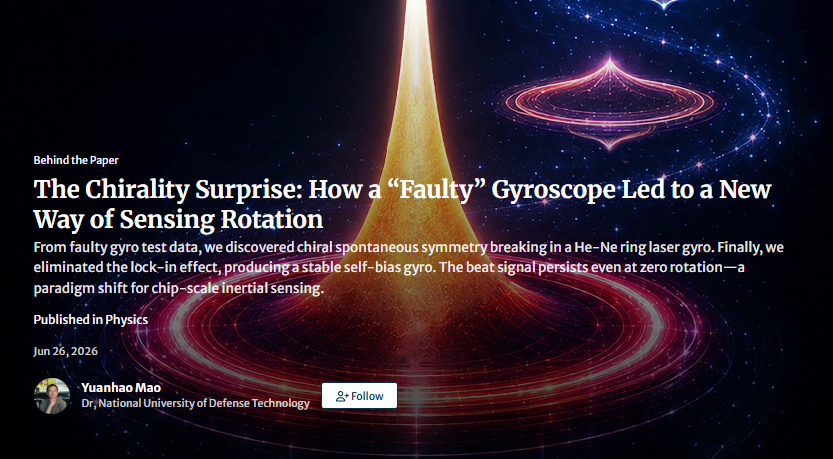
What if a “faulty” gyroscope turned out to be the key to a major breakthrough?
Sometimes, the most exciting discoveries begin with data that doesn't make sense. In a new Behind the Paper post, @Yuanhao Mao shares how an unexpected anomaly in a supposedly defective ring laser gyroscope led to the discovery of chiral spontaneous symmetry breaking - a finding that challenges decades of conventional gyroscope design.
Published in Nature, this research reveals how curiosity, persistence, and a willingness to question accepted wisdom transformed a production-line "failure" into a new approach for eliminating the long-standing lock-in effect.
Read the full Behind the Paper post to discover how an overlooked anomaly became the foundation for a new generation of laser gyroscopes.
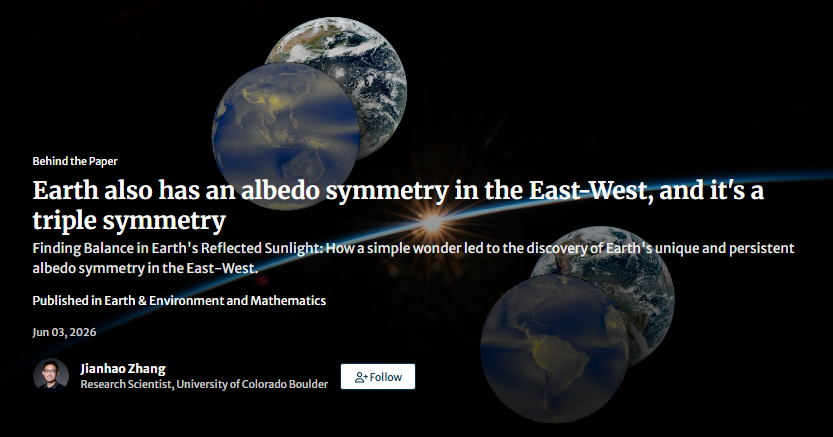
Could Earth be hiding another remarkable symmetry in plain sight?
“Given that the Earth is approximately spherical, it is unsurprising that we can divide it into two non-overlapping hemispheres that reflect equal amounts of sunlight.”
We all know about the balance between Earth's Northern and Southern hemispheres, but what if there's another, less obvious symmetry waiting to be uncovered? @Jianhao Zhang reveals how a simple question led to the discovery of a unique East–West albedo symmetry, where two halves of our planet reflect almost exactly the same amount of sunlight.
The blog posts, reflecting on research published in Nature, takes readers behind the scenes of the study revealing how 25 years of satellite observations can still hide surprises waiting to be revealed.
Curious how an overlooked pattern became a new way to test our understanding of Earth's climate? Read Jianhao Zhang's full Behind the Paper post to explore the discovery.
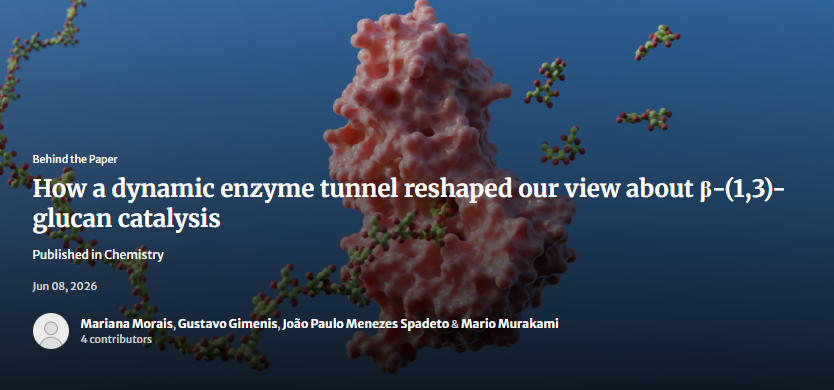
A hidden molecular mechanism behind enzyme-driven sugar breakdown
A surprising enzyme behavior led @Mariana Morais , @Gustavo Gimenis , @João Paulo Menezes Spadeto & @Mario Murakami to question what was known about β-(1,3)-glucan degradation. Their research, published in Nature Communications, uncovered a dynamic tunnel within the enzyme that opens, closes, and guides the breakdown of complex carbohydrates through a highly coordinated process.
This Behind the Paper story takes readers on a journey from the first unexpected findings to the structural and computational approaches that revealed a new catalytic mechanism.
Read the full post to learn how this discovery reshaped our understanding of enzyme dynamics.
Meet the Editor: Dr. Yitong Shang
In the latest Editor Story series @Lingyi Xu interviewed Dr. Yitong Shang, an Editorial Board Member for Scientific Reports and Research Assistant Professor at Hong Kong University of Science and Technology, about his perspectives on maintaining scientific rigor, finding reliable reviewers, and supporting authors throughout the publication process. He also discusses the growing importance of reproducibility, the challenges posed by AI and information overload, and why curiosity is one of an editor's greatest strengths.
Interested in learning more about Dr. Shang's editorial journey, his advice for fellow editors, and his vision for the future of research publishing? Read the full Editor Story to discover his insights and explore his work in smart grid research.
We hope these highlights inspire you to explore new ideas, connect with fellow researchers, and continue the conversation within our Mathematics, Physical and Applied Sciences Communities. Thank you to all contributors for sharing the stories behind their research and editorial experiences with us.
Stay tuned for more Community highlights and discoveries in the months ahead!
Explore more research breakthroughs:
Passionate about connecting researchers and amplifying their voices through digital engagement. As Manager for the Research Communities by Springer Nature, I work with researchers to showcase their discoveries and experiences.
With a strong interest in public engagement and creative science communication, I’m dedicated to making research more accessible and inspiring wider conversations around scientific discovery and innovation.
Follow the Topic
-
Nature
A weekly international journal publishing the finest peer-reviewed research in all fields of science and technology on the basis of its originality, importance, interdisciplinary interest, timeliness, accessibility, elegance and surprising conclusions.
-
Nature Communications
An open access, multidisciplinary journal dedicated to publishing high-quality research in all areas of the biological, health, physical, chemical and Earth sciences.
-
Scientific Reports
An open access journal publishing original research from across all areas of the natural sciences, psychology, medicine and engineering.



Related Collections
With Collections, you can get published faster and increase your visibility.
Women's Health
Publishing Model: Hybrid
Deadline: Ongoing
Cancer Prevention and Control
Publishing Model: Hybrid
Deadline: Feb 19, 2027