May Highlights from Mathematics, Physical and Applied Sciences Communities
Published in Chemistry, Earth & Environment, and Materials


This month in the Research Communities, researchers and editors shared stories that reveal how unexpected observations, interdisciplinary thinking and close attention to overlooked details can reshape scientific understanding.
From carbonate rich melts discovered high in the Himalaya to the hidden atmospheric limits of solar energy generation, these Behind the Paper posts highlight the human side of discovery and the evolving questions driving research forward. We also explore new perspectives on coastal carbon cycling, biodegradable electronic skin inspired by a simple laboratory interaction, and editorial insights into peer review, inclusivity and research integrity in scientific publishing.
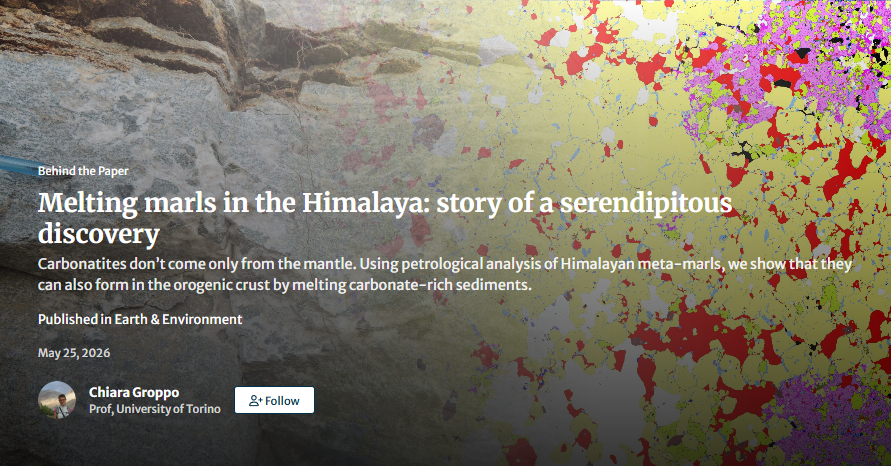
Can carbonatites really form deep within Earth’s crust?
A serendipitous discovery in the Himalaya suggests they can. While studying meta- marls in eastern Nepal, @Chiara Groppo stumbled upon unusual rock structures that pointed to something unexpected: partial melting of carbonate rich sediments within the orogenic crust. What began as routine fieldwork among remote Himalayan outcrops quickly turned into a striking observation of rocks recording melt processes never clearly documented before in such compositions.
Back in the lab, microscopic analysis revealed a remarkable “ball- bearing” texture and evidence of two coexisting melts, one silicate and one carbonate. Chemical signatures confirmed that these liquids separated and crystallized independently, forming minerals typical of carbonatitic compositions. This challenges the long- standing view that carbonatites are exclusively mantle derived, showing instead that crustal processes during mountain building can also generate them under the right conditions.
Explore the full Behind the Paper story to learn how this accidental field discovery reshaped ideas about carbonatite formation.
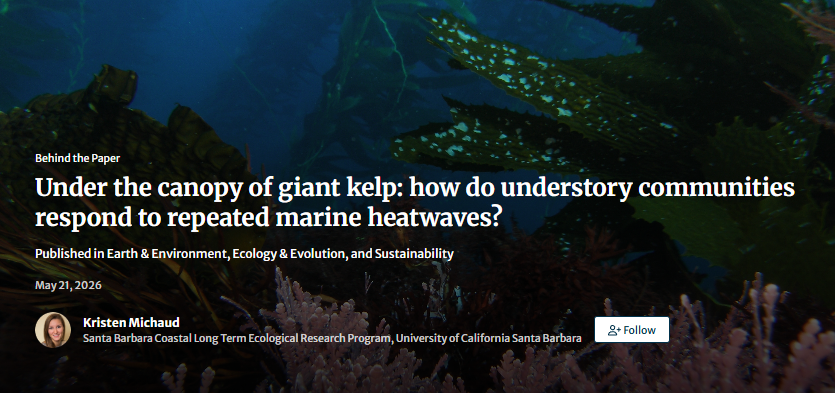
Are we underestimating the role of coastal oceans in the global carbon cycle?
@Kristen Michaud shared the story behind research that examines how carbon moves through coastal environments and why these regions are far more dynamic than they often appear. The work highlights the importance of understanding not just large-scale ocean processes, but also the small, local interactions that govern how carbon is processed and stored.
By combining observational data with a system-level perspective, the study published in Communications Earth & Environment shows how coastal zones act as active regulators of carbon exchange, with implications for both regional ecosystems and the broader climate system.
Explore the full Behind the Paper post to learn how coastal processes are shaping our understanding of Earth’s carbon balance.
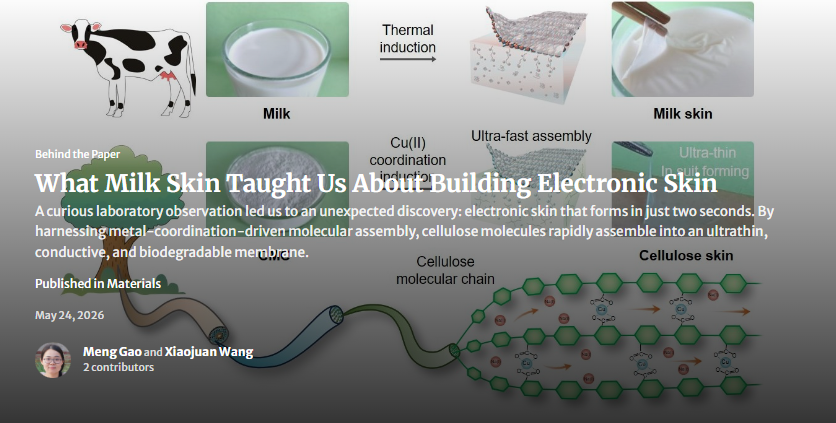
What if electronic skin could form in seconds from a simple chemical interaction?
@Meng Gao and @Xiaojuan Wang trace how an unexpected interface reaction between carboxymethyl cellulose and copper ions led to the rapid formation of an ultrathin, self-assembled membrane. What first appeared as a strange laboratory artefact gradually revealed a clear coordination-driven mechanism, where metal ions link polymer chains into a stable, continuous film.
Beyond the mechanism, the material itself pointed toward something much larger: a biodegradable, ionically conductive, and highly conformal membrane that can be formed directly on surfaces without complex processing. From an accidental observation to a functional skin-like material, the work shows how chance findings can reshape design strategies in wearable electronics.
See how a simple interface reaction evolved into electronic skin technology in this Behind the Paper post.
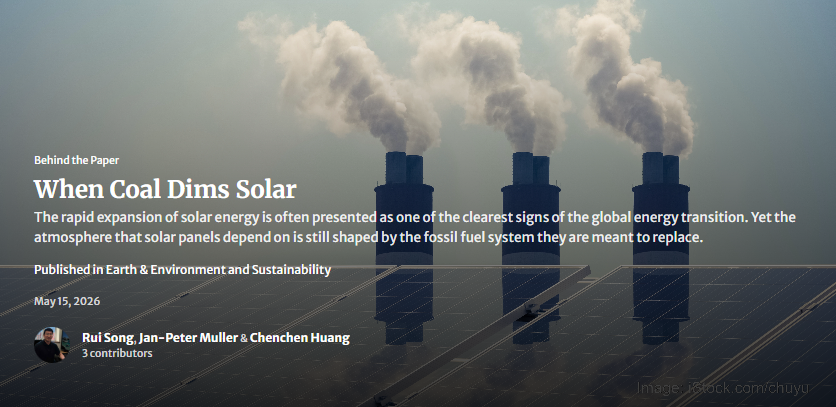
Mapping the atmospheric limits of solar energy
How much solar energy is lost before sunlight even reaches a solar panel? This Behind the Paper post from @Rui Song , @Jan-Peter Muller & @Chenchen Huang explores the relationship between coal emissions, atmospheric aerosols and solar PV performance on a global scale. By combining Sentinel-2 imagery, machine learning, and atmospheric reanalysis data, the authors quantify how polluted skies reduce solar electricity generation worldwide.
The findings, published in Nature Sustainability, reveal a significant gap between installed solar capacity and the energy actually delivered under real atmospheric conditions, especially in regions where coal-fired power and solar systems exist side by side.
Discover how atmospheric pollution can quietly reduce solar energy generation in some of the world’s fastest-growing renewable regions in the Behind the Paper blog post.

Editorial Insights from Dr. Marilisa Leone
In this latest Editor Story, Dr. Marilisa Leone reflects on her experience as an Editorial Board Member for Scientific Reports, sharing her perspectives on peer review, scientific rigor and reproducibility in research publishing. From handling multidisciplinary manuscripts to supporting authors through the editorial process, she offers thoughtful insights into the responsibilities and challenges of being an editor today.
She also discusses reviewer selection, inclusivity in scientific publishing, and the growing role of AI tools in strengthening research integrity.
Explore the full Editor Story written by @Sagar Yadav to explore Dr. Leone’s editorial journey and advice for the Research Communities.
Together, these stories show how research so often starts with a simple question, an unexpected result, or a moment that makes someone look at a problem differently. From discoveries in the field and surprising observations in the lab to large scale environmental studies and reflections from editors, each post gives a glimpse into the people, ideas and challenges behind the science. Explore the Behind the Paper posts and Editor Stories to see the unexpected paths, setbacks and insights that continue to shape research today.
We hope this month’s roundup offers fresh perspectives, sparks new ideas and gives you the opportunity to explore the diverse research shaping the Mathematics, Physical and Applied Sciences Communities.
Explore more research breakthroughs:
Passionate about connecting researchers and amplifying their voices through digital engagement. As Manager for the Research Communities by Springer Nature, I work with researchers to showcase their discoveries and experiences.
With a strong interest in public engagement and creative science communication, I’m dedicated to making research more accessible and inspiring wider conversations around scientific discovery and innovation.
Follow the Topic
-
Nature Communications
An open access, multidisciplinary journal dedicated to publishing high-quality research in all areas of the biological, health, physical, chemical and Earth sciences.
-
Scientific Reports
An open access journal publishing original research from across all areas of the natural sciences, psychology, medicine and engineering.
-
Communications Earth & Environment
An open access journal from Nature Portfolio that publishes high-quality research, reviews and commentary in the Earth, environmental and planetary sciences.
-
Nature Sustainability
This journal publishes significant original research from a broad range of natural, social and engineering fields about sustainability, its policy dimensions and possible solutions.




Related Collections
With Collections, you can get published faster and increase your visibility.
Phytochemicals and health
Publishing Model: Open Access
Deadline: Oct 28, 2026
Ecological resistance and resilience under global change
Publishing Model: Open Access
Deadline: Apr 07, 2027