Nicknames for lab instruments
Published in Chemistry, Materials, and Neuroscience

When I visit labs to watch and learn, I have picked up on the fact that the instruments in use often have names. So it's been high time to find out who is called what and why. As it turns out, the instrument names are chosen with affection and for good reasons. In case you visit any of these labs, here are some of the names you will hear.
It's practical to name your instruments.
Delissa McMillen manages the spatial transcriptomics core lab at the Allen Institute for Brain Science
It's good to know your lab fridges and their quirks:
Bianca Coleman is the lab manager in the University of Pittsburgh lab of Dr. Sara Gaffen in the Department of Immunology.
Who is Severus? He is the professor of Potions at Hogwarts School of Witchcraft and Wizardry in the Harry Potter series.
Names make lab equipment more memorable:
Heather Job is a systems engineer who co-leads the Materials Innovation through Robotics and AI Laboratory at Pacific Northwest National Laboratory.
Names can be delicious and make you think of desserts.
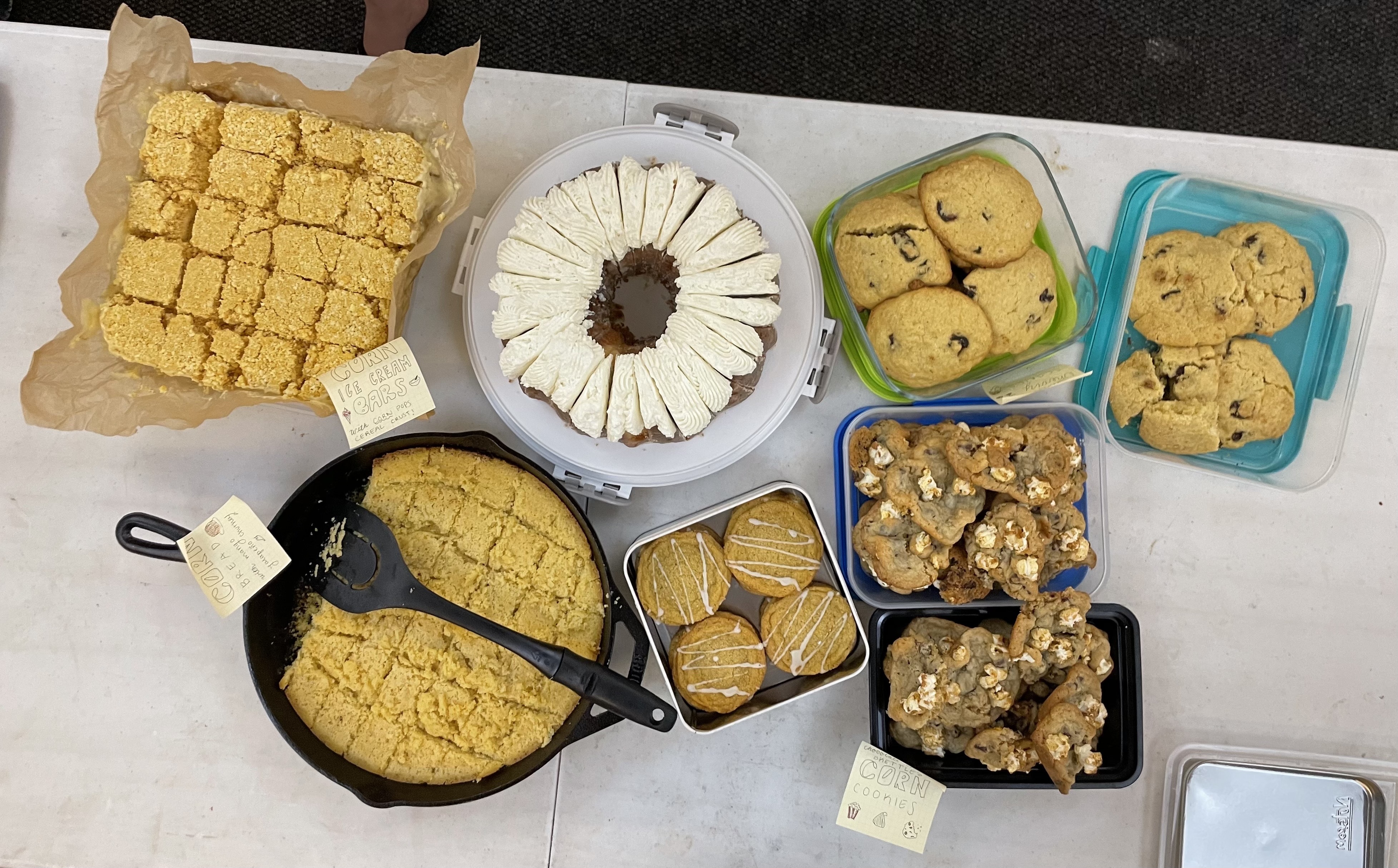
Dr Cécile Chazot is a materials scientist at Northwestern University’s McCormick School of Engineering. Her lab began naming its instruments two years ago. The lab bakes together when its their turn to bring baked goods for the department's coffee hour. Plus: Dr. Chazot is a self-professed foodie.
Here are is a photo of some of their baked goods.
The story 'An instrument named Cannoli' in Nature Methods is here. And here is a quasi openly-accessible version.
And I did a short video, which is here
After publication I received a few comments:
Dr Suh Hee Cook is a postdoctoral fellow in bioengineering at the University of Maryland who mentioned that during her PhD the PCR machine was named Peter. "Our hoods were named Luke and Leia," she says.
Dr Madeleine Scott is kindly letting this squeak by as a "minor error" but my descriptions of Plankton and Mr Krabs were switched. (Oh no, sorry about that!)
As a SpongeBob SquarePants fan, she points out that Mr. Krabs is the restaurant owner and Plankton is the (misunderstood villain) who regularly tries to steal Mr Krabs's secret formula.
What thickens the plot, however, is that that Krabs and Plankton actually were business partners when they were younger. And "after a fight Krabs essentially stole the recipe from Plankton and used it to establish his now-successful restaurant, whereas Plankton runs a failing restaurant," she says.
Who's SpongeBob SquarePants, you might ask?
And what does this series have to do with instrument names? Delissa McMillen at the Allen Institute for Brain Science applies names from the series and many more in her spatial transcriptomics lab. They all fit together.
You can read about the choices she and her colleagues made as well as the naming choices of others mentioned on this page and others still in the story in Nature Methods here. And here is a quasi openly-accessible version.
-
Some more comments have come in after Dr. Magdalena Skipper, editor in chief of Nature and chief editorial advisor of the Nature Portfolio, kindly posted about the piece on Bluesky.
Dr. Arnoud van Vliet, also known as Dutchscientist (the real one) @dutchscientist.bsky.social on Bluesky, is a molecular microbiologist and bioinformatician at the University of Surrey. He mentioned they have a set of bioinformatics computers that are named to make it easier to identify them.
Some names are "more closer to home," he says, such as Old Man -- a reference to his young age.
Then there is "the Middle Child," a name that stems from a time when the lab had three computers. It was also middle in terms of specs. Add to this: Dr. van Vliet is also a middle child in his family. Other computers are named to reflect what these computers can do: The Beast is one of those. Others are named for when they were added to the team: The Newbie.
Dr Ravindra Chaudari and I am not sure of afiliation, mentioned that during their PhD the DNA capillary sequencers were named after the bar staff in the Rovers Return pub in Coronation Street. "Raquel, Bet & I think Jack."
For those who might not know Coronation Street. Oh, I am not going to try to pick an episode. The Youtube channel is here.
More will be bought, I may do a naming competition 😉, says Arnoud van Vliet.
Dr. Paula Salgado, structural microbiologist at Newcastle University, mentioned that during her PhD, the computers were named after beverages. And in her current lab, the team also uses drinks for naming equipment.
"Our anaerobic chambers were fondly named Gassy and Wizzy due to the noises they made. April fools' joke or not, scientists name their equipment, it's a normal thing, no?," says Paula Salgado.
Instead of needing to say "the anaerobic chamber on the left," it's easier to say 'Gassy', she says.
Dr. Natalie Tatum, who is a researcher in the structural biology group Newcastle University's Cancer Research Horizons Newcastle Drug Discovery Unit, says "All of our size exclusion columns are named after Disney characters." The names help for booking them out and to identify issues with specific chromatography columns when they have multiples of a particular type.
It also helps to get songs stuck in your head, because who puts the glad in "gladiator"? Hercules, our Superdex 75 26/600 column designated protease-free 😂," says Natalie Tatum.
If I am not mistaken, a protease-free column is one that has been prepared to separate molecules, such as proteins or complex compounds of other types, exceptionally well. With columns, one uses them to separate protein mixtures and collect them as they elute form a column. Chromatography is rather an art in many ways, it seems to me.
Dr. Suzannah Harnor, a researcher in the Cancer Research Horizons Therapeutic Innovation at the Newcastle University Centre for Cancer, mentioned their Teledyne ISO chromatography systems are named after Newcastle United Football Club members. Alex, Bruno, Callum, Dan, Eddie and Fabian. The alphabetical order corresponds to the purchase date. And the names, she says, make it easier to distinguish systems in the lab and they are helpful for booking engineer visits, too.
P.S. Alex lives as Anthony in my head after 'that' drama. 🤣," says Suzannah Harnor.
With 'that' drama (reporter googles) she means that Alexander Isak, well-known striker who had scored 27 goals in 47 games, and after a period of speculation and rumors, made public that he wanted to leave Newcastle United. Well, it seems that he feels promises had been broken and he had lost trust in the organization. He now plays for Liverpool.
I won't stray too far into this but there is indeed drama, and thus also 'attached' to this chromatography system name, for sure. Then again, chromatography can itself be drama? Uh-oh better duck under my desk now.
Dr. Cathy Abbott who studies EF1A2/neurological disorders mentioned that when she first moved to Edinburgh, all the Unix computers were named after types of whisky.
Having to type bruichladdich every time I logged on really made me aware I was now in Scotland 😀, says Cathy Abbott.
And if you have more instrument names to share, please reach out or put them in the comments, am happy to add them. You can find me on LinkedIn and Bluesky: @vivienm.bsky.social