July 2026 Highlights from the Health & Clinical and Life Sciences Research Communities
Published in Healthcare & Nursing, Earth & Environment, and Cell & Molecular Biology

July has brought a broad selection of posts from across the Health & Clinical and Life Sciences Research Communities. This month's highlights explore the research behind World Population Day, evolutionary biology and metabolic disease research.
Here are some of the posts that stood out to me, showcasing the diverse research and real-world impact being shared across our communities.
World Population Day
World Population Day is observed on 11 July every year and raises awareness of the trends shaping our global population and the opportunities and challenges they bring.
To mark the occasion, we've brought together a selection of recent posts exploring topics including population health, ageing, fertility, migration and sustainable development.
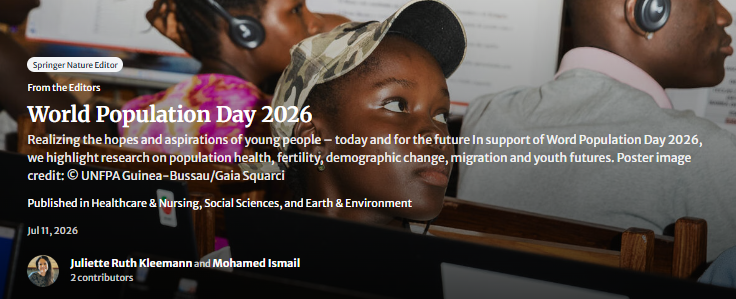
Exploring the future of population research
In recognition of World Population Day 2026, @Juliette Ruth Kleemann and @Mohamed Ismail have compiled research exploring the demographic trends shaping societies around the world. It is an excellent From the Editors highlight post which covers topics including population health, fertility, migration, sustainability and youth futures. It brings together a wide range of articles, books and journal collections, including a fascinating Behind the Paper interview exploring how mathematical modelling can help us better understand the challenges of population ageing and future healthcare needs.
Read the whole post to discover this is a carefully curated selection, spanning global health, social change and the future of population research.
Explore the Topics: Population and Demography, Public Health, Reproductive Medicine, Migration and Health, Environmental Health, General Practice and Family Medicine
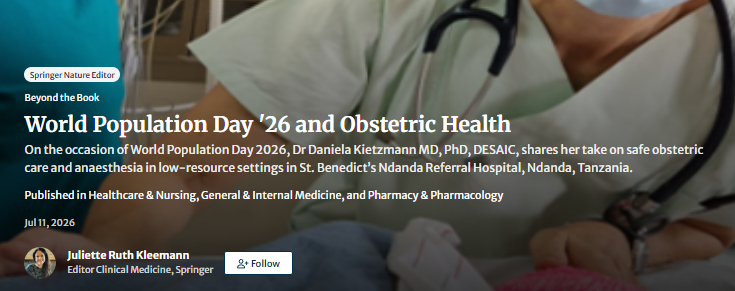
Strengthening maternal healthcare in low-resource settings
In this Beyond the Book interview for World Population Day 2026, Dr Daniela Kietzmann shares insights by @Juliette Ruth Kleemann from her experience delivering safe obstetric care and anaesthesia in low-resource settings in Tanzania. They discuss the vital role of non-physician anaesthesia providers, the challenges of maternal healthcare, and practical ways to improve patient safety.
Read the full post to learn of the importance of investing in sustainable healthcare systems and supporting the clinicians delivering life-saving care in resource-limited settings.
Explore the Topics: Public Health, Obstetrics, Anesthesiology, Health Care
Discover journals spotlight population research
@Angela Yang showcases recent research from the Discover journals on population trends and young people's futures in this From the Editors post. Spanning topics including sustainability, urban development, mental health, employment and wellbeing, the featured articles explore the opportunities and challenges shaping the lives of future generations and demonstrate how research is helping us better understand an ever-changing world.
Explore the full collection to discover the latest findings, alongside related topical collections for further reading.
Explore the Topics: Research Publishing
Alongside this month's World Population Day content, researchers have shared fascinating behind-the-scenes stories about their latest publications. Here are just two of the many recent posts that are well worth a read, covering evolutionary biology and metabolic disease research.
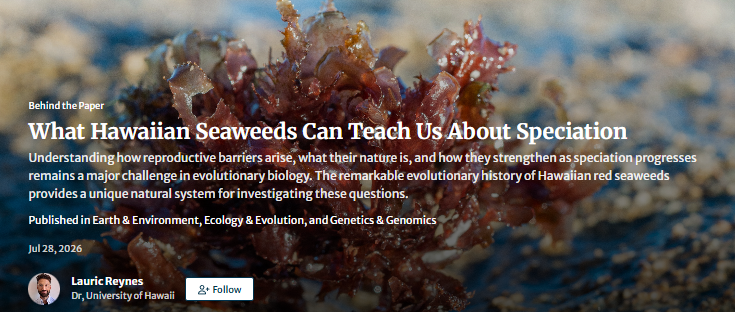
Evolution in Hawaiian seaweeds
How do new species form, and what can Hawaiian red seaweeds reveal about the process? In this Behind the Paper post, @Lauric Reynes explores how the unique evolutionary history of Hawaiian red seaweeds is helping researchers understand the development of reproductive barriers and the mechanisms behind speciation. Combining challenging fieldwork with cutting-edge genomic analysis, the post uncovers how ancient geological changes have shaped the evolution of these remarkable marine organisms.
Read the full post to discover how studying Hawaiian seaweeds is providing new insights into one of evolutionary biology's biggest questions.
Explore the Topics: Speciation, Population Genetics, Plant Science, Marine Biology, Evolutionary Biology, Evolutionary Genetics
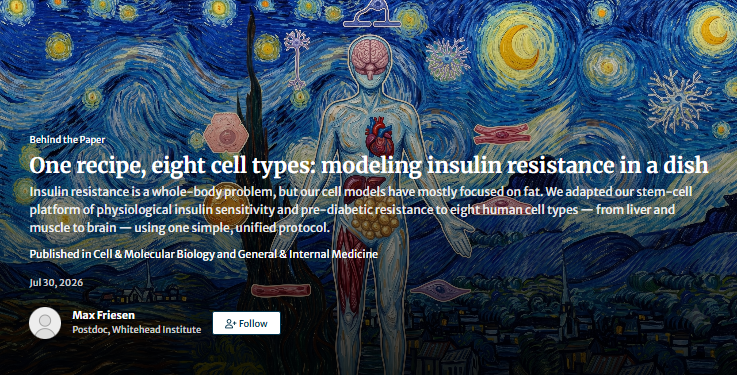
Rethinking insulin resistance
In this Behind the Paper post, @Max Friesenexplains how his team developed a simple stem-cell platform capable of modelling insulin sensitivity and pre-diabetic insulin resistance across eight different human cell types. The post explores the challenges of recreating complex metabolic diseases in the lab and the exciting potential for studying how different tissues interact to drive whole-body metabolism.
Read the full post and explore how this innovative approach could transform research into insulin resistance, type 2 diabetes, and future therapeutic development.
Explore the Topics: Induced pluripotent stem cells, Type 2 Diabetes, Stem-Cell Differentiation, Metabolic Disease, Insulin Signalling
We hope these posts have inspired you to explore the latest research and expert perspectives shared across the Research Communities. If one of these topics sparks your interest, we'd love to hear your thoughts in the comments, and don't forget to follow the Communities and Topics of interest to stay up to date with future content.
Explore more:

Helping researchers connect, collaborate, and communicate their work. Specialising in Medicine and Life Science and passionate about making science more visible and accessible.
Follow the Topic
-
Signal Transduction and Targeted Therapy
This is an international, peer-reviewed, open-access journal publishing articles related to signal transduction in physiological and pathological processes, alongside signal transduction-targeted therapeutics in the form of biological agents and small molecular drugs used to treat human diseases.
-
BMC Primary Care
Previously known as BMC Family Practice, this is an open access, peer-reviewed journal that considers articles on all aspects of primary health care research.
-
Discover Global Society
This is an interdisciplinary, international journal that welcomes research on the complexities of modern global society, its development and its challenges.
-
Discover Public Health
This is an open access journal publishing research from all fields relevant to public health.
-
Heredity
The official journal of the Genetics Society, covering a broad range of topics within the field of genetics.
-
Journal of Population Economics
This is a highly cited international quarterly that publishes original theoretical and applied research with significant policy relevance.






Related Collections
With Collections, you can get published faster and increase your visibility.
Ethics and regulation of AI in primary care
The integration of artificial intelligence (AI) into primary care is rapidly transforming healthcare delivery, enabling more personalized, efficient, and effective patient care. However, the ethical and regulatory challenges associated with the deployment of AI technologies in this context are multifaceted and require thorough examination. Issues such as patient privacy, data protection, informed consent, and the potential for algorithmic bias are at the forefront of discussions surrounding AI's role in healthcare. As AI systems increasingly influence clinical decision-making, understanding the ethical frameworks and regulatory requirements governing their use is essential for safeguarding patient rights and ensuring equitable access to healthcare services.
The significance of addressing the ethical and regulatory dimensions of AI in primary care lies in its potential to enhance patient trust and ensure that AI applications are developed and implemented responsibly. Recent advancements in AI have demonstrated its capabilities in improving diagnostic accuracy and streamlining administrative tasks; however, these benefits must be balanced with robust protections for patient data and ethical considerations regarding decision-making. Furthermore, the lack of comprehensive regulations can lead to inconsistencies in AI application and misuse, which could undermine public confidence in these technologies.
In this Collection, we welcome submissions that span a wide array of topics, including but not limited to:
- Ethical considerations in AI applications
- Data protection and patient privacy in AI
- Informed consent processes for AI use
- Regulatory frameworks for AI in primary care
All manuscripts submitted to this journal, including those submitted to collections and special issues, are assessed in line with our editorial policies and the journal’s peer review process. Reviewers and editors are required to declare competing interests and can be excluded from the peer review process if a competing interest exists.
Publishing Model: Open Access
Deadline: Jan 28, 2027
Identifying and responding to domestic violence and abuse in primary care
Domestic violence and abuse (DVA) remains a pervasive issue affecting individuals across various demographics, often leading to significant physical and mental health consequences. Primary care settings are uniquely positioned to identify and respond to instances of DVA, yet many healthcare providers feel ill-equipped to address this sensitive issue. This Collection aims to explore the role of primary care in recognizing the signs of domestic abuse and developing effective response strategies, enhancing the capacity of healthcare professionals to support affected individuals.
As this research area continues to evolve, we may see significant advancements in the implementation of standardized protocols for identifying and responding to domestic violence in primary care. Future studies could lead to the development of comprehensive training programs for healthcare providers, enhancing their confidence and competence in addressing this issue. Ongoing research could facilitate the creation of collaborative networks between primary care providers, social services, and community organizations, ultimately leading to more effective support for survivors of domestic violence. Additionally, integrating mental health support and community resources into primary care settings has shown promise in creating safer environments for patients, and fostering early detection and intervention.
In this Collection, we welcome submissions that span a wide array of topics, including but not limited to:
- Identification tools for domestic violence in primary care
- Training programs for healthcare providers on DVA
- Integrating primary care, social services, and mental health support
- Community and peer support resources for domestic abuse survivors attending primary care
This Collection supports and amplifies research related to SDG 3: Good Health and Well-being.
All manuscripts submitted to this journal, including those submitted to collections and special issues, are assessed in line with our editorial policies and the journal’s peer review process. Reviewers and editors are required to declare competing interests and can be excluded from the peer review process if a competing interest exists.
Publishing Model: Open Access
Deadline: Nov 11, 2026