One recipe, eight cell types: modeling insulin resistance in a dish
Published in Cell & Molecular Biology and General & Internal Medicine
Why we cared
Insulin resistance — when cells stop responding properly to insulin — is one of the earliest warning signs on the road to type 2 diabetes, a disease that affects hundreds of millions of people. What makes it such a hard problem is also what makes it fascinating: it doesn't happen in just one place. Insulin acts on nearly every tissue in the body, and when that signalling breaks down, the consequences ripple through the liver, muscle, brain, blood vessels, and beyond.
A few years ago, we built a human cell model of this process in fat cells (Science Advances, 2022). I'll admit I have a soft spot for adipocytes — but I know not everyone shares my enthusiasm, and fat is only one part of the story. Our collaborators kept asking the same reasonable question: What about liver? What about muscle? If insulin resistance touches every organ, why study it in only one?
That question is really the origin of this paper. Rather than build a bespoke model for each tissue, we wanted to know whether a single, simple approach could capture physiological insulin sensitivity and pre-diabetic insulin resistance across many different human cell types at once.
What we did
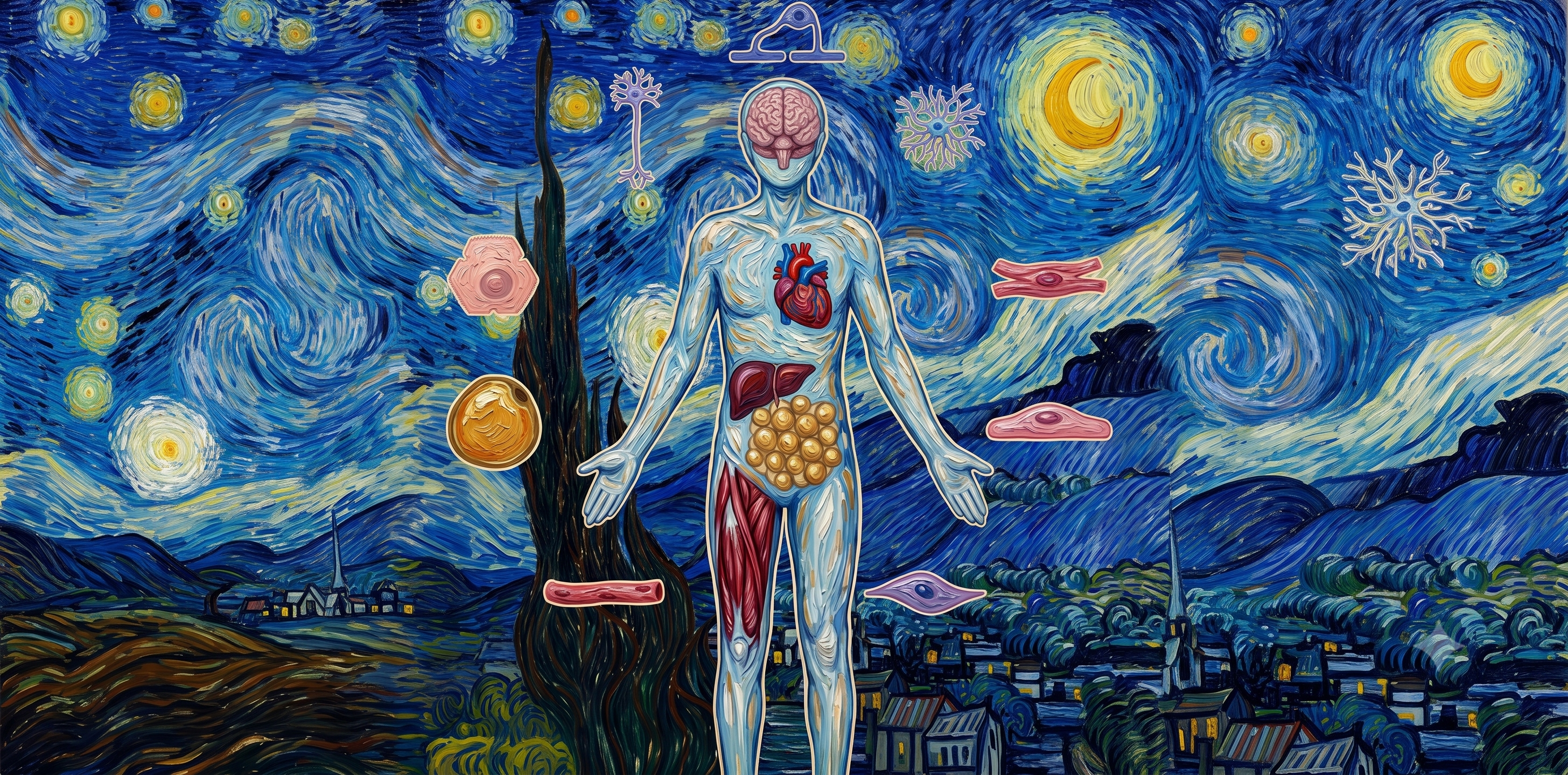
We start from human pluripotent stem cells — cells that can be coaxed into becoming almost any cell type in the body. Using well-established, deliberately simple differentiation recipes, I generated eight different cell types: hepatocytes and skeletal muscle from the metabolic organs; cardiomyocytes, endothelium and smooth muscle from the cardiovascular system; and neurons, astrocytes and oligodendrocytes from the brain.
The key ingredient was the medium. We switched to Human Plasma-Like Medium (HPLM), which mimics the nutrient makeup of real human blood far better than standard lab media. From there the protocol itself was almost embarrassingly simple: five days in a low dose of insulin nudges cells into a healthy, insulin-sensitive state, while five days in a diabetic-level dose pushes them toward the blunted, insulin-resistant state that resembles early metabolic disease.
The honest surprise was how well it worked. I fully expected to spend months tuning conditions for each cell type — instead, nearly every one adapted to HPLM with almost no fuss. Skeletal muscle was the stubborn exception: we had to shorten its treatment window, but the cells still ended up sensitive. And where good functional readouts existed — glucose production in hepatocytes, glucose uptake in muscle — the cells behaved exactly as they should, responsive when sensitized and a blunted response when resistant. Throughout, the cells kept their identities. A neuron stayed a neuron with our protocol.
The part that doesn't show up in the figure
I did all of these differentiations myself, usually juggling three or four cell types at the same time. Because I'd chosen the simplest published protocols, the work went smoothly — but "smoothly" still meant a long haul, especially the brain cell types, which take their sweet time to mature. And behind the tidy result sits a genuinely absurd number of 24-well plates: replicates for every condition, every cell type, across two independent stem cell lines. All of that is quietly compressed into a single figure with four panels. I find that both deeply satisfying and a little funny — months of cell culture distilled into a handful of neat graphs.
Where this goes next
For me, the exciting part is what it opens up. Because every cell type runs on the same base medium, they can, in principle, be grown together. That's the real prize: multi-tissue coculture systems in which liver, muscle, fat and others talk to one another the way they do in the body, letting us study the cross-organ conversations that govern whole-body metabolism. And because the protocol is so simple, it should extend readily to whatever cell type someone wants to add next.
Insulin resistance is a whole-body problem. It seems only right that the tools to study it should be, too.

Follow the Topic
-
Signal Transduction and Targeted Therapy
This is an international, peer-reviewed, open-access journal publishing articles related to signal transduction in physiological and pathological processes, alongside signal transduction-targeted therapeutics in the form of biological agents and small molecular drugs used to treat human diseases.