
For decades, ice cores have been treated as sealed time capsules: snow buries snow, faithfully recording atmospheric temperature, gases, and dust until a drill brings it back to the surface. Grains of dust falling into the ice were assumed to be fossil messengers, untouched by the cold piling up above them. Over the last few years, this picture has cracked a little. In deep ice, particles that should have travelled alone turned up clumped into aggregates; iron-bearing minerals carried magnetic signatures far too strong for ordinary windblown dust; and finally, authigenic jarosite (a ferric-potassium hydroxide sulfate very common on Mars but rare on Earth) was found forming inside the ice itself.
The reason: as ice recrystallizes under pressure, it expels dissolved salts into micron-scale liquid veins and pockets, creating acidic brines that stay liquid at temperatures well below the bulk freezing point. Dust grains sitting in these brines are not passive bystanders: they dissolve a little, exchange ions, and new minerals can grow on their own surfaces, long after their atmospheric transport from the Southern Continents to Antarctica.
For a field built on the idea of a pristine archive, this was definitely an uncomfortable finding. Yet, as it sometimes happens, it arrived at precisely the moment another field needed it.
In 2009, well before the discovery of authigenic jarosite in Antarctic ice, Niles and Michalski - approaching the problem from planetary science rather than glaciology - proposed a theoretical model of cryogenic weathering inside buried ice-rich deposits to account for the laminated jarosite deposits at Meridiani Planum. But for a while, the model rested on theory alone. Antarctica suddenly offered something rarer than a hypothesis: a working, present-day analogue.
If jarosite could crystallise authigenically inside terrestrial ice, isolated from the atmosphere and permanently below freezing, then a planet whose ice has spent billions of years in much the same state could plausibly be doing the same thing, at a far grander scale. Based on the suspect that the analogy would not stop with a single mineral, we went looking for evidence in the Roosevelt Island (RICE) ice core, a coastal Antarctic archive from Roosevelt Island characterized by warmer and wetter conditions than the interior sites where jarosite had previously turned up.
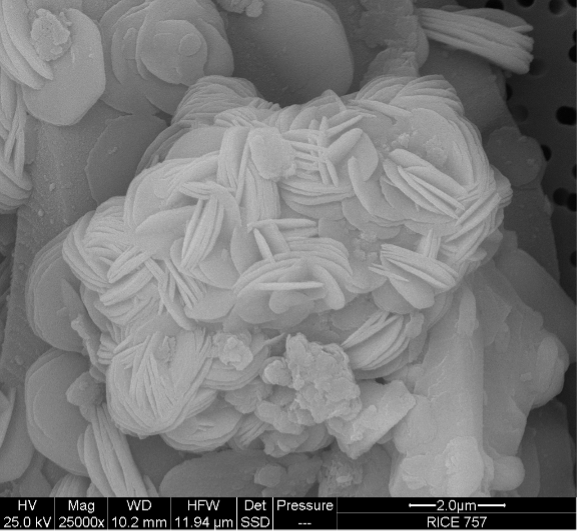
Again, below roughly 700 metres, in ice dating to the last glacial maximum and before, particles that had travelled cleanly through the atmosphere — feldspars, plagioclase, sharp-edged volcanic shards — were no longer alone: many were coated or crowned with crystals grown in place, not only tabular jarosite, as expected, but also goethite, hematite, and their metastable cousins lepidocrocite and maghemite — sometimes coexisting on the same grain, sometimes replacing one another.
That coexistence was the real message. Rather than one uniform weathering pathway, we were looking at a mosaic of micro-environments, where chemical conditions fluctuate over the scale of micrometres: jarosite where brines stayed strongly acidic and sulfate-rich; goethite where conditions eased toward more water and less acidity; hematite and maghemite where oxidation ran furthest, marking a later stage in the chemical evolution of the brine.
The implication for Mars follows naturally.
Windblown Martian dust is red, magnetically active, and chemically oxidised — usually explained by invoking a long-vanished era of surface water. Our results, consistent with the same dust-weathering model that produces jarosite, suggest a cheaper alternative: if Martian dust has cycled in and out of ice deposits over billions of years, as orbital forcing predicts, the same cryogenic authigenesis we watched happen in Roosevelt Island ice could account for the colour, the magnetism, and the oxidation of Mars’ global dust veil — no prolonged warm, wet climate required, just a great deal of cold ice, a great deal of time, and chemistry that doesn’t stop simply because the thermometer says it should.
This work is a reminder of why ice core science matters beyond its own field. Antarctica’s deepest, coldest, most forgotten ice turns out to be a live laboratory for exactly the reactions we cannot yet observe directly on another planet. Sometimes the best window onto Mars is buried, quite literally, under our own feet. And sometimes, it is a strange kind of comfort to learn that your paleoclimate archive lies to you a little.
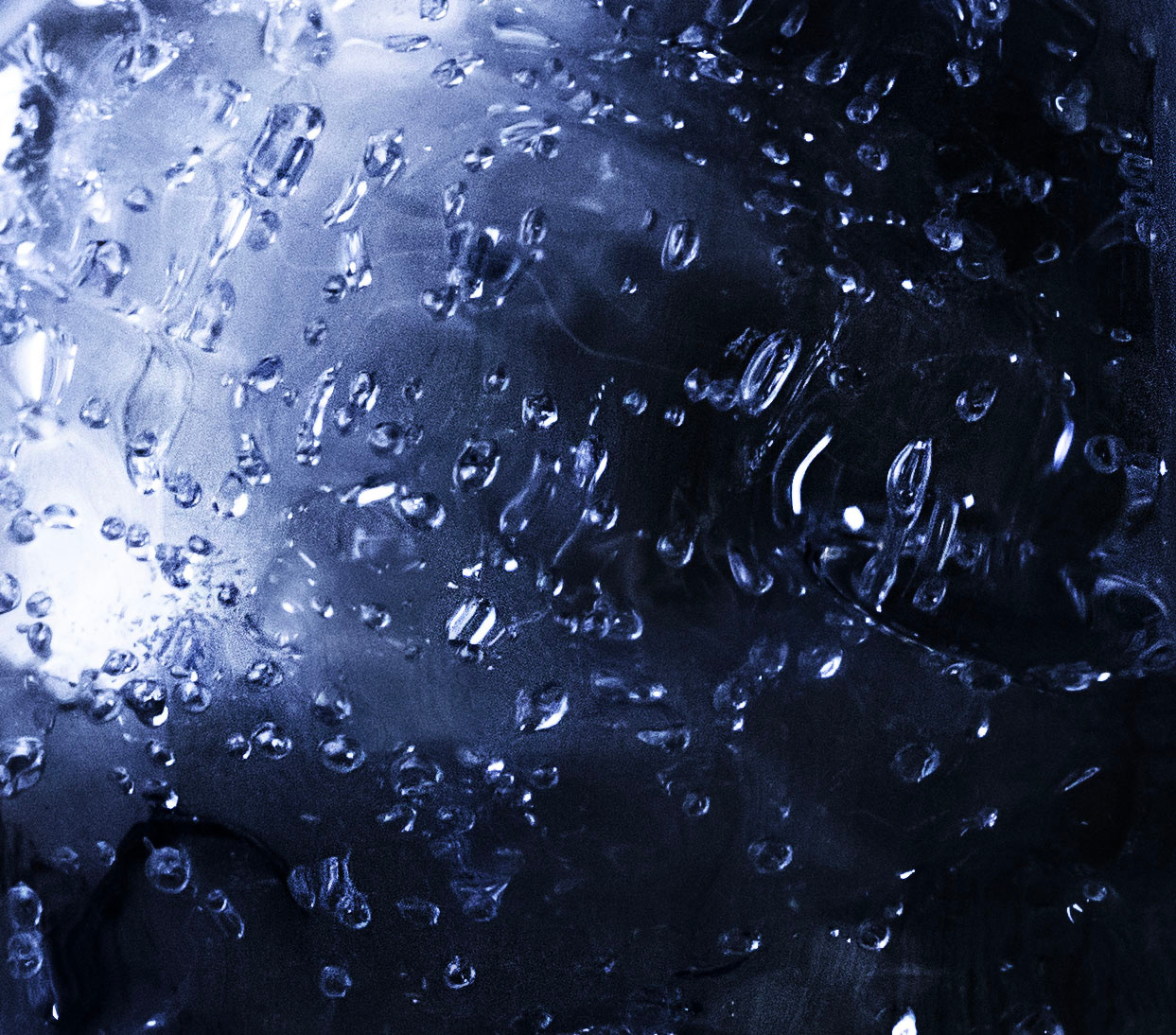
Header image: Valeria Arrigo

Follow the Topic
-
Communications Earth & Environment
An open access journal from Nature Portfolio that publishes high-quality research, reviews and commentary in the Earth, environmental and planetary sciences.

Related Collections
With Collections, you can get published faster and increase your visibility.
High-resolution modeling for Earth system
Publishing Model: Open Access
Deadline: Feb 07, 2027
Soil microbiomes and carbon sequestration under global change
Publishing Model: Hybrid
Deadline: Mar 18, 2027