Looking beyond ABL1 variants in later-line CML therapy
Published in General & Internal Medicine



Clinical questions
Despite improved outcomes with tyrosine kinase inhibitors (TKIs), resistance remains a major challenge in chronic myeloid leukemia (CML). Third-generation (3G-) TKIs, including olverembatinib and ponatinib, are effective after imatinib and/or second-generation TKI failure, including in patients with ABL1T315I variant, but nearly half remain resistant, with heterogeneous responses and outcomes. This heterogeneity motivated our study. The molecular features underlying this heterogeneity remain incompletely defined. We therefore integrated genomic and transcriptomic analyses to identify features beyond ABL1 variants associated with responses and outcomes of 3G-TKI therapy.
Patients and methods
We retrospectively analyzed 202 adults with chronic-phase (n = 125) or accelerated-phase (n = 77) CML receiving olverembatinib or ponatinib after failure of imatinib and/or second-generation TKIs. Median follow-up was 58 months. Baseline samples underwent targeted DNA sequencing of 475 hematologic malignancy-related genes in all patients and RNA sequencing in 149. Paired baseline and follow-up samples were available for genomic analyses in 111 patients and transcriptomic analyses in 130, allowing assessment of molecular features associated with responses and outcomes and their dynamic changes during therapy.
Genomic features associated with responses and outcomes
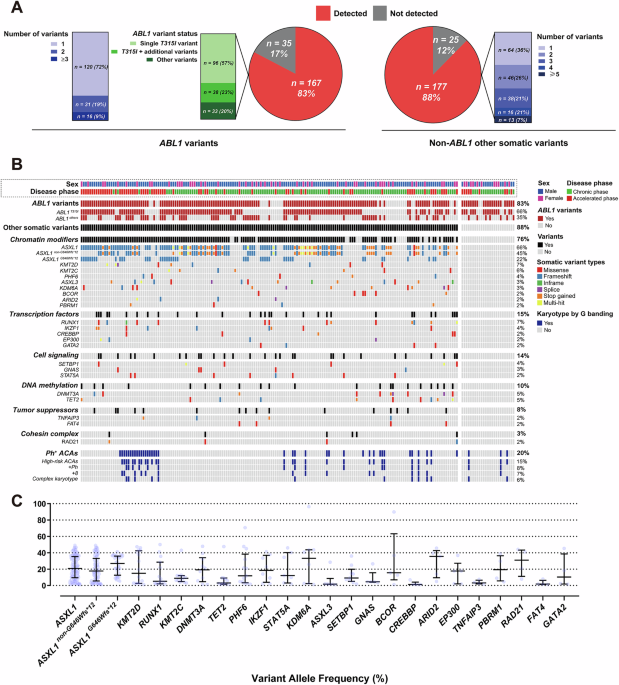
Beyond ABL1, variants in genes involved in chromatin regulation and transcription were associated with responses and outcomes of 3G-TKI therapy. High-burden ASXL1 p.G646Wfs*12 (VAF ≥30%) emerged as the most consistent adverse genomic feature in penalized multivariable analyses. Additional associations involved RUNX1, PHF6 and GATA2 variants with inferior progression-free survival, and SETBP1 variants with poorer survival. These findings suggest that broader genomic profiling may inform risk assessment in heavily treated CML. However, associations involving uncommon variants and the internally derived ASXL1 VAF threshold require independent validation; bulk sequencing also limits assignment of variants to leukemic or non-leukemic clones.
Clonal evolution during treatment
Serial genomic profiling of 111 patients revealed distinct dynamic patterns associated with responses and outcomes. ABL1 variants decreased in both responders and patients with primary resistance, whereas non-ABL1 variants declined in responders but increased in those with primary resistance. Persistent or emerging/expanding variants frequently involved ASXL1 p.G646Wfs*12, RUNX1 and PHF6. Among 12 patients with secondary resistance, response loss was accompanied by increased non-ABL1 variant burden, including newly detected ASXL1, RUNX1, SETBP1 and TP53 variants. These findings suggest that suppression of ABL1-variant clones may be insufficient for disease control and implicate broader clonal evolution in later-line resistance.
Three transcriptional states associated with prognosis
Baseline RNA profiling identified a 40-gene signature defining three transcriptional clusters with distinct responses and outcomes. Gene-expression profile based cluster 1 (GEPC1), associated with favorable prognosis, showed higher immune activity and lower leukemia stemness signatures. GEPC2 exhibited predominantly extracellular matrix and niche-associated programs with intermediate prognosis. GEPC3, associated with unfavorable prognosis, showed stronger stemness and proliferation signatures with suppressed immune-related activity.
Longitudinal profiling revealed distinct changes during therapy. GEPC1 showed reduced stemness signatures, increased apoptosis-related activity and selective immune activation during treatment. GEPC2 retained stable overall stemness scores but showed reduced cell-cycle activity and matrix remodeling, with modest immune activation. GEPC3 retained relatively high stemness signatures and persistent immune suppression, with limited apoptosis-related and immune activation despite some decline in stemness-associated activity. These trajectories suggest that baseline transcriptional states are associated with differing molecular responses to 3G-TKI therapy.
Implications and next steps
Together, these findings support investigating molecular risk assessment beyond ABL1 variant testing. They identify candidate prognostic features and suggest biological processes for further study, rather than establish biomarkers ready for routine treatment selection.
Important limitations include the retrospective single-center design, inclusion of mixed-cell sequencing, and small subsets carrying uncommon variants. Independent cohorts are needed to assess reproducibility and generalizability. Studies with greater cellular resolution and functional experiments should clarify the origins and biological relevance of the observed signals.
Our next challenge is to determine whether integrating clinical, genomic and transcriptomic information can improve prospective risk assessment. If independently validated, this framework could inform future studies of monitoring and therapeutic strategies for patients with heavily treated CML.
Follow the Topic
-
Leukemia
This journal publishes high quality, peer reviewed research that covers all aspects of the research and treatment of leukemia and allied diseases. Topics of interest include oncogenes, growth factors, stem cells, leukemia genomics, cell cycle, signal transduction and molecular targets for therapy.