Measles Is Returning Where Vaccination Slowed
Published in Bioengineering & Biotechnology



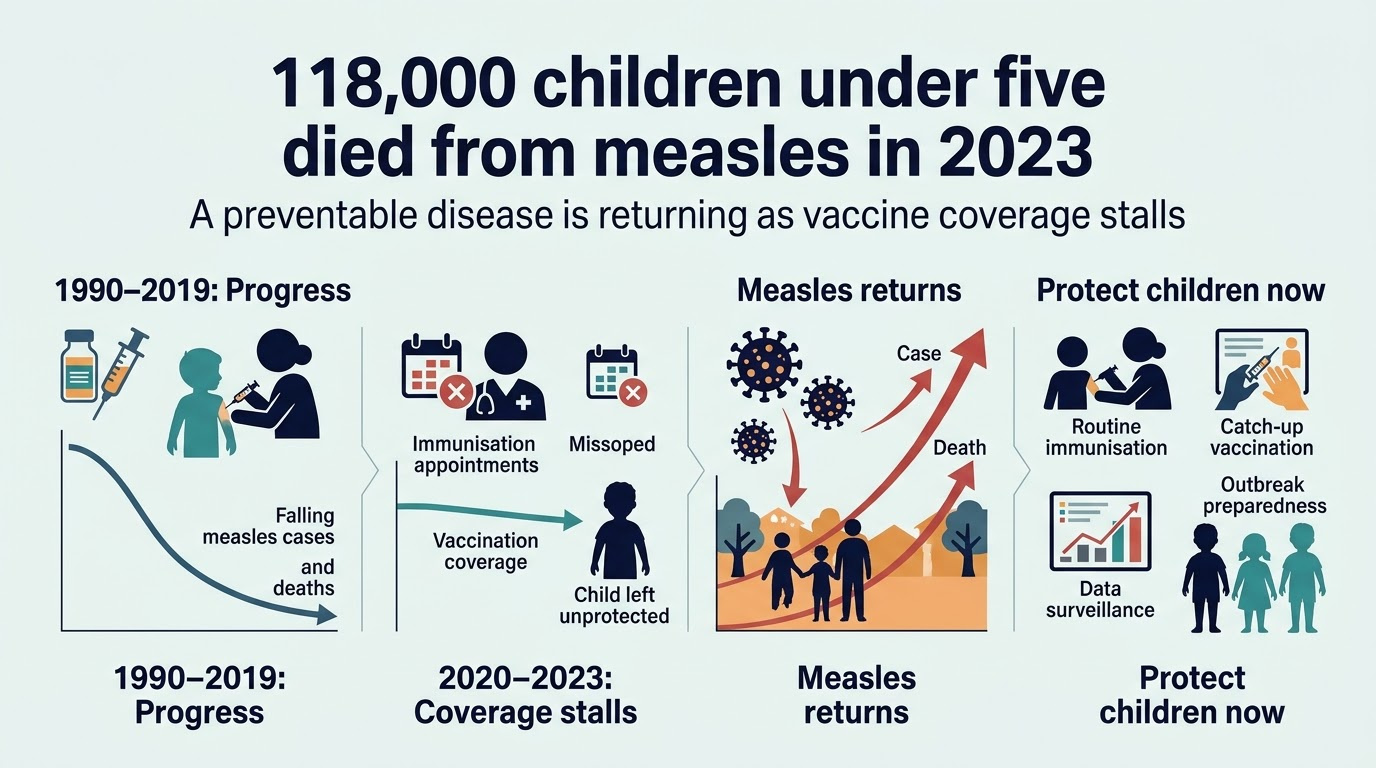
In 2023, an estimated 118,000 children under five died from measles. The number is not a historical statistic. It is a warning that one of the world’s most contagious diseases is returning in places where vaccination coverage has slowed.
A new study published in Nature Medicine examined the global and regional burden of measles among children under five between 1990 and 2023. The researchers found that measles incidence and mortality declined dramatically between 1990 and 2019, but rose again after 2020.
The study was conducted by the GBD 2023 Measles Collaborators, an international network of researchers and public-health institutions. It was supported by the Institute for Health Metrics and Evaluation at the University of Washington and funded by the Bill & Melinda Gates Foundation and Gavi, the Vaccine Alliance.
A preventable disease that came back
Measles is not a mild childhood illness. It can cause pneumonia, encephalitis, severe diarrhoea and death, particularly in young children and in communities with limited access to medical care.
The study found that the disease had declined dramatically between 1990 and 2019. During that period, measles incidence among children under five fell by about 80%, and deaths fell by about 90%.
But the progress was not permanent.
In 2023, the researchers estimated 15.6 million measles cases and 118,000 deaths among children under five. Compared with 2019, this was a 40% increase in cases and a 12% increase in deaths.
The numbers are not simply a statistical rebound. They suggest that immunity gaps have been accumulating. When enough children are unvaccinated or incompletely vaccinated, measles can spread rapidly through communities.
The uneven geography of risk
The burden is not distributed equally.
Sub-Saharan Africa and South Asia continue to bear the greatest share of measles cases, deaths and disability-adjusted life years, or DALYs. These are not only regions with large populations. They are also places where access to routine immunisation, health services and outbreak response can be uneven.
Conflict, displacement, poverty, weak surveillance and disrupted health services can all make it harder to vaccinate children on time. When outbreaks occur, the same children who were already vulnerable may face the greatest risk.
This is why measles is not merely a question of vaccine supply. It is also a question of whether health systems can reach children consistently, before an outbreak begins.
Coverage stopped improving
The researchers examined coverage with the first and second doses of measles-containing vaccine, known as MCV1 and MCV2.
MCV1 coverage rose from 67.2% in 1990 to 83.6% in 2019.
But by 2023, it had fallen slightly to 81.0%. This may sound like a small change, but in a highly contagious disease such as measles, even small gaps in coverage can matter.
MCV2 coverage increased more substantially over time, rising from 14.4% in 1990 to 71.4% in 2023. Yet this still means that many children are not receiving the second dose that provides stronger and longer-lasting protection.
The World Health Organization’s Immunization Agenda 2030 aims for 90% coverage. Several regions remain far from that goal.
Why the second dose matters
The first dose of measles vaccine provides important protection, but it does not protect every child equally. Some children do not develop a strong immune response after one dose. Others miss vaccination altogether.
The second dose helps close these gaps. It improves protection at the individual level and strengthens community immunity, making it harder for measles to spread.
But the study’s message is not that MCV2 alone can solve the problem. If children do not receive the first dose, they remain vulnerable during early childhood, when measles can be most dangerous.
Immunisation programmes therefore need to do more than increase the total number of doses given. They need to identify children who have never been vaccinated, follow up those who missed doses and maintain reliable routine services.
What the study cannot tell us
The study provides a powerful global picture, but it does not explain every outbreak.
Measles transmission depends on more than vaccine coverage. Population density, travel, conflict, displacement, health-system disruption, surveillance quality and access to care all influence how the disease spreads.
The estimates are also modelled from available data. They are useful for comparing countries and tracking long-term trends, but they should not be read as exact counts for every community or every year.
The value of the study lies in its scale. It shows where progress has stalled and where children may be most at risk.
What needs to change
The findings point to a clear public-health challenge.
Countries need to rebuild routine immunisation services. They need to reach children who missed vaccination during periods of disruption. They need to strengthen surveillance so outbreaks are detected early. And they need to invest in health systems before crises occur, rather than responding only when cases begin to rise.
The most important lesson may be the simplest one: measles does not disappear on its own. It returns when immunity gaps grow.
What remains uncertain
Several questions remain.
How quickly can countries restore pre-pandemic immunisation levels? Which communities have the largest immunity gaps? How can programmes reach children in conflict-affected or underserved areas? And what mix of routine vaccination, catch-up campaigns and outbreak response will work best in different settings?
Answering these questions will require local data, sustained investment and closer collaboration between health systems, communities and international partners.
Conclusion
The study does not simply report an increase in measles cases. It shows what happens when progress against a preventable disease slows.
Between 1990 and 2019, measles vaccination helped reduce cases and deaths among young children. After 2020, that progress reversed. Cases rose, deaths rose, and vaccine coverage stalled.
The message is clear: measles remains preventable, but prevention depends on reaching children consistently. When coverage weakens, the disease returns.
Reference
GBD 2023 Measles Collaborators. Global and regional burden of measles and vaccine coverage among children under 5 years, 1990–2023: a Global Burden of Disease Study. Nature Medicine. 2026. doi: 10.1038/s41591-026-04661-7.
Follow the Topic
-
Nature Medicine
This journal encompasses original research ranging from new concepts in human biology and disease pathogenesis to new therapeutic modalities and drug development, to all phases of clinical work, as well as innovative technologies aimed at improving human health.