Mechano-Electrochemical Synergy in Cellulose@MOF Scaffold-Based Asymmetric Electrolyte for Stable Solid-State Lithium Metal Batteries
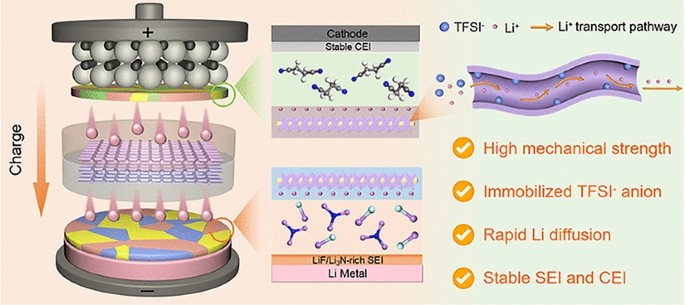
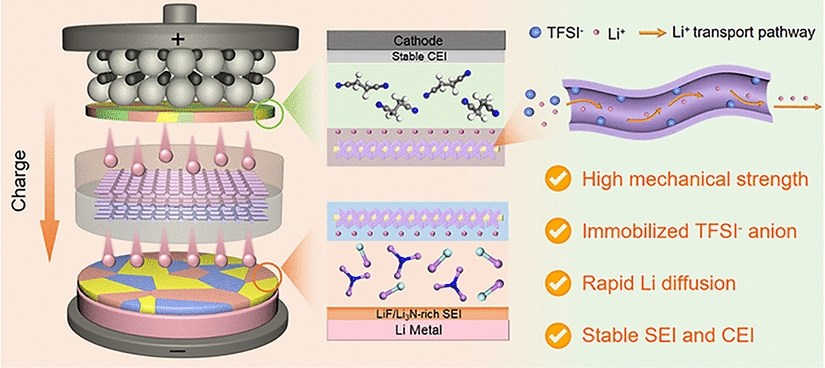

As the demand for high-energy-density and safer energy storage technologies continues to grow, solid-state lithium metal batteries (SSLMBs) have emerged as one of the most promising candidates for next-generation batteries. However, the practical deployment of SSLMBs is still hindered by challenges such as poor mechanical strength of electrolytes, unstable electrode–electrolyte interfaces, and lithium dendrite growth. Recently, researchers from Northwestern Polytechnical University and Beijing Forestry University, led by Professor Ying Huang and Professor Zheng Zhang, reported a novel asymmetric composite solid-state electrolyte design that enables stable and high-performance solid-state lithium metal batteries.
Why Advanced Solid-State Electrolytes Matter
- Enhanced Safety: Solid-state electrolytes replace flammable liquid electrolytes, greatly improving battery safety while enabling the use of lithium metal anodes with extremely high theoretical capacity.
- Higher Energy Density: Lithium metal anodes offer a theoretical specific capacity of 3860 mAh g-1, which can significantly increase the energy density of next-generation batteries.
- Interface Stability: A well-designed solid electrolyte can simultaneously stabilize both the lithium metal anode interface and the high-voltage cathode interface, enabling long-term cycling stability.
Innovative Design and Structural Features
- Cellulose@MOF Scaffold: The researchers constructed a three-dimensional cellulose framework decorated with self-assembled metal–organic framework (MOF) nanosheets, forming a CP@MOF network that enhances both mechanical strength and ion transport.
- High Mechanical Strength: The electrolyte achieves a Young’s modulus of about 1.19 GPa, providing a strong mechanical barrier that effectively suppresses lithium dendrite penetration.
- Efficient Ion Transport: The MOF nanosheets anchor TFSI- anions and create fast Li+ transport pathways within the cellulose network, improving ionic conductivity and Li+ transference number.
- Asymmetric Electrolyte Architecture: An asymmetric composite solid-state electrolyte (ACSE) design is adopted to independently optimize the interfaces for both the lithium metal anode and high-voltage cathode.
Applications and Future Outlook
- Long-Term Cycling Stability: Lithium symmetric cells equipped with the designed electrolyte exhibit stable lithium plating and stripping for more than 5000 hours, indicating excellent dendrite suppression capability.
- High-Performance Full Cells: NCM811|Li full cells demonstrate stable cycling with 84.9% capacity retention after 350 cycles, confirming the effectiveness of the asymmetric electrolyte design.
- Practical Pouch Cell Demonstration: The assembled pouch cell delivers a high energy density of 337.9 Wh kg-1 and 711.7 Wh L-1, showing strong potential for real-world applications.
- Robust Mechanical Stability: Even under bending, cutting, or piercing conditions, the pouch cell remains operational, demonstrating excellent structural robustness and safety.
This work demonstrates a mechano-electrochemical synergistic strategy for designing advanced solid-state electrolytes. By integrating a cellulose-MOF scaffold with asymmetric electrolyte architecture, the study provides a promising pathway toward high-energy-density and safe solid-state lithium metal batteries, bringing next-generation energy storage technologies closer to practical implementation.

Editor of Nano-Micro Letters, which is an Open-Access, peer-reviewed journal reported papers that have at least one dimension ranging from a few sub-nanometers to a few hundreds of micrometers. The journal is published by Springer Nature and indexed by SCI, EI, SCOPUS, Pubmed, etc. The 2024 JCR Impact Factor is 36.3. The 2024 CiteScore is 53.1.
Follow the Topic
-
Nano-Micro Letters

Nano-Micro Letters is a peer-reviewed, international, interdisciplinary and open-access journal that focus on science, experiments, engineering, technologies and applications of nano- or microscale structure and system in physics, chemistry, biology, material science, and pharmacy.
Please sign in or register for FREE
If you are a registered user on Research Communities by Springer Nature, please sign in