Memory-induced nonlinear dynamics in a fractional human–mosquito malaria model with data-driven insights
Published in Microbiology and Mathematics
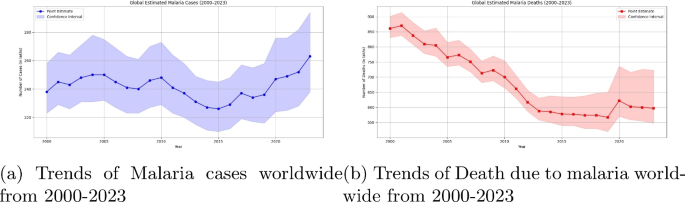

Our paper investigates the influence of non-local memory effects on malaria transmission dynamics using a fractional-order human mosquito model in the Atangana–Baleanu–Caputo (ABC) sense. By incorporating a non-singular kernel, we capture the hereditary characteristics of epidemiological processes, with the fractional order serving as a control parameter. Our analytical results confirm positivity, boundedness, and unique solutions, while stability conditions for disease-free and endemic equilibria are derived. Notably, memory effects significantly alter transient behavior, delaying epidemic peaks and reducing infection intensity. These findings offer new insights into memory-driven processes in epidemiological modeling. Read the full paper here.