Metal‑in‑Zeolite Catalysts Poised to Power Clean‑Energy Breakthroughs

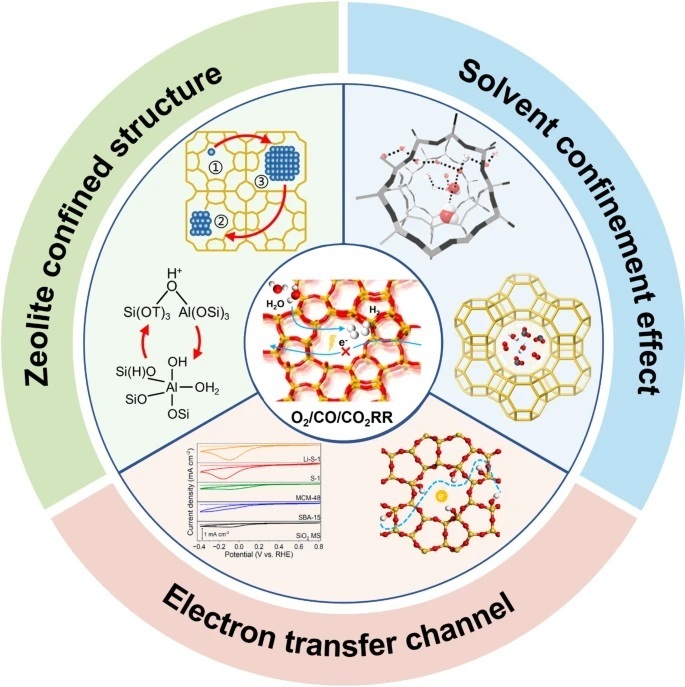


In this review, we present recent advances in metal‑in‑zeolite (MZ) catalysts, a class of materials that leverage the unique confinement effects of zeolite frameworks to stabilize active metal species, regulate reaction pathways, and enable electrocatalytic transformations under mild conditions. By integrating progress in synthesis, structural characterization, and mechanistic understanding, we highlight how MZ catalysts can significantly enhance reactions such as CO₂ reduction, oxygen reduction, and CO conversion, and how these systems are poised to contribute to next‑generation clean‑energy technologies.
Key Insights
- Confinement‑driven stability and selectivity
Zeolite micropores afford atomic‑level control over metal dispersion, oxidation state, and electronic structure, improving activity and product selectivity relative to conventional carbon supports.
- Multiple incorporation pathways: framework
Substituted, ion‑exchanged, and metal‑encapsulated configurations allow tailoring of catalytic centers for targeted electrocatalytic reactions.
- Mechanistic clarity via advanced characterization
In‑situ XAS, Raman, STEM, and solid‑state NMR reveal metal‑site evolution and key intermediates with atomic‑level sensitivity.
- Demonstrated performance
Representative systems include InSn@SnY for CO2‑to‑formic‑acid (98.2% FE) and Co@S‑1 for selective two‑electron ORR to H2O2 (96% FE).
Significance
Our assessment indicates that MZ catalysts provide a robust platform for energy‑efficient, selective, and scalable electrocatalytic processes. Tunable microporous environments and strong metal–framework interactions enable precise control of active sites and reaction environments, supporting future carbon‑neutral chemical transformations and renewable‑energy conversion systems.
Authors & Affiliations
Xiaoyang Han — College of Materials Science and Engineering, Zhengzhou University
Wenfu Yan — College of Chemistry, Jilin University
Jihong Yu — College of Chemistry, Jilin University; International Center of Future Science, Jilin University (now at Beijing Normal University)
Corresponding Authors
Qiang Zhang
Email: qiangz@jlu.edu.cn
Affiliation: College of Chemistry & International Center of Future Science, Jilin
Jia‑Nan Zhang
Email: zjn@zzu.edu.cn
Affiliation: College of Materials Science and Engineering, Zhengzhou
How to Cite This Article
Han, X., Zhang, Q., Yan, W., Zhang, J‑N., & Yu, J. (2026). Challenges and perspectives of metal‑in‑zeolite catalysts for electrocatalysis. Catal, 2, 8. https://doi.org/10.1007/s44422‑026‑00016‑y
Follow the Topic
-
Catal

Catal is an open access journal covering full spectrum of catalysis critical advances. From biocatalysts to heterogeneous catalysts, it integrates fundamental and applied sciences. Catal offers a primary platform for researchers and practitioners in the field.



Please sign in or register for FREE
If you are a registered user on Research Communities by Springer Nature, please sign in