Minimally Invasive Fixation of Intraarticular Calcaneal Fractures: Cannulated Screws vs. K-Wires
Published in Surgery
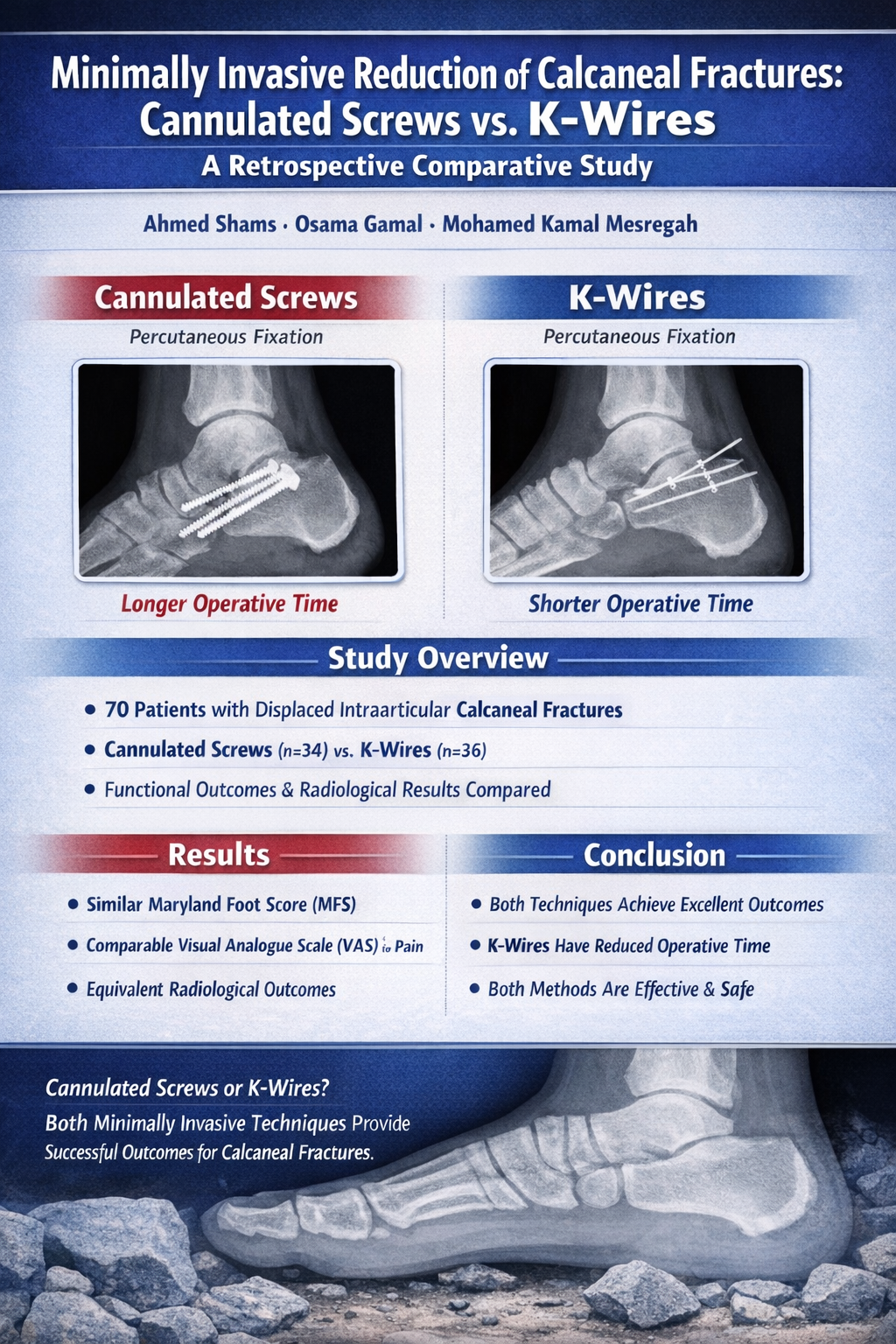

The management of displaced intraarticular calcaneal fractures continues to evolve, with minimally invasive techniques gaining popularity due to reduced soft tissue complications. However, the optimal fixation method remains debated.
In our study published in Foot & Ankle Specialist, we compared two commonly used minimally invasive fixation techniques: cannulated screws and Kirschner wires (K-wires).
🔎 Study Overview
- 70 patients with displaced intraarticular calcaneal fractures
- Cannulated screws (n = 34) vs. K-wires (n = 36)
- Retrospective comparative design
- Outcomes assessed using:
- Maryland Foot Score (MFS)
- Visual Analog Scale (VAS) for pain
- Radiological parameters
- Complications
📊 Key Findings
• Operative time was significantly shorter with K-wires
– K-wires: 40.5 ± 5.6 min
– Cannulated screws: 49.5 ± 4.5 min
• Functional outcomes (MFS) were comparable between both groups
• Pain scores (VAS) showed no significant difference
• Radiological outcomes (Böhler’s angle, Gissane angle, calcaneal dimensions) were equivalent
• Complication rates were similar
💡 Clinical Takeaway
Both minimally invasive techniques—cannulated screws and K-wires—achieve excellent and comparable functional and radiological outcomes, with high patient satisfaction.
The main differentiating factor was operative time, favoring K-wires, which may be particularly relevant in high-volume settings or resource-limited environments.
⚖️ Practical Implications
This study supports a flexible, surgeon-tailored approach, where:
- K-wires offer efficiency and simplicity
- Cannulated screws provide stable fixation with familiar instrumentation
Ultimately, both are valid and effective options in the minimally invasive management of these challenging fractures.
📄 Minimally Invasive Reduction of Intraarticular Calcaneal Fractures With Percutaneous Fixation Using Cannulated Screws Versus Kirschner Wires
Foot & Ankle Specialist (2023)
DOI: 10.1177/1938640020987750
Ahmed Shams, Osama Gamal, Mohamed Kamal Mesregah
Article links:
https://pubmed.ncbi.nlm.nih.gov/33511858/
https://journals.sagepub.com/doi/10.1177/1938640020987750
I’d be interested to hear your experience:
- Do you favor screws or K-wires for minimally invasive calcaneal fixation?
- Has operative time influenced your technique selection?

Dr. Mohamed Mesregah MD is an experienced orthopedic surgeon with a strong background in both clinical practice and orthopedic research. He specializes in the diagnosis and management of musculoskeletal conditions, with a commitment to delivering high-quality, patient-centered care.
With years of hands-on experience, Dr. Mohamed Kamal Mesregah has developed a deep understanding of modern orthopedic techniques and evidence-based treatment approaches. His research involvement reflects his dedication to advancing medical knowledge and improving patient outcomes.