Multiplicity of solutions through generalized nonlinear Rayleigh quotients
Published in Mathematics


Generalized nonlinear Rayleigh quotients and multiplicity of solutions
Multiplicity of solutions is one of the central questions in nonlinear elliptic equations. A particularly delicate situation occurs when the geometry of the associated energy functional does not allow the Nehari manifold to be treated only through its usual nondegenerate components.
In our paper, we study the semilinear elliptic problem
−Δu + V(x)u = μa(x)|u|(q-2) u − λ|u|(p-2)u + γ|u|(r-2)u in R^N,
with 2 < q < p < r < 2*, and with parameters λ, γ > 0 and μ ∈ R.
A distinctive feature of the problem is that the associated fibering maps may possess critical points that are also inflection points. Consequently, the Nehari set may contain degenerate critical points, and the classical application of the Lagrange multiplier theorem is no longer automatic.
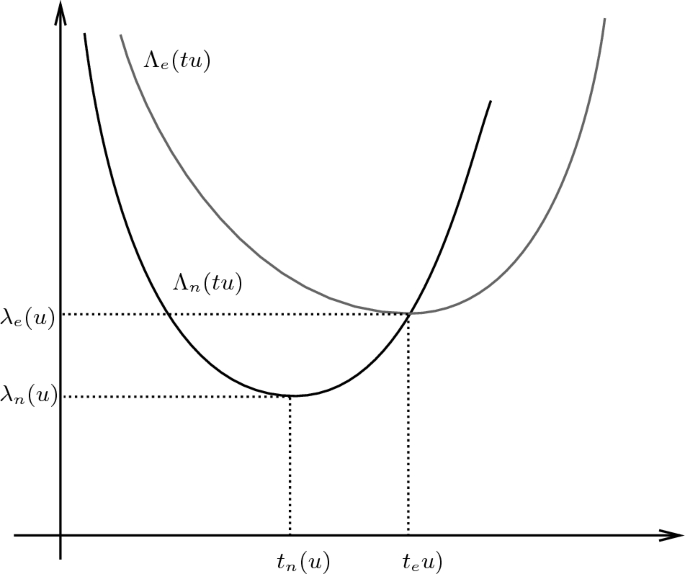
Our approach combines the Nehari method with generalized nonlinear Rayleigh quotients. Two quotients are introduced: one related to the Nehari constraint and another associated with the zero-energy condition. Their fibering maps allow us to identify extremal parameter values and to describe more precisely the geometry of the Nehari manifold.
An important point is that the negative part of the Nehari manifold is further decomposed according to the position of the critical points of the corresponding Rayleigh fibering map. This refined decomposition produces different minimization problems and makes it possible to distinguish several critical points of the energy functional.
Under suitable assumptions on the potential V and the weight a, we obtain existence and multiplicity results for different parameter regimes. In particular, for an appropriate region of the parameters, the problem admits at least three distinct positive solutions.
One of the technical challenges is to guarantee that the minimizers obtained on the different components of the Nehari set are nondegenerate. Instead of using the Mountain Pass Theorem to resolve this issue, we derive estimates that allow the Lagrange multiplier argument to be recovered for the relevant minimizers.
The generalized nonlinear Rayleigh quotient therefore plays two roles: it identifies the threshold values of the parameters and provides a geometric description of how solutions arise on different portions of the Nehari manifold.
This approach illustrates how Rayleigh-type quotients can be used beyond the classical eigenvalue framework, becoming a useful tool for studying nonlinear problems with a complicated variational geometry.
Reference
M. L. M. Carvalho, E. D. Silva, C. Goulart and M. L. Silva,
Multiplicity of Solutions for A Semilinear Elliptic Problem Via Generalized Nonlinear Rayleigh Quotient,
Bulletin of the Brazilian Mathematical Society, New Series 55 (2024), Article 1.

Follow the Topic

Related Collections
With Collections, you can get published faster and increase your visibility.
Perspectives in dynamical systems: a tribute to Jacob Palis
This special issue aims to honor Jacob Palis and his profound and lasting contributions to mathematics. Palis was not only a leading figure in dynamical systems, but also an extraordinary promoter of science and mathematics at many levels. For many years, he served as Editor-in-Chief of the Bulletin of the Brazilian Mathematical Society, playing a fundamental role in the journal’s internationalization and in the strengthening of its scientific profile and visibility.
From the mathematical point of view, beyond his seminal contributions to the theory of homoclinic bifurcations, Palis was one of the principal architects of modern dynamical systems. He formulated several influential conjectures that shaped a broad research program in dynamics beyond uniform hyperbolicity. Among the most prominent are the “hyperbolicity versus cycles” conjecture and the conjecture on the “essential finiteness of attractors,” both of which have guided a vast body of research over the past decades.
This special issue aims to collect contributions concerning geometric, topological, and ergodic aspects of dynamics beyond hyperbolicity, particularly works in the spirit of Palis’s research program. The volume seeks not only to highlight recent advances in dynamical systems, but also to reflect the broad and enduring impact of his ideas on the field.
Publishing Model: Hybrid
Deadline: Dec 31, 2026