Old MacDonald had a Tick problem: Tick abundance on UK farms
Published in Microbiology






This time last year I wrote a blog on tick activity and seasonality across Europe as we approached the start of tick season. Now I’m back with another timely tick blog, this time based on research specifically from the UK. This article caught my eye as research in the realm of parasites and vectors is not as common in the UK as it is in other regions. Furthermore, the mention of transects and Spearman’s rank took me back to the days of field courses and made me want to be out throwing quadrats across fields!
Ticks are one of the most important arthropod vectors across Europe and the UK, carrying important human and animal diseases. Research on tick-borne diseases is increasing across Europe as things like climate change and changing land use alter their distribution. As mentioned in my last blog, landscape restoration projects that aim to positively impact the environment, can affect vector, pathogen and host dynamics and may inadvertently contribute to the emergence and spread of vector-borne diseases.
Ticks in the UK
Ixodes ricinus is the most widespread tick species across Europe and causes the highest burden of tick-borne diseases to both humans and animals such as livestock. Habitat and landscape structure influence the abundance and distribution of I. ricinus through their effects on things like humidity and availability of hosts, with species density often highest in woodland or ecotones (transitions between habitats). Policies across Europe aim to restore landscapes and improve biodiversity, e.g., by establishing millions of hectares of new woodland (a positive thing, of course), but at the same time these policies could be increasing habitats that are favourable to ticks. Farms often play a large part in landscape restoration and improvement strategies and so understanding how tick distribution may be altered across farms is important for understanding tick-borne disease risks. Two important diseases transmitted by I. ricinus affecting cattle are Bovine babesiosis and tick-borne fever; both are rarely fatal but can lead to production losses through reduced milk production. This study by Shanks et al., investigates “landscape-scale environmental factors influencing the abundance and distribution of ticks on grazing pastures within dairy farms” and looks at the results in the context of environmental policies in the UK as well as their relevance for disease control in livestock and humans.
Study sampling
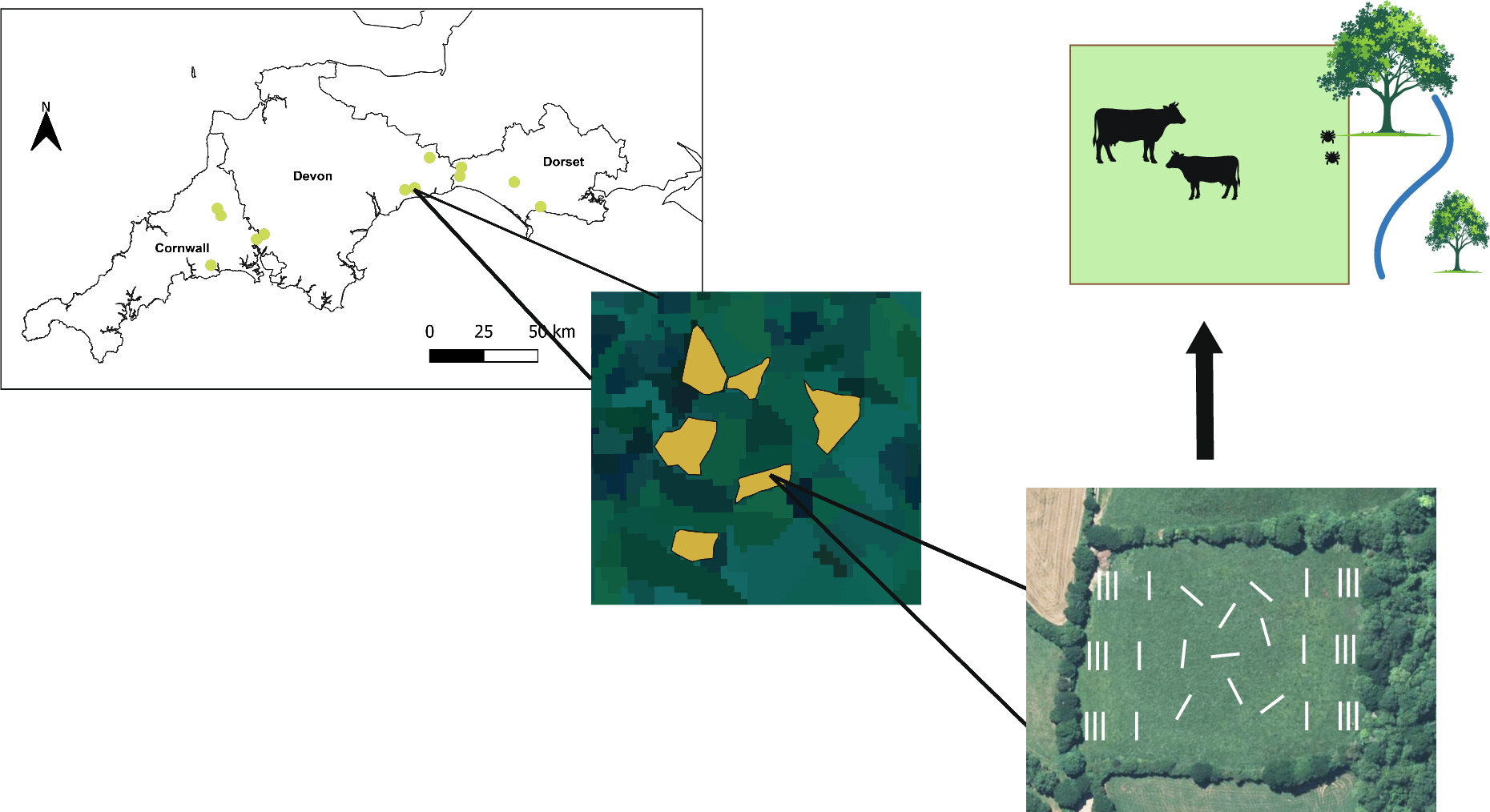
12 farms in the South West (Cornwall, Devon and Dorset), with an established presence of I. ricinus and where cows are kept outside for part of the day, were selected. The study looked at within-pasture effects on tick presence, as well as the effects of ecotones and woodland proximity to the pasture.
- At the transect scale: vegetation type, height, and density were recorded. Humidity was also measured at vegetation height.
- At the pasture boundary scale: the presence or absence of structures like hedgerows, fences and ditches was recorded, along with the dominant habitat adjacent to the pasture. The proportion of woodland cover surrounding pastures was also noted.
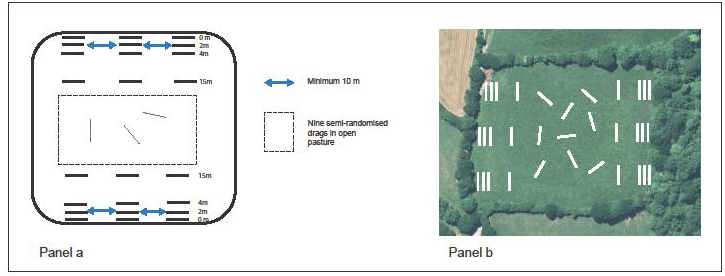
The study used blanket dragging to collect ticks across transects grouped by distance from the boundary, with additional drags done in the ‘open pasture’ away from the boundary.
Shanks, S., Duncan, J., Johnson, N. et al. Environmental drivers of tick density in UK dairy farms:
implications for livestock health and agri-environment policy. Parasites Vectors (2026)
Factors affecting tick distribution
Ticks were found on 20.3% of transects, and 91.3% of all collected ticks were nymphs. 75% of all ticks were collected from just 12 of the 72 pastures sampled. In terms of habitat characteristics, hedgerows were the boundary feature at 81% of the boundary transects, and the most common adjacent habitat was pasture, followed by trees, then track, scrubland and finally water.
The overall findings were that, at the transect level, the probability of detecting ticks:
- Decreased with increasing distance from the boundary.
- Increased with vegetation height.
- Increased with proportion of woodland within a 50m buffer around the pasture.
At the pasture boundary:
- Nymph density was positively associated with the proportion of woodland within a 50m buffer.
- There was a slight association with boundaries adjacent to water, although few of the sample sites were.
With climate change already affecting parasite and vector dynamics, and the potential ‘side effects’ of landscape restoration programmes being hypothesised, studies analysing the effects of microclimates, vegetation and surrounding habitats on tick distribution will be useful for anticipating how afforestation policies in the UK may affect vector distribution and behaviour. As the first study examining environmental factors that affect the abundance of I. ricinus in cattle pastures in the UK, this research can then be used to “reconcile biodiversity and climate objectives with the protection of livestock and public health”.

Freyja has a BSc in Zoology, and an MSc in the History of Science, Technology and Medicine from The University of Manchester. She currently works as an Associate Publisher for BMC's open access portfolio.
Follow the Topic
-
BugBitten
A blog for the parasitology and vector biology community.
Please sign in or register for FREE
If you are a registered user on Research Communities by Springer Nature, please sign in