One ordinary day, a lifelong change: counting spinal cord injury in Brazil
Published in Biomedical Research

It started with a visit
As a medical student at Unicamp, I once visited the Spinal Cord Rehabilitation Laboratory led by Prof. Alberto Cliquet Júnior. A PhD student there, Orcizo Silvestre, worked closely with the patients. I talked with some of them, and what stayed with me was how abrupt it had all been. One moment they were walking, or moving freely. The next, they were not. An ordinary day, an unexpected event, a change for the rest of their lives.
Some injuries came from a car crash caused by a split second of inattention. Others came from violence, at times that were already hard enough. I left shaken, and I decided to study it.
I did my undergraduate research project in that same laboratory. I applied a quality-of-life questionnaire (the WHOQOL-BREF) and asked about substance use. What I found worried me even more. I taped the number of Brazil’s suicide-prevention helpline (CVV) to the walls of the outpatient clinic, and I showed the PhD students how common depression and substance use were among the patients.
A small manual with a big future
Some years later, I was a resident in Family and Community Medicine, the primary care specialty. Orcizo showed me a short guide he had written, fewer than ten pages, meant to teach undergraduates how to care for people with spinal cord injury. I told him it was brilliant. To me, it was the seed of a real care manual, and I wanted to build it.
He was busy finishing his PhD and gave it to me on the spot. That manual became my master’s project.
“Start with the numbers”
My residency partner at the health center, Guilherme Coelho, is a physician who loves epidemiology. In a casual conversation, he told me something I could not unhear: you cannot write a care manual if you do not know who your population is, or how large it is.
So we started with the numbers. That became my residency final project: a systematic review of the epidemiology of spinal cord injury in Brazil. When I presented it, one of the examiners, an epidemiologist and pediatrician, told me I had something excellent and should keep improving it. Guilherme took on the whole meta-analysis, and he was also the one who encouraged me to publish. Without his statistical work and his push, this paper would not exist. Later, the peer reviewers’ suggestions made it better still.
What we found
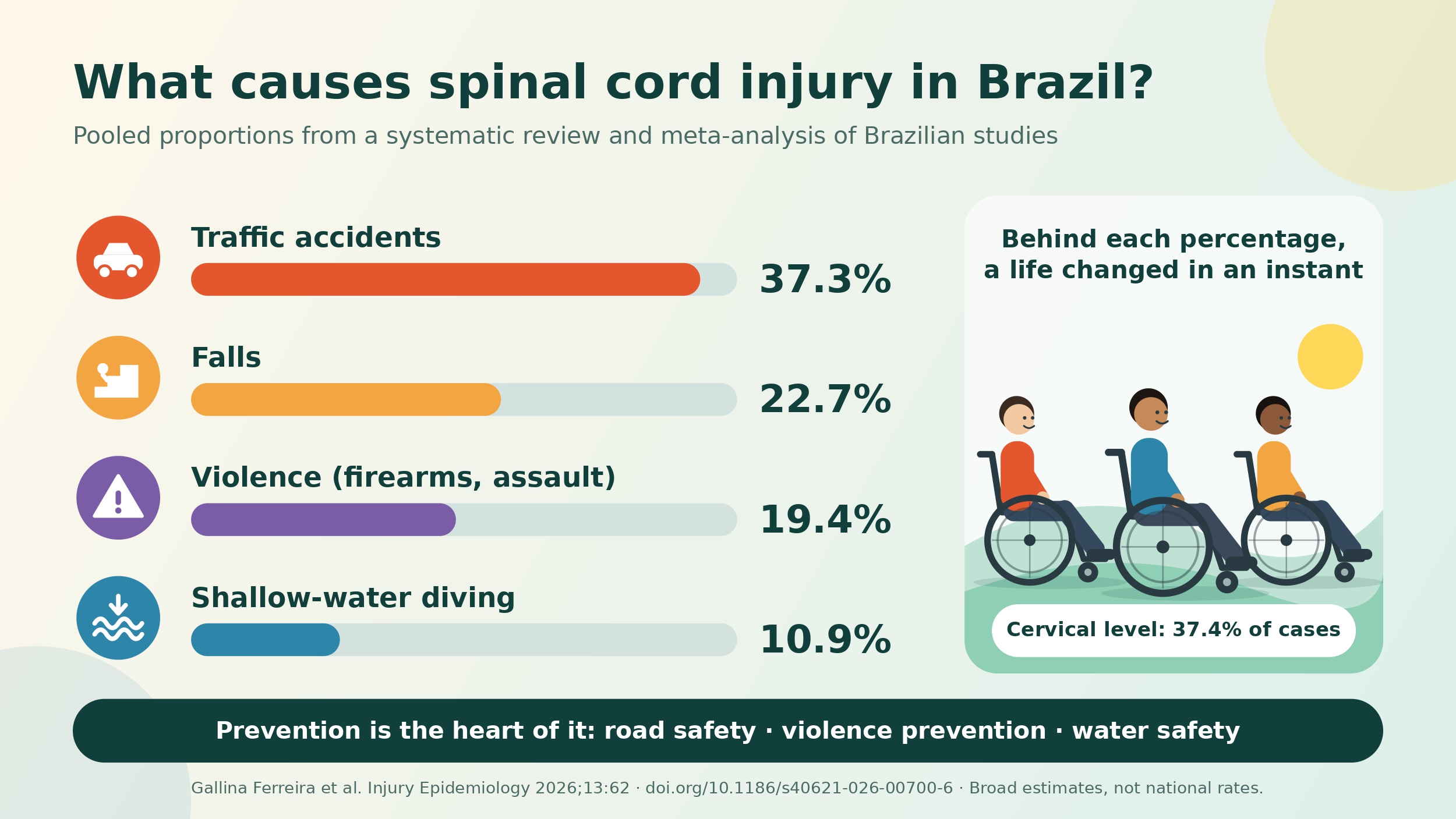
We combined data from Brazilian studies spanning several decades. Traffic accidents were the leading cause of spinal cord injury (about 37%), followed by falls (about 23%), violence including firearm injuries and assault (about 19%), and diving into shallow water (about 11%). The cervical region was the most commonly affected level, and men were the majority in every study.
But we want to be careful with these numbers. The studies differed a lot from one another, most were based in a single hospital or rehabilitation center, and many were concentrated in the Southeast of the country. Two older studies existed only in physical libraries, and we could not retrieve them. The figures are a broad picture, not definitive national rates.
The finding behind the findings
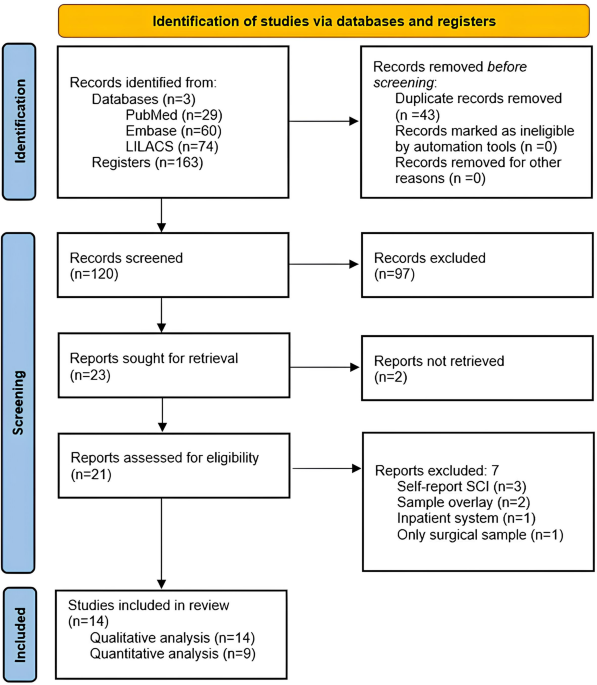
The most striking result may be how little there is to count. Out of 163 records identified in our searches, only 14 studies met our criteria for inclusion, and only 9 could be combined in the meta-analysis. Many had limited methods, and basic information such as education, income, and work was rarely reported.
To me, this is the real message of the paper. It shows how neglected this population is in Brazilian research. People who live with spinal cord injury are often overlooked by health services, and the gaps in our data show that they are overlooked by research too.
Why prevention is the heart of it
Behind each percentage is someone whose life changed in an instant. We cannot rehabilitate our way out of this problem. Without understanding the causes, we cannot prevent injuries, and prevention is what matters most. Road safety, violence prevention, and awareness about diving in shallow water are not abstract policy ideas. They are the difference between an ordinary day and a lifelong change.
We hope this paper encourages more population-based studies, with better methods and national reach, so that public policy can rest on solid ground.
Thanks
To Guilherme Coelho, who showed me where to begin, carried out the entire meta-analysis, and encouraged me to publish this work. To Prof. Cliquet and Orcizo, who opened the laboratory door and shared the idea that started it all. To Prof. Arlete Coimbra and Amadeu Zattoni da Silva, for their work and support. To the Unicamp Graduate Dean’s Office (PRPG), for funding the open access publication. And to the patients, who taught me why this matters.
Physician, a graduate of the Faculty of Medical Sciences at the State University of Campinas (FCM-UNICAMP). Specialist in Family and Community Medicine (UNICAMP). Holds a Master’s degree from the Professional Master’s Program for Medical Qualification (UNICAMP). Currently a doctoral candidate in the Obstetrics and Gynecology program at UNICAMP.