Opening the gate: how we learned to help antibiotics enter Pseudomonas aeruginosa
Published in Microbiology


When we think about antibiotic resistance, we often focus on enzymes that degrade drugs or mutations that alter targets. But for Pseudomonas aeruginosa, one of the most problematic Gram-negative pathogens, the challenge starts even earlier: many antibiotics simply do not get in.
This question—how antibiotics enter bacterial cells—has been at the core of our work for several years. We have been particularly interested in the relationship between intracellular accumulation and antibacterial activity. In Escherichia coli, a set of physicochemical rules can often predict whether a compound will accumulate. But P. aeruginosa is different. Its outer membrane is much less permeable, its porins are highly selective, and its efflux systems are remarkably efficient. Together, these features create a formidable barrier.
This barrier has a striking consequence: antibiotics that are highly effective against other bacteria, such as doxycycline, are essentially inactive against P. aeruginosa. Not because they fail to hit their target, but because they never reach it in sufficient amounts.
Rather than designing entirely new antibiotics, we wondered whether it might be possible to help existing ones cross this barrier.
This is where NV716 comes in. This polyaminoisoprenyl compound had already been described as an antibiotic adjuvant capable of restoring the activity of several drugs in Gram-negative bacteria. However, its mechanism of action remained unclear. Did it inhibit efflux? Did it disrupt membranes? Or was something more subtle happening?
To address this, we decided to directly measure antibiotic accumulation and link it quantitatively to antibacterial activity. This required combining several approaches, from genetic models to fluorescence-based accumulation assays and advanced imaging techniques.
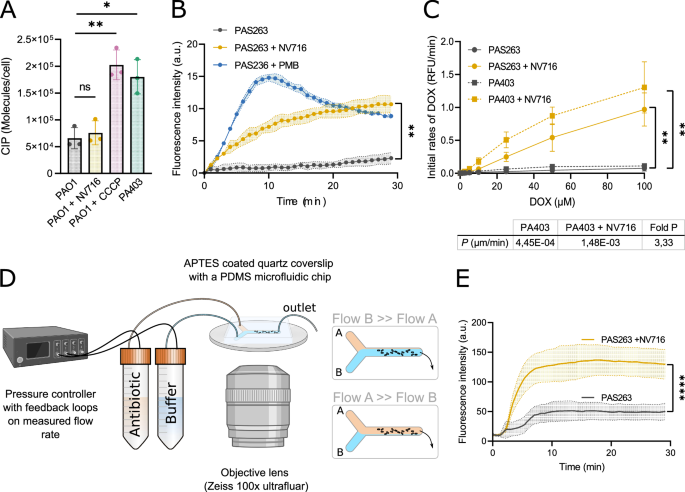
One of the first surprises came early. If NV716 were acting as an efflux inhibitor, we would expect to see a clear increase in the accumulation of antibiotics such as ciprofloxacin, which are strongly affected by efflux. But this was not the case. NV716 had little to no effect on ciprofloxacin accumulation under our conditions.
In contrast, the effect of doxycycline was immediate and striking. As soon as NV716 was added, intracellular accumulation increased dramatically in P. aeruginosa. Importantly, this effect was also observed in efflux-deficient strains, indicating that the mechanism was independent of efflux inhibition.
This pointed us toward the outer membrane.
Using a combination of biochemical assays and mutant strains, we found that NV716 interacts with lipopolysaccharides, the major components of the outer membrane. Rather than causing catastrophic damage, NV716 appears to induce controlled perturbation of membrane organization. This perturbation is sufficient to enhance antibiotic entry—particularly for doxycycline—without compromising the integrity of the inner membrane.
In other words, NV716 does not break the bacterial envelope; it subtly reshapes it.
To better understand what this perturbation looks like, we turned to imaging. This was one of the most exciting aspects of the project. By combining techniques such as cryo-soft X-ray tomography and nano-XRF, we were able to visualize membrane-associated changes and track the localization of the compound at the nanoscale.
One consistent observation was an increase in outer membrane vesicle production. These vesicles are known to be released in response to envelope stress, suggesting that the bacterial cell senses and responds to NV716-induced perturbation. Seeing this response emerging across different experimental scales—from population-level assays to single-cell imaging—was particularly rewarding.
Another important step was to move beyond qualitative observations and establish a quantitative framework. By measuring accumulation kinetics and applying a diffusion-based model, we could estimate changes in membrane permeability. This allowed us to directly connect a physical parameter—outer membrane permeability—to a biological outcome—antibiotic activity.
More broadly, our results support the idea that outer membrane permeability is a key determinant of antibiotic efficacy in Gram-negative bacteria and that it can be modulated in a controlled manner.
This has important implications. If we can tune membrane permeability, we may be able to broaden the range of compounds effective against intrinsically resistant bacteria such as P. aeruginosa. This includes not only existing antibiotics, but also new molecules that would otherwise fail to accumulate.
Of course, many questions remain. In our preliminary in vivo experiments, the NV716-doxycycline combination showed a trend toward improved survival, but it was not statistically significant under the tested conditions. Bridging the gap between enhanced accumulation and therapeutic efficacy will require further work and optimized models.
Nevertheless, this study provides a framework for thinking about antibiotic entry in a more quantitative and mechanistic way.
Ultimately, overcoming antibiotic resistance may not always require stronger drugs. Sometimes, it may simply require helping them get inside.
Do you want to know more? Take a look at our article in npj Antimicrobials and Resistance: https://doi.org/10.1038/s44259-026-00203-w

Follow the Topic
-
npj Antimicrobials and Resistance
This journal considers basic, applied, and clinical research that advances our understanding of all aspects of antimicrobials and antimicrobial resistance.

Related Collections
With Collections, you can get published faster and increase your visibility.
Data Science, AI and Machine Learning Approaches to AMR
Publishing Model: Open Access
Deadline: Jul 07, 2026
Pathogen drug permeability
Publishing Model: Open Access
Deadline: Jul 15, 2026



Please sign in or register for FREE
If you are a registered user on Research Communities by Springer Nature, please sign in