PheSeq: How Bayesian Deep Learning Conceptualizes the Gene-Disease Associations and Bridges ’em with P-values?
Published in Genetics & Genomics

"This study introduces PheSeq, a Bayesian deep learning model designed to integrate p-value data from sequence analysis with phenotype descriptions from literature and network data. It improves the robustness and interpretability of gene-disease association studies."
Published in Genome Medicine
Apr 16, 2024
Behind the paper [1]: (https://genomemedicine.biomedcentral.com/articles/10.1186/s13073-024-01330-7)
Highlights:
- The Bayesian deep learning framework successfully bridges the phenotype description perception and association significance(p-value) in the gene-disease association studies.
- Deep learning is used to derive embeddings for phenotype description from literature and network data.
- The framework treats the p-value as a weak supervised signal in the uncertainty inference.
- A probability graphical model effectively bridges the aforementioned heterogeneous data modalities by activating a switch when there is consistency between the association significance and the phenotype description.
In the scenario of genotype-phenotype association studies, p-values from various sequence analyses such as GWAS and RNA-seq provide a measure of significance. However, these p-values often come with high uncertainty and lack of interpretability.
The proposed PheSeq model addresses these challenges by combining p-value data with deep learning-derived phenotype embeddings from literature and network data, and bridging two types of heterogeneous association data, thus enhancing the robustness and interpretability of the results.
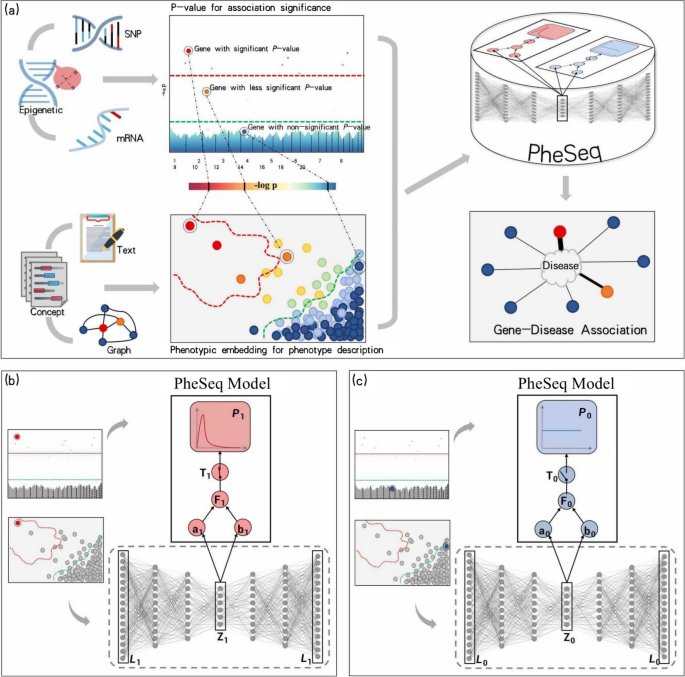
The figure outlines the framework of the Bayesian deep learning model, PheSeq.
|
a. General model input in PheSeq involves p-values for association significance in sequence analysis and phenotypic embeddings for phenotype description from texts or graphs. The associations with p-values are graphically depicted in a Manhattan-style plot. A threshold line with a strict criterion (red line) or a less strict criterion (green line) is then applied. Concurrently, a DL perception module learns the association description of gene-disease association from text or graph. Genes exhibiting significant association descriptions tend to aggregate in the top-left region of the semantic space, as shown in the figure. Analogous patterns emerge in other scenarios. Finally, PheSeq learns the data distributions and performs data fusion for gene-disease associations. b/c Data fusion of association significance and phenotype description for a significant/non-significant gene-disease association by PheSeq. For each gene-disease association, two distinct types of observations, denoted as L for phenotypic embedding and P for p-value, are considered for data fusion. Both sets of observations are input into the PGM inference module, facilitating the learning of dependency relationships among them in conjunction with latent variables. The phenotypic embedding L is initially processed through the DL perception module for semantic training, generating high-quality embeddings denoted as Z. The latent variable T serves a pivotal role in synchronizing the phenotypic embedding data with the p-value data, the latter adhering to a beta distribution indicative of a predisposition toward“small-p-value.” In addition, another latent variable F functions as an association score, establishing connections among model parameters. Conceptually, the switch mechanism activates when both the association significance and phenotype description align, effectively bridging the above heterogeneous data modalities. Part c shows the converse situation, wherein the data indicate non-significance for the gene-disease association. In this case, a uniform distribution is employed to characterize the distribution of the p-value. The remaining configurations of the model remain consistent |
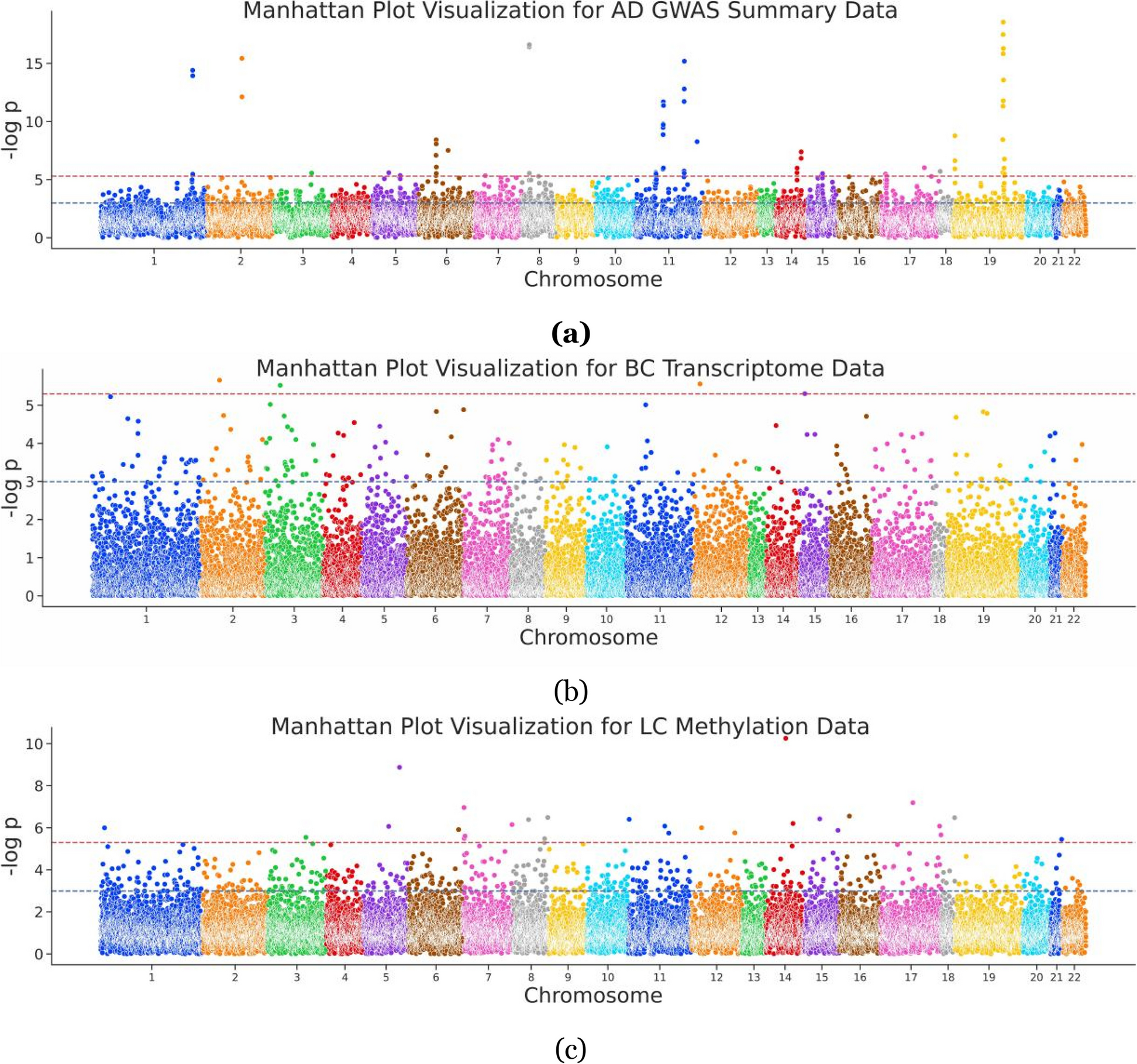
The PheSeq model was tested in three case studies involving Alzheimer’s disease (AD), breast cancer (BC), and lung cancer (LC), using GWAS, transcriptomic, and methylation data respectively. Phenotypic descriptions of the three diseases were collected from disease-related literature downloaded on a PubMed and PMC scale. Sentences that address phenotype description of the gene-disease association are filtered by a biomedical event extraction model on AGAC (Annotation of Genes with Alteration-Centric function changes [2]) corpus.
Finally, PheSeq identified 1024 priority genes for AD and 818 and 566 genes for BC and LC, respectively. Benefiting from data fusion, these findings represent moderate positive rates, high recall rates, and interpretation in gene-disease association studies.
PheSeq holds particular importance in situations where a single sequence analysis may elicit systematic bias and flawed predictions of crucial genes. In such instances, PheSeq serves as an effective tool for establishing a connection between phenotype descriptions and association significance in sequence analysis and helps to recall the significant genes.
In conclusion, this research performs a worth-trying attempt at heterogeneous association data fusion. This framework successfully bridges the phenotype description perception and p-value uncertainty inference. The association significance is utilized as a fine-grained weak signal for the association significance. Overall, it is an inspiring idea to unveil genotype-phenotype associations and investigate the potential relation dependency through data perception, data fusion, and probabilistic inference in a novel Bayesian framework.
Finally, we are delighted to share our work with the scientific community and domain experts in the prestigious journal, Genome Medicine. We sincerely hope that this resource can provide valuable research groundwork and further insights for the community.
References
- Yao, X., Ouyang, S., Lian, Y., Peng, Q., Zhou, X., Huang, F., ... & Xia, J. (2024). PheSeq, a Bayesian deep learning model to enhance and interpret the gene-disease association studies. Genome Medicine, 16(1), 56.
- Wang, Y., Zhou, K., Gachloo, M., & Xia, J. (2019, November). An overview of the active gene annotation corpus and the BioNLP OST 2019 AGAC track tasks. In Proceedings of The 5th workshop on BioNLP open shared tasks(pp. 62-71).
The blog is written by Yanhong He, Fumin Chen, Yawen Liu, Xinzhi Yao, and Jingbo Xia.

- Research Interests
- BioNLP (生物医药自然语言处理)
- Data mining (数据挖掘)
- Bioinformatics (生物信息学)
- Research Projects
- Corpus design and Biomedical knowledge discovery based on BioNLP (语料库设计和基于BioNLP的知识挖掘)
- Data mining for geno-phenotype association (针对表型-基因型关联的生物信息数据挖掘)
Follow the Topic
-
Genome Medicine
This is an open access journal publishing outstanding research in the application of genetics, genomics and multi-omics to understand, diagnose and treat disease, bridging the basic science and clinical research communities.

Related Collections
With Collections, you can get published faster and increase your visibility.
Coronavirus Resource
Given the highly evolving landscape of SARS-CoV-2 and COVID-19 research and to capture significant advances in this field, Genome Medicine is pleased to announce a call for papers for our Coronavirus Resource, guest edited by Dr Junhua Li from BGI Research. We encourage work from academic-industry partnerships and collaboration among scientists from multi-disciplinary fields.
We are now inviting the submission of Research, Method, Software, Database and Guideline manuscripts of outstanding interest covering the breadth of the multi-disciplinary work and advances made in this area, covering all aspects of:
-SARS-CoV-2 evolution, infection and immune response,
-Detection and diagnostics,
-Vaccine development,
-Novel treatment strategies,
-Epidemiology,
-Public health genomics and surveillance.
To submit your manuscript, please use the Genome Medicine online submission system and indicate in your covering letter that you would like the article to be considered for the Coronavirus Resource. If you would like to enquire about the suitability of a manuscript for consideration, please email editorial@genomemedicine.com.
This collection of articles has not been sponsored and articles will undergo the journal’s standard peer-review process. The Guest Editor declares that they have no competing interests. The Guest Editor serves an advisory role to guide the scope of the collection and commissioned content; final editorial decisions lie with the Editor.’
Publishing Model: Open Access
Deadline: Ongoing
Prevention and intervention in metabolic health
Genome Medicine is pleased to present a Collection on the mechanisms, risk factors, and therapeutic strategies to improve metabolic health.
Metabolic disorders—including diabetes, obesity, cardiovascular-kidney-metabolic syndrome and metabolic fatty liver disease—are strongly interconnected, and contribute to increasing health burdens across societies. From tissue to systemic levels, the control of optimal metabolic parameters is essential to improve and sustain well-being and reduce future health risk factors.
This Collection aims to highlight advances in our understanding of the molecular, physiological, and environmental determinants of metabolic physiology and dysfunction, as well as novel and equitable approaches to prevention and treatment of metabolic disorders. We invited research spanning from basic biology to population-level interventions and precision medicine approaches.
We welcomed submissions within, but not limited to, the following areas of interest:
•
Omics-based insights into metabolic regulation at tissue and systemic levels,
•
Genetic and epigenetic contributions to metabolic health,
•
Precision medicine for the prediction of metabolic phenotypes,
•
Analyses of nutritional and lifestyle-based approaches to prevention and care,
•
Exercise and its contributions to physiology, health and recovery,
•
Therapeutic interventions, including pharmacological targeting for metabolic health,
•
Health disparities and determinants of metabolic health across populations, and intergenerational effects
This Collection supports and amplifies research related to SDG 3: Good Health and Well-Being. All manuscripts submitted to this journal, including those submitted to collections and special issues, are assessed in line with our editorial policies and the journal’s peer-review process. Reviewers and editors are required to declare competing interests and can be excluded from the peer review process if a competing interest exists.
Publishing Model: Open Access
Deadline: Jan 29, 2027