Photothermal Superhydrophobic Textiles: An Emerging Paradigm from Passive Water Repellency to Active Thermal Management
Published in Materials and Mechanical Engineering

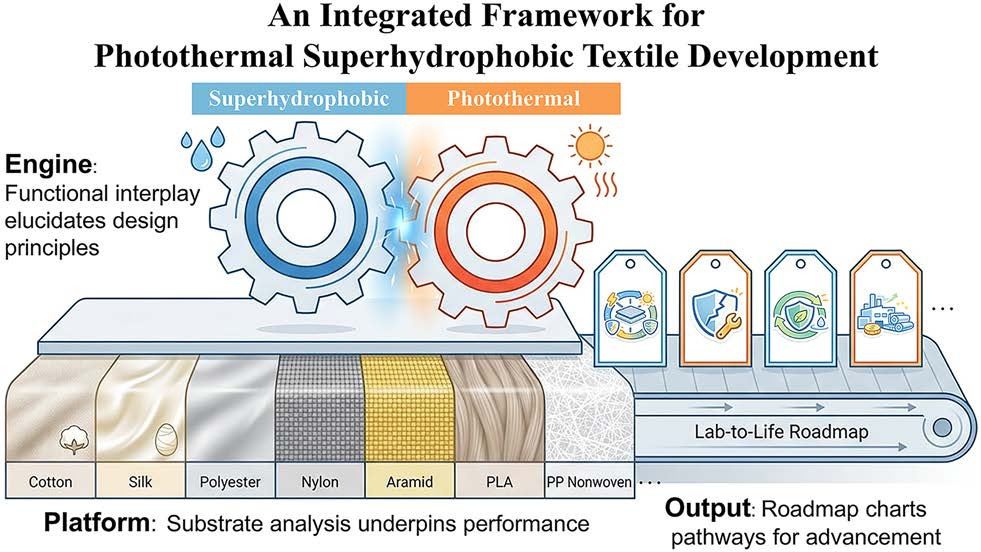
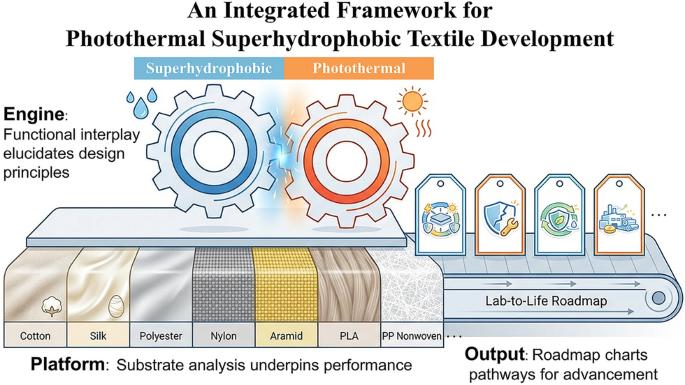

As demand grows for functional textiles that can withstand harsh weather while reducing energy consumption, conventional water-repellent fabrics face a critical limitation: passive protection alone cannot prevent ice accumulation, remove persistent moisture, or restore damaged surface properties. Researchers from Hubei University, Wuhan Textile University, Harbin Institute of Technology, and the Chinese Academy of Sciences have reviewed emerging photothermal superhydrophobic textiles, revealing how the integration of sunlight-driven heating and exceptional water repellency can transform ordinary fabrics into multifunctional materials for intelligent clothing, infrastructure protection, and environmental applications.
Why These Smart Textiles Matter
Conventional superhydrophobic textiles rely on hierarchical micro/nanostructures and low-surface-energy coatings to repel water and resist contamination. However, moisture can penetrate their surface textures, while frost and ice can compromise their protective functions. Photothermal superhydrophobic textiles address these limitations by combining passive liquid repellency with active, light-triggered thermal regulation. Their potential extends beyond keeping fabrics dry: localized heating can accelerate evaporation, facilitate droplet removal, melt ice, and support the recovery of water-repellent properties after damage. This combination offers a promising route toward textiles that actively respond to changing environmental conditions rather than simply resisting them.
Innovative Design and Mechanism
The review establishes a framework for understanding the mutually reinforcing relationship between photothermal conversion and superhydrophobicity. Photothermal components—including plasmonic nanoparticles, semiconductors, and carbon-based materials—convert absorbed light into heat through mechanisms such as localized plasmonic heating, non-radiative relaxation, and molecular vibrations. Meanwhile, hierarchical surface structures promote multiple light-scattering events, enhancing optical absorption, while trapped air pockets reduce heat loss. The interaction works in both directions: photothermal heating accelerates moisture evaporation and droplet removal, and can activate the reorientation of hydrophobic molecular chains to restore surface repellency. The authors emphasize that textile substrates are active design components, with fiber chemistry, porosity, flexibility, and thermal properties all influencing performance.
Outstanding Performance
Reported examples demonstrate the practical potential of this integrated approach. Hierarchically structured photothermal superhydrophobic textiles have achieved solar absorptance of 95–98%. In one representative system, a TiN-based superhydrophobic cotton fabric completely melted ice within approximately 50 seconds under one-sun irradiation. Other reported systems combine water repellency with additional functions: a CuS-based cotton fabric achieved oil–water separation efficiencies above 98.5% for oil-in-water emulsions and above 98.7% for surfactant-stabilized water-in-oil emulsions. A silk-based photothermal textile also demonstrated antibacterial activity exceeding 99% under near-infrared irradiation. These examples illustrate how coupled surface chemistry, hierarchical structures, and photothermal materials can deliver multiple functions within a single textile platform.
Applications and Future Outlook
Potential applications include self-deicing infrastructure, protective clothing, personal thermal management, antibacterial fabrics, and solar-driven water treatment. However, commercialization requires more than impressive laboratory results. Mechanical abrasion, repeated washing, ultraviolet exposure, and coating delamination can undermine long-term performance, while fluorinated chemicals, organic solvents, and particle shedding raise environmental concerns. The authors advocate stronger interfacial bonding, fluorine-free materials, sustainable processing, standardized durability testing, and circular design strategies. Looking ahead, artificial intelligence could accelerate material discovery and optimize the balance among light absorption, water repellency, mechanical durability, cost, and environmental safety—helping transform photothermal superhydrophobic textiles into scalable, intelligent, and sustainable technologies.
Follow the Topic
-
Nano-Micro Letters
Nano-Micro Letters is a peer-reviewed, international, interdisciplinary and open-access journal that focus on science, experiments, engineering, technologies and applications of nano- or microscale structure and system in physics, chemistry, biology, material science, and pharmacy.