Planning for the Future, One Conversation at a Time
Published in Neuroscience and General & Internal Medicine


When dementia erases the vocabulary of preference, when motor neuron disease silences the voice, when Parkinson's disease advances beyond the reach of any intervention, who decides how and where that person dies? And why has no one in Indian medicine systematically asked physicians what they think about this?
This is the story of a study that tried to answer those questions, and in doing so, uncovered something far more complicated than its investigators expected.
The research began under the leadership of a neurologist, Dr Arunmozhimaran Elavarasi and her team at the All India Institute of Medical Sciences, New Delhi with Prof Manjari Tripathi, the Head of the Department of Neurology who had long observed a troubling gap between what modern medicine promised its most vulnerable patients and what it actually delivered at the end of life.
Neurodegenerative diseases, by their nature, follow a trajectory that is known in broad outline even when its precise pace remains uncertain. Parkinson's disease, dementia, motor neuron disease, progressive supranuclear palsy, and their many related conditions share a common feature: they move relentlessly forward, and they eventually arrive at a place where the patient can no longer participate in decisions about their own care. Advance care planning, the structured process by which patients articulate their values and preferences for future medical treatment while they still retain the capacity to do so, exists precisely to bridge that gap and to ensure that dignity at the end of life is honoured, not assumed. Evidence from across the world consistently shows that it reduces unwanted hospitalizations, improves quality of life, and allows patients to die with dignity and comfort. However, across much of India, it remained a concept discussed in academic journals but rarely in clinics.
The study that emerged from this concern was ambitious in scope. With no dedicated funding, a team of researchers drawn from institutions across the country set out to conduct the first mixed-methods investigation of its kind, targeting the physicians most likely to care for patients with neurodegenerative disorders: neurologists, geriatricians, and movement disorder specialists spread across a nation of 1.4 billion people.
The first phase was a structured online survey, carefully designed and vetted by neurologists and a palliative care specialist, disseminated through professional groups and academic mailing lists from October 2024 to March 2025. 140 physicians responded, a sample large enough to yield meaningful data.
What the survey revealed was, in some respects, encouraging. An overwhelming 93.6 percent of respondents acknowledged that advance care planning was necessary. However, the data beneath that figure told a far more sobering story. Only a quarter of physicians felt they had sufficient time to hold such conversations. Nearly two-thirds reported inadequate institutional resources. More than half expressed a need for greater clarity on the legal dimensions of advance care planning in India. Furthermore, approximately 16 percent had never encountered the concept in any formal or informal setting whatsoever.
But numbers, however striking, cannot capture the texture of reluctance. To understand why a practice almost universally deemed necessary remained so persistently absent from clinical life, the research team turned to qualitative inquiry. Two final-year medical students conducted semi-structured in-depth interviews with fifteen physicians purposively selected from the survey pool. Two final-year medical students, Pavit Singh and K.N. Parvathy, who were also the study's principal architects alongside Dr. Elavarasi, conducted semi-structured in-depth interviews with fifteen physicians purposively selected from the survey pool. The choice to use medical students as interviewers was deliberate and methodologically astute. Senior colleagues asking about deficiencies in practice invite performance. Students, by contrast, invite candor. We also had a strong team with experts in Movement Disorders with experience in Advance care planning from the USA and Canada.
What emerged from those conversations was a portrait of a profession caught between knowing and doing. Physicians described crowded clinics where there was barely time to address the presenting complaint, let alone a conversation about the long arc of a neurodegenerative illness. They described the absence of counselors, dedicated rooms, and trained support staff - the basic institutional infrastructure that transforms a good intention into a meaningful encounter. They described families steeped in denial, unwilling to contemplate a future of progressive dependency and loss. They described the fear that raising the subject of end-of-life care would extinguish hope, erode trust, or drive patients to seek more optimistic counsel elsewhere. And they described a confusion so fundamental that it threatened the entire enterprise. Many physicians, when asked about advance care planning, spoke instead about deep brain stimulation, infusion therapies, and symptom management in advanced disease. The word "advance" had, for many, hijacked the concept entirely. This was not a failure of intelligence but of exposure: without structured training, without institutional conversation, a term borrowed from a different healthcare context had been reinterpreted through the lens of what physicians already knew. For a neurologist managing a patient with progressive neurodegeneration, "advance" inevitably connoted treatment escalation rather than future preference documentation.
It bears noting that this picture is not uniform across the country. In certain centres, particularly in southern India, advance care planning conversations are already being held with patients and families living with neurodegenerative conditions. These pockets of practice, where physicians have built the language, the relationships, and the clinical habit of discussing future care, represent precisely the kind of model that could be replicated more widely. They demonstrate that the barriers are real but not insurmountable.
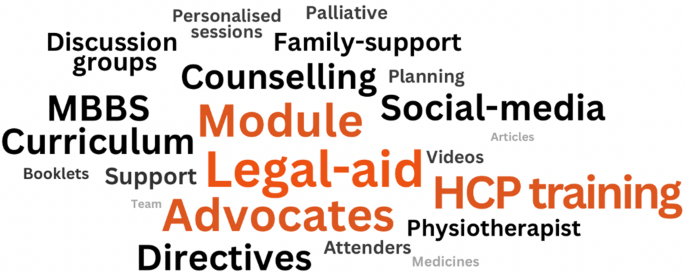
The physicians who participated in this study were not indifferent to the idea. They were, in fact, willing and in many cases eager. What they asked for, consistently and across different practice settings, was institutional support: a legal framework that clearly delineated their obligations and protections, dedicated time and space within the clinical encounter, trained counselors and social workers to share the weight of these conversations, and education woven into medical training from its earliest stages. They did not need to be persuaded of the value of advance care planning for their patients with neurodegenerative disease. They needed the conditions under which it could actually happen.
The study concluded with a proposal that was as much linguistic as it was clinical: that the term "future care planning" might travel more clearly across the conceptual landscape of Indian medicine, sidestepping the confusion with advanced disease stages or surgical intervention that the word "advance" inadvertently invited.
What this research ultimately documented was not simply a gap in physician practice. It documented the early contours of a conversation that Indian medicine is ready to have, about progressive illness, dignity, and the right of every patient to shape the final chapters of their own story. The message from the participating physicians was clear: we want to have these conversations. Give us the framework, the space, the people, and the clarity to do so.
Follow the Topic
-
BMC Health Services Research
An open access, peer-reviewed journal that considers articles on all aspects of health services research, focusing on digital health, governance, policy, system quality and safety, delivery and access, financing and economics, implementing reform, and the workforce.

Related Collections
With Collections, you can get published faster and increase your visibility.
Promise, perception, and practice: workforce capability and technology integration in healthcare
BMC Health Services Research invites submissions on how health workforce professionals interact with, adopt, and shape the implementation of digital health technologies, artificial intelligence (AI), and modern electronic health record (EHR) systems. Whether these technologies deliver value depends not only on the technical specifications but also on how they are implemented, governed, evaluated, and continuously refined within the organizations and workforces in which they operate. Health systems worldwide are committing to technology portfolios at a pace that consistently outstrips the evidence base needed to guide them, leaving technology program leaders without the knowledge they need to make sound investment and deployment decisions. We particularly welcome work that bridges implementation science, clinical informatics, and health services research to generate evidence actionable for health systems managing growing technology portfolios.
Topics of interest include, but are not limited to:
- Adoption and sustained use: digital literacy, training, and effective human–AI collaboration
- Front-line feedback as a signal for monitoring and improving technology performance
- Case studies of AI tools (clinical systems, ambient documentation, EHRs, decision support) with focus on long-term value and sustainment
- Governance, evaluation frameworks, and learning health system models for continuous assessment
- Impacts on care quality, clinician well-being, efficiency, and costs, including unintended effects (e.g., workflow disruption, alert fatigue)
- Ethical, equity, and policy considerations, including evolving AI governance
- Innovative measurement using EHR logs, administrative data, and observational methods
- Development of standardized evaluation frameworks applicable across technologies and settings
We welcome submissions across all article types accepted by BMC Health Services Research, including research articles, systematic reviews, study protocols, database and software articles.
All manuscripts submitted to this journal, including those submitted to collections and special issues, are assessed in line with our editorial policies and the journal’s peer review process. Reviewers and editors are required to declare competing interests and can be excluded from the peer review process if a competing interest exists.
Publishing Model: Open Access
Deadline: Jan 29, 2027
Bridging the gap between research and policy making
The relationship between research and policy making in health services is often fraught with challenges that hinder the effective translation of evidence into practice. Despite the wealth of data generated by health researchers, a gap frequently exists between scientific findings and their application in policy settings. Factors such as bureaucratic inertia, lack of communication between researchers and policymakers, and insufficient understanding of the practical implications of research findings contribute to this disconnect. Addressing these barriers is vital for improving health outcomes and ensuring that policies are informed by the best available evidence.
Bridging this gap is crucial for the development of effective health policies that can respond to the needs of diverse populations. Recent advancements have highlighted the importance of stakeholder engagement, interdisciplinary collaboration, and the use of knowledge translation strategies to facilitate the adoption of research into policy. By fostering an environment where research informs decision-making, we can enhance the efficiency and effectiveness of health services, ultimately leading to improved health outcomes for communities.
Topics for submission include but are not limited to:
- Strategies and frameworks for effective knowledge translation in health policy
- Stakeholder engagement, co-production, and participatory approaches to policymaking
- Interdisciplinary and cross-sector collaborations that support evidence-informed policy
- Models of researcher–policymaker partnerships and communication
- Case studies demonstrating successful (or challenging) research-to-policy translation
- Digital innovations, data analytics, and tools that facilitate real-time evidence use
- Equity-focused or context-sensitive approaches to integrating evidence into policy
All manuscripts submitted to this journal, including those submitted to collections and special issues, are assessed in line with our editorial policies and the journal’s peer review process. Reviewers and editors are required to declare competing interests and can be excluded from the peer review process if a competing interest exists.
Publishing Model: Open Access
Deadline: Apr 30, 2027