Plastic Mulching’s Lasting Impact: How Microplastics Are Affecting Soil Health
Published in Sustainability and Agricultural & Food Science


Plastic mulching has become a routine practice in modern agriculture, valued for its ability to conserve moisture, control weeds, and boost crop yields. Yet beneath these short-term benefits lies a growing concern: the accumulation of microplastics in soil. This study examines how years of plastic use translate into long-term changes in soil health, offering a closer look at a problem that is only beginning to be fully understood.
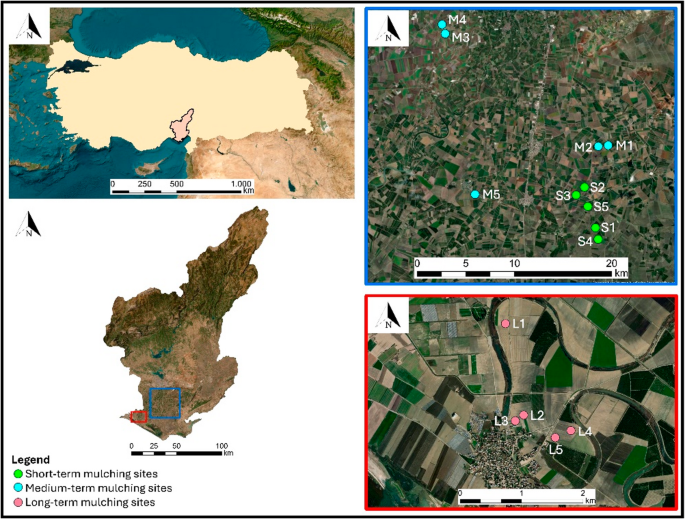
The research focuses on agricultural fields with different histories of plastic mulching—ranging from a few years to several decades. By analyzing soils across these timeframes and at different depths, the study captures how microplastics build up over time. Using advanced identification techniques, the researchers quantify microplastic particles and relate their presence to a broad set of soil indicators, including physical structure, chemical properties, and biological activity.
The findings reveal a clear pattern: the longer plastic mulching is used, the more microplastics accumulate in the soil. Over time, these particles begin to interfere with key soil functions. Indicators such as aggregate stability, water dynamics, and microbial activity show declines, pointing to a gradual degradation of soil quality. Importantly, the study uses a soil quality index to integrate these changes, showing a consistent drop in overall soil performance under long-term mulching.
Beyond individual parameters, the results highlight how microplastics affect the soil as a system. Physical properties such as bulk density and water retention are altered, while biological indicators—including microbial biomass and nitrogen cycling—are negatively impacted. These combined effects suggest that microplastics are not just passive contaminants, but active agents influencing how soil functions and supports plant growth.
For the broader agricultural community, the implications are significant. Plastic mulching is widely adopted across cropping systems, particularly in regions facing water scarcity or intensive production pressures. This study suggests that its long-term use may come with hidden costs, slowly undermining the very resource it aims to protect: the soil itself.
Ultimately, the research calls for a more balanced view of agricultural technologies. While plastic mulching can deliver immediate agronomic benefits, its cumulative environmental impact cannot be ignored. For researchers and practitioners alike, the challenge now is to rethink soil management strategies—exploring alternatives, improving material design, or developing better recovery systems—to ensure that productivity gains today do not compromise soil health tomorrow.
Image credit: Mypix
This post was created with the assistance of AI.

As a Senior Publisher, I manage a portfolio of Life Sciences journals, including some influential publications in the field. I have over ten years of experience in academic publishing, with a background in neuroscience and science journalism.
Follow the Topic

What are SDG Topics?
An introduction to Sustainable Development Goals (SDGs) Topics and their role in highlighting sustainable development research.
Continue reading announcement

Please sign in or register for FREE
If you are a registered user on Research Communities by Springer Nature, please sign in