Polyphenol-Gated Composite Electrolytes with Enhanced Cross-Phase Lithium-Ion Transport for Solid-State Lithium Batteries
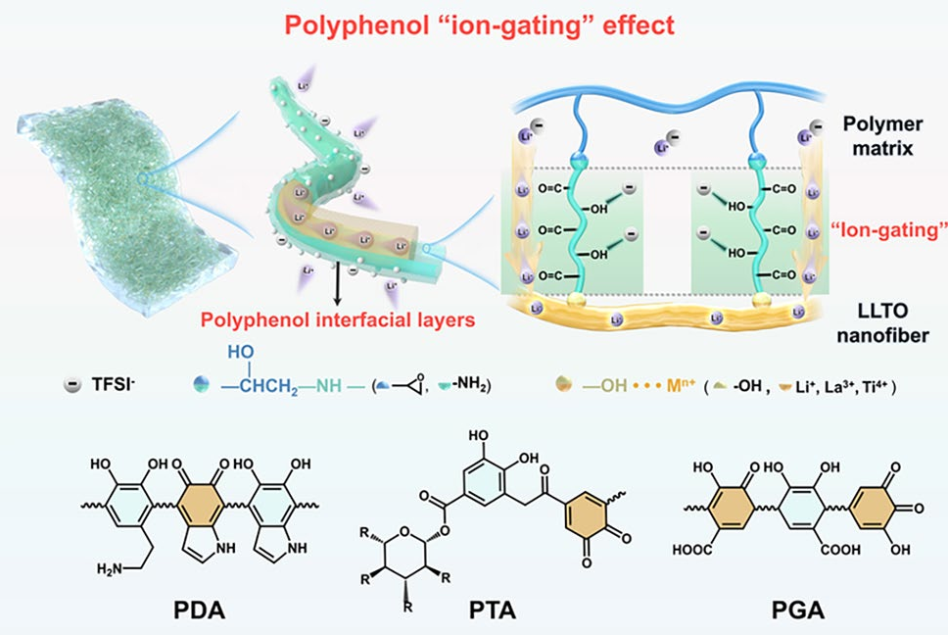

As the demand for high-performance solid-state lithium batteries continues to grow, conventional polymer-ceramic composite electrolytes face critical limitations in interfacial Li+ transport and low Li+ transference numbers. Now, researchers from Donghua University, led by Professor Yue-E Miao, Professor Hui Zhang, and Professor Feili Lai, have presented a breakthrough polyphenol-gated composite electrolyte that bridges the gap between polymer flexibility and ceramic ionic conductivity.
Why This Electrolyte Matters
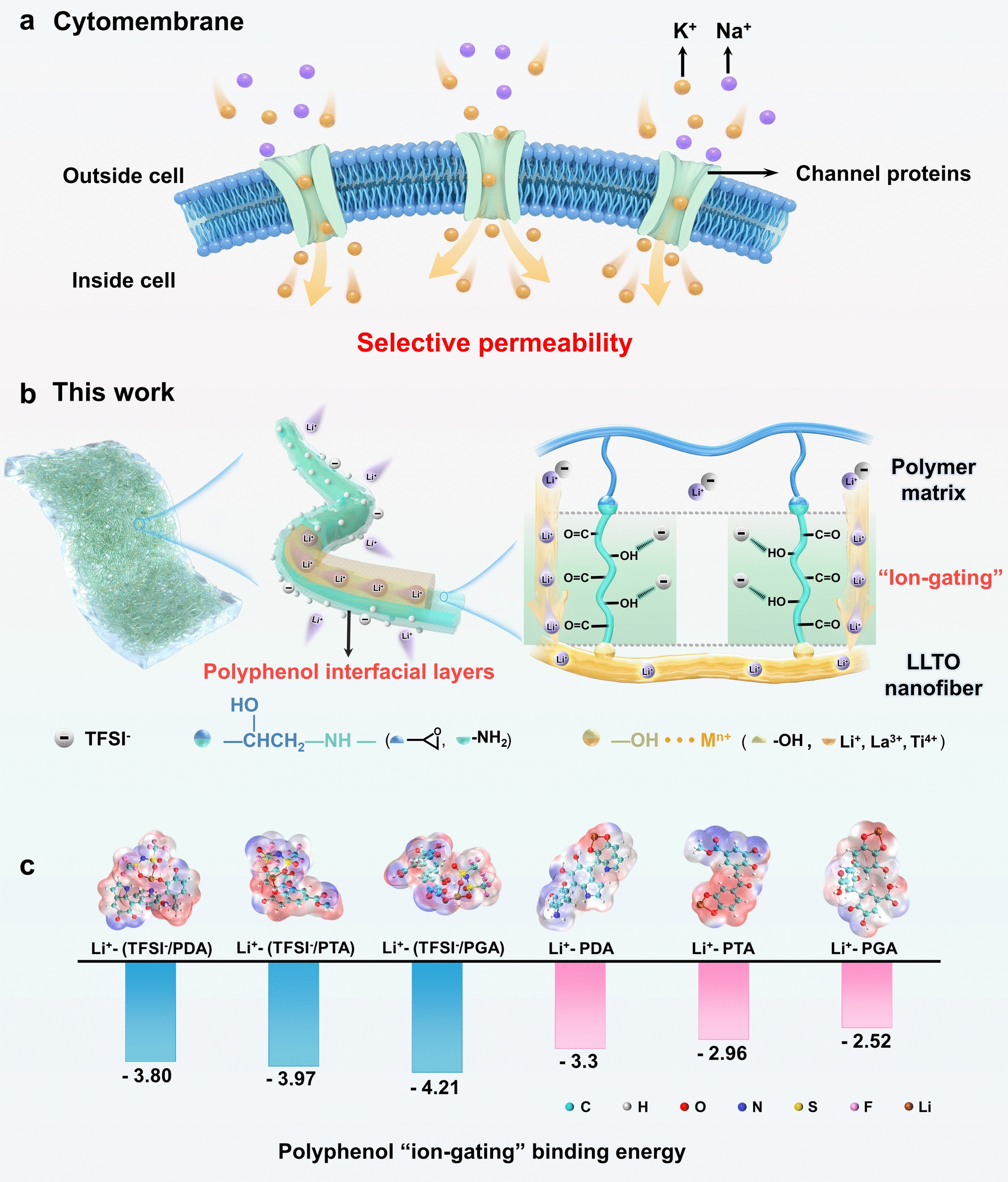
Traditional composite solid-state electrolytes suffer from sluggish Li⁺ transport across polymer-ceramic interfaces due to incompatible conduction mechanisms and space-charge layer effects, resulting in low Li⁺ transference numbers (often <0.4). The novel polyphenol-gated strategy overcomes this limitation by mimicking biological ion-selective channels—enabling fast, selective Li⁺ transport while immobilizing anions through hydrogen bonding, achieving an exceptional Li⁺ transference number of 0.68.
Innovative Design and Mechanism
The material employs bioinspired polyphenol interlayers (polydopamine, poly-tannic acid, or poly-gallic acid) that chemically bridge La0.56Li0.33TiO3 ceramic nanofibers and glycidyl polyether matrix. Within this interface, carbonyl groups selectively coordinate Li+ to lower energy barriers, while hydroxyl and amino groups immobilize TFSI- anions. This "ion-gating" effect nearly doubles interfacial Li+ concentration and creates a three-dimensional percolation network for rapid cross-phase ion migration.
Outstanding Performance
PDA2@LLTO/GE delivers a high ionic conductivity of 3.01×10⁻⁴ S cm-1 at 60°C—more than four times higher than unmodified systems. The assembled Li||LiFePO4 battery exhibits an impressive capacity of 151.6 mAh g-1 and stable cycling over 600 cycles with 85.5% capacity retention. Remarkably, the pouch cell maintains 82.9% capacity after 400 cycles and operates reliably under mechanical stress including folding, cutting, and puncturing.
Applications and Future Outlook
This work establishes a universal design principle for selective ion conduction across polymer-ceramic interfaces, opening promising avenues for next-generation solid-state lithium-metal batteries combining high safety, fast charging, and long cycling stability.
Stay tuned for more groundbreaking research from this collaborative team at Donghua University, Shanghai Jiao Tong University, and international partners!

Editor of Nano-Micro Letters, which is an Open-Access, peer-reviewed journal reported papers that have at least one dimension ranging from a few sub-nanometers to a few hundreds of micrometers. The journal is published by Springer Nature and indexed by SCI, EI, SCOPUS, Pubmed, etc. The 2024 JCR Impact Factor is 36.3. The 2024 CiteScore is 53.1.
Follow the Topic
-
Nano-Micro Letters
Nano-Micro Letters is a peer-reviewed, international, interdisciplinary and open-access journal that focus on science, experiments, engineering, technologies and applications of nano- or microscale structure and system in physics, chemistry, biology, material science, and pharmacy.

Please sign in or register for FREE
If you are a registered user on Research Communities by Springer Nature, please sign in