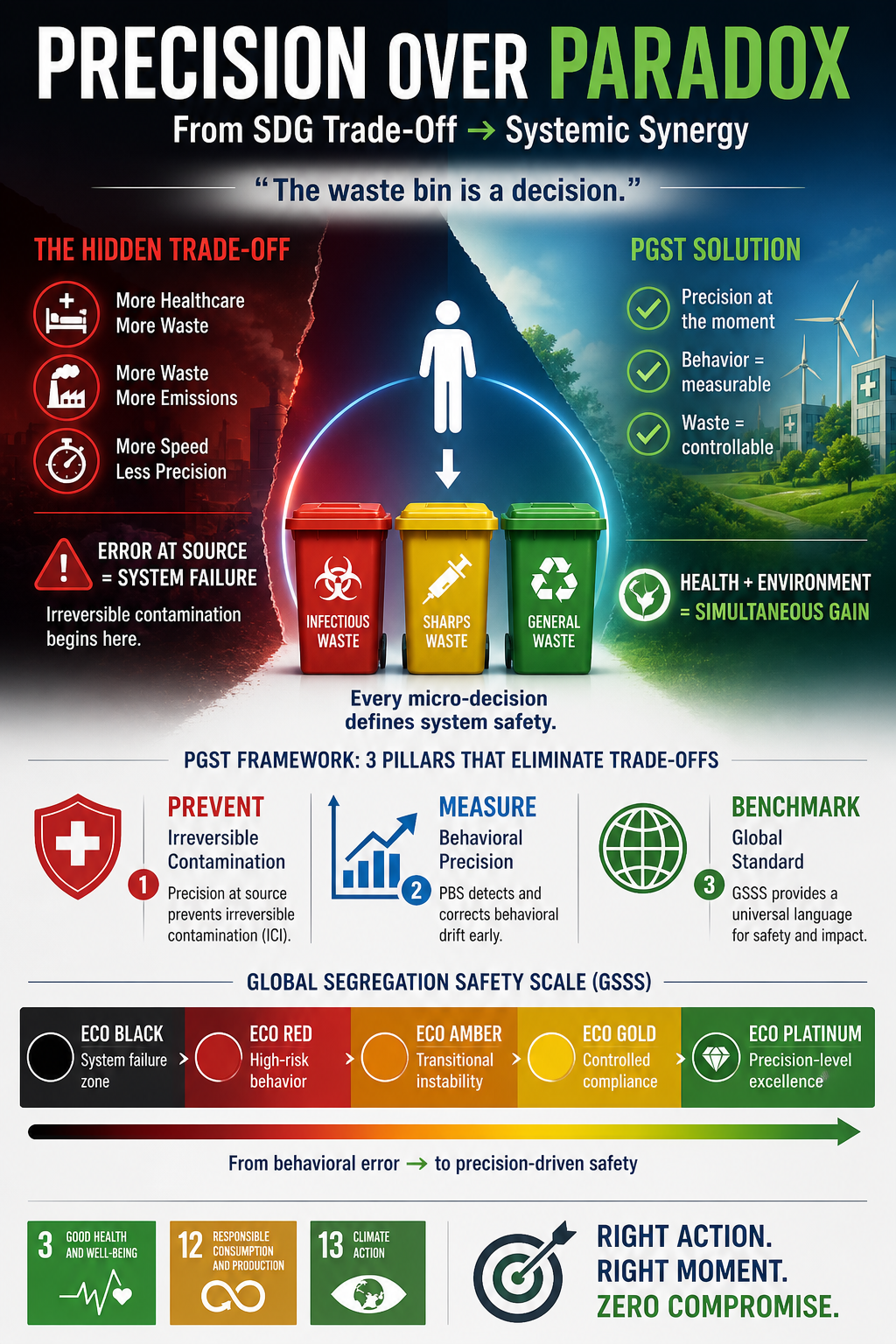
In the world of global development, we often face a frustrating "sustainability paradox." To improve public health (SDG 3), we build more hospitals and perform more surgeries. But more healthcare inevitably creates more hazardous waste, which threatens responsible consumption (SDG 12) and climate action (SDG 13).
Historically, this has been a trade-off: a "win" for health was often a "loss" for the environment. But Bhadran’s Point-of-Generation Segregation Theory (PGST), recently published in Nature Scientific Reports, offers a way to flip this script from a trade-off to a synergy.
The Anatomy of the Trade-Off
A SDG trade-off occurs when progress in one goal comes at the expense of another. In healthcare, the trade-offs are often "hidden":
The Infection vs. Environment Conflict:
Increasing medical services (SDG 3) leads to higher volumes of infectious waste. If this waste isn't perfectly sorted, it contaminates general waste, making it impossible to recycle and forcing high-energy, high-emission incineration (damaging SDG 12 and 13).
The Safety vs. Efficiency Conflict:
Fast-paced clinical environments often prioritize speed (SDG 3) over precise sorting, leading to behavioral drift—small, repeated lapses that eventually cause systemic safety failures.
How PGST Controls the Trade-Off
Bhadran’s PGST reframes waste management as a behavioral act of precision. By focusing on the exact moment waste is generated, it neutralizes trade-offs in three ways:
1. Preventing Irreversible Contamination
The theory identifies an Irreversible Contamination Index (ICI). It posits that errors made at the source cannot be "undone" by downstream technology like autoclaves or incinerators. By using Moment-Based Precision Behavioral Fidelity (MBPBF) to ensure a syringe goes into the correct bin the first time, PGST prevents hazardous waste from "spoiling" the entire waste stream. This protects the environment (SDG 13/15) without compromising health services (SDG 3).
2. Quantifying "Behavioral Drift"
Trade-offs often happen because of "behavioral drift"—the insidious, slow decline in staff vigilance due to fatigue. PGST’s Precision Behavior Score (PBS) makes this invisible drift measurable. By catching these lapses early, hospitals can maintain high safety standards without needing to choose between staff speed and environmental compliance.
3. Standardizing Global Benchmarking
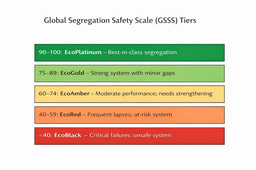
Through the Global Segregation Safety Scale (GSSS), PGST provides a five-tier ranking (from EcoPlatinum to EcoBlack). This creates a "universal scorecard" that forces institutions to account for both their health outcomes and their environmental footprint simultaneously, turning a potential conflict into a unified standard of excellence.
From Conflict to Synergy
Bhadran’s theory suggests that we don't have to sacrifice the planet to save patients. By treating every disposal act as a "micro-decision" that can be measured and improved, PGST decouples healthcare growth from environmental degradation.
In the PGST framework, precision behavior is the bridge that connects individual actions at the bin to the global achievement of the 2030 Agenda.

Renjith Seela Bhadran, developer of Bhadran’s Point of Generation Segregation Theory (PGST), is an Indian academic and public health researcher whose work integrates behavioral science with public health to address systemic challenges in healthcare waste management. He is an Assistant Professor in the Department of Public Health at Amrita School of Medicine, Amrita Vishwa Vidyapeetham, Kochi, India, where he primarily teaches Social and Behavioral Science to healthcare students.
Bhadran holds a Master of Science in Public Health (MSc PH) from the University of Bedfordshire and an MBA from the University of Nottingham, United Kingdom. His academic work reflects a multidisciplinary perspective that combines public health systems analysis, behavioral science, and environmental sustainability. His research initially focused on onsite biomedical waste segregation challenges in healthcare facilities and later expanded to investigate the cognitive and behavioral determinants influencing segregation practices at the point of generation.
During his doctoral research (PhD) at Amrita School of Medicine, Bhadran developed the Point-of-Generation Segregation Theory (PGST), a behavioral–systems framework that conceptualizes biomedical waste segregation as a precision-dependent behavioral process occurring at the moment of waste generation. The theory introduces analytical constructs such as the Precision Behavior Score (PBS) and Moment-Based Precision Behavioral Fidelity (MBPBF) to evaluate segregation accuracy at the point of disposal, along with behavioral drift analysis to monitor system performance and support improvement over time.
PGST also proposes the Global Segregation Safety Scale (GSSS), a structured benchmarking framework designed to classify institutional segregation performance and support international comparisons in biomedical waste management practices. By reframing waste segregation as a behavioral decision-making process rather than solely an operational activity, the framework provides a new interdisciplinary perspective linking healthcare worker behavior, environmental sustainability, and public health safety.
Bhadran’s research sits at the intersection of behavioral systems research, public health impact assessment, health education, and environmental health management. His work is increasingly gaining international academic attention for its potential to strengthen training systems, institutional audits, and evidence-based policy development in biomedical waste management.

Please sign in or register for FREE
If you are a registered user on Research Communities by Springer Nature, please sign in