Proper elements of resonant systems, Marchal’s family of periodic orbits I: Stability of inclined co-orbital planetary systems
Published in Astronomy





Speakers
- Anargyros Dogkas
- Alexandre Prieur
Abstract
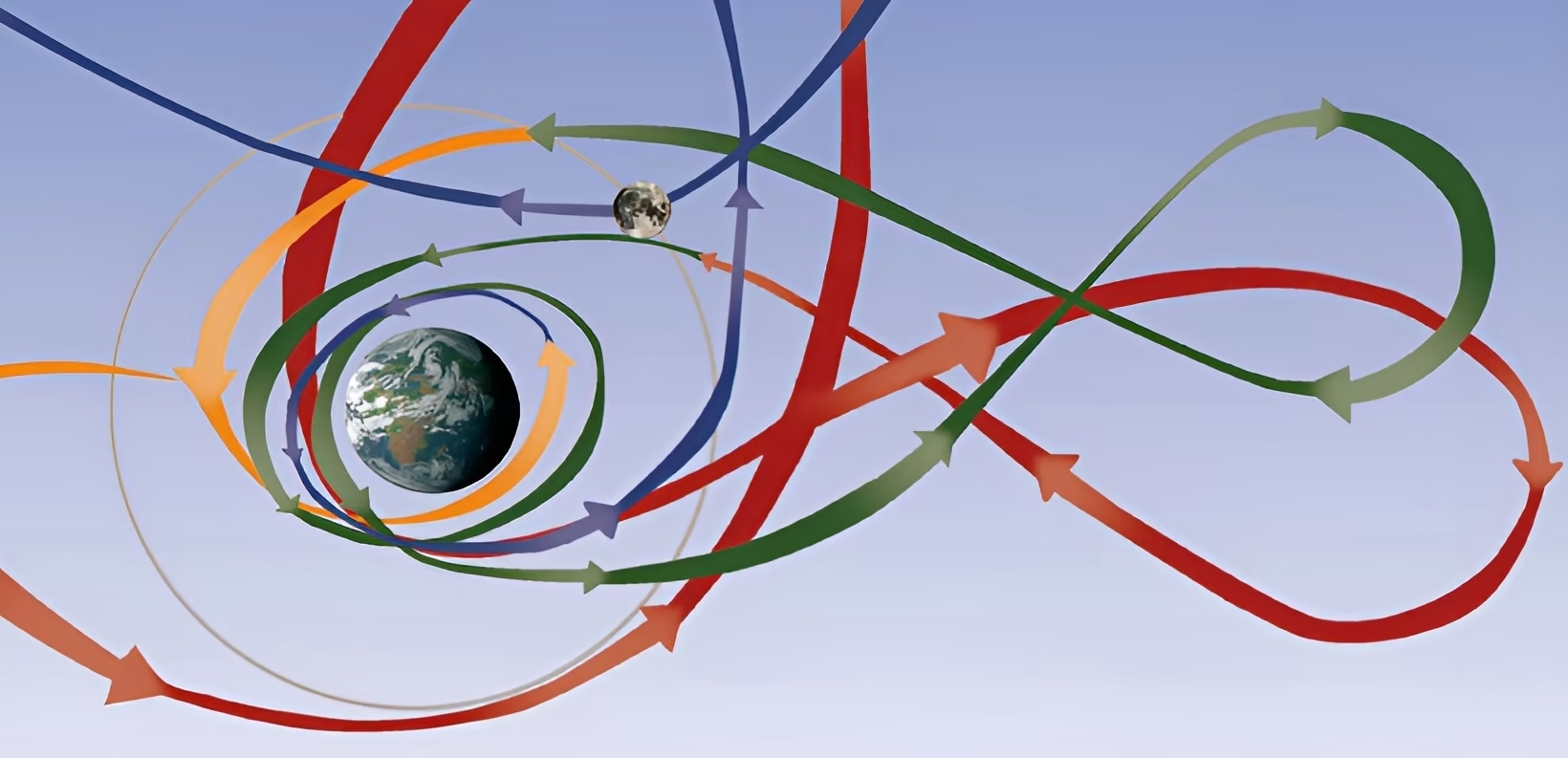
In celestial mechanics, the computation of local quasi-integrals of the motion has been a central subject of study. Proper elements have been historically used for the classification of objects (like asteroids and Earth orbiters) as well as for the construction of local analytical solutions for the evolution of orbital elements. However, the domain where these quasi-integrals are well defined is naturally restricted by the existence of resonances. In this article, we use analytical methods to define quasi-integrals of motion in the case of resonant systems. This is done using the quasiperiodic properties of libration regions in isolated resonances, as well as in the multi-resonant case, allowing us to apply perturbation theory effectively even though the initial system was resonant. Finally, we introduce the problem of Earth orbiters, like satellites and space debris, and we illustrate the results of these methods in a variety of examples in mean motion and secular resonances, including thinner resonances
and multi-resonant systems.
At the Lagrange relative equilibrium of the three-body problem, for all values of the masses, the elliptic eigenvalues associated with vertical eigenvectors give rise to spatial quasi-periodic orbits, which become periodic in a rotating frame. In 2009, by averaging out the fast frequencies, Christian Marchal showed that these orbits, which are fixed points in the restricted average problem, form a one-parameter family connecting
to . Using perturbation methods, we show the persistence of this family in the average three-body problem for nonzero masses in the limit where one mass is dominant over the other two (known as the planetary problem). We also give an analytical approximation valid for mutual inclinations less than . Then, using purely numerical methods, we show that this family exists in the full three-body problem (neither restricted nor average) for a wide range of masses, beyond the planetary case. We also show that the stability of its orbits evolves along the family, with inclined systems remaining stable for masses exceeding the Gascheau’s value (also known as Routh’s critical value). Finally, we show the impact of this family’s stability on the global dynamics of the co-orbital region as well as its high instability for mutual inclinations exceeding .

Research Seminars by Springer Nature - giving you access to the latest research talks, direct from authors and editors.
Follow the Topic
-
Celestial Mechanics and Dynamical Astronomy
This is an international journal that is concerned with the broadest range of celestial mechanics and its applications, as well as with peripheral fields.

Related Collections
With Collections, you can get published faster and increase your visibility.
Multiple Planet Systems
This article collection is based on peer-reviewed contributions to the Multiple Planet Systems Conference held from 31 Aug – 4 Sept 2026 at the Sofia University "St. Kliment Ohridski", Sofia, Bulgaria.
All participants are invited to submit review articles and original research papers that address problems related to the dynamics of multi-planet systems and planets in binary stars, both on theoretical and observational aspects of these complex architectures. This is a multi-journal collection: Please select either Celestial Mechanics and Dynamical Astronomy (CM&DA) or Astrophysics and Space Science (Ap&SS) – depending on the scope of your work.
Publication under the subscription model is free of charge, open-access is offered for a fee or under the terms of Springer's institutional agreements.
Subjects relevant to CM&DA include: Detection and characterization of multiple-planet systems; Resonant and near-resonant configurations; Secular dynamics and chaos; Transit timing variations (TTVs); Three-dimensional architectures and Lidov–Kozai effects; Formation and stability of S-type and P-type planets in binaries; Numerical tools for fitting exoplanet data, dynamical analysis, and long-term stability; etc.
For Ap&SS, we expect papers within a broader astrophysical and planetary-science scope: related to planet formation and migration, protoplanetary disks, post-main-sequence evolution, stellar binaries, observational surveys, Gaia astrometry, etc.
Publishing Model: Hybrid
Deadline: May 31, 2027
Dynamics of Space Debris and NEO
Publishing Model: Hybrid
Deadline: Ongoing