Pulsed Dynamic Water Electrolysis: Mass Transfer Enhancement, Microenvironment Regulation, and Hydrogen Production Optimization
Published in Chemistry and Mechanical Engineering
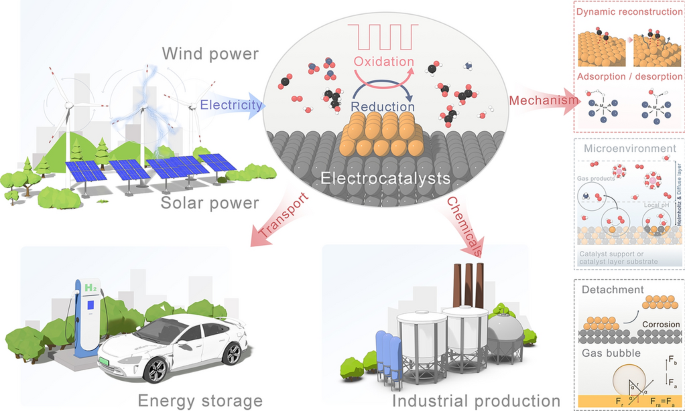
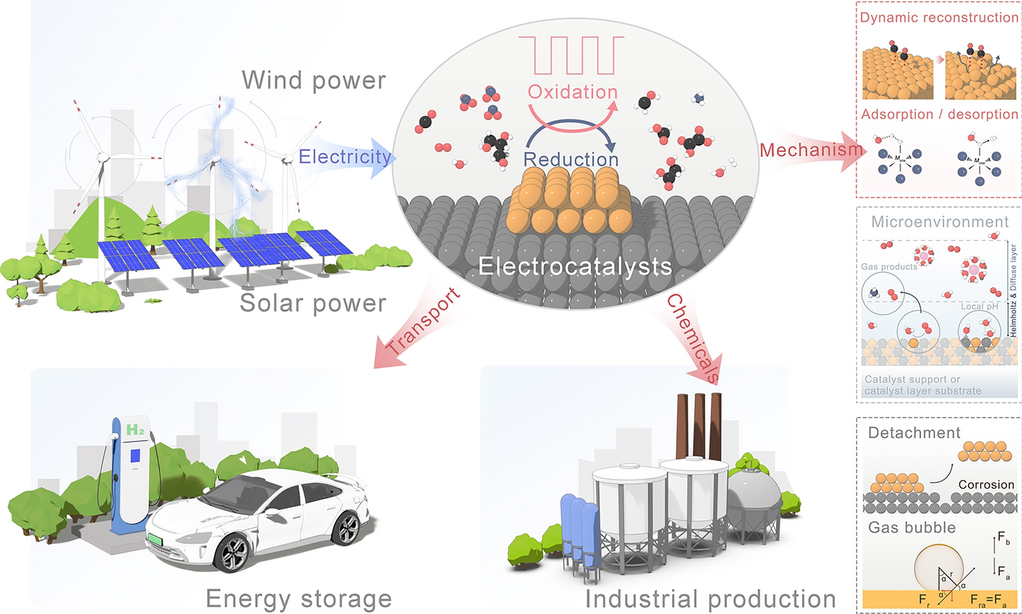

As the global demand for clean hydrogen continues to grow, the limitations of conventional steady-state water electrolysis in terms of energy efficiency, mass transfer, and system stability become more pronounced. Now, researchers from the School of Energy Science and Engineering at Harbin Institute of Technology, led by Professor Wei Zhou and Professor Jihui Gao, have presented a comprehensive review on pulsed dynamic electrolysis (PDE) and its potential applications in enhancing water electrolysis performance. This work offers valuable insights into the development of next-generation hydrogen production technologies that can overcome these limitations.
Why Pulsed Dynamic Electrolysis Matters
- Energy Efficiency: PDE can significantly reduce energy consumption in water electrolysis systems by disrupting the electric double layer and minimizing concentration polarization, addressing the efficiency limitations of conventional constant electrolysis.
- Renewable Energy Integration: By dynamically regulating current and voltage, PDE can better adapt to the fluctuating and intermittent nature of renewable energy sources such as wind and solar power, making it especially important for energy transition.
- System Stability: PDE effectively extends the lifespan of electrolysis systems by mitigating electrode degradation, preventing impurity deposition, and optimizing bubble detachment processes.
Innovative Mechanisms and Features
- Mass Transfer Enhancement: The review covers how PDE affects energy and mass transfer at the electrode/electrolyte interface. By alternating between "power-on" and "power-off" phases, PDE creates synergistic effects that optimize reactant replenishment and product removal across multiple time and length scales.
- Microenvironment Regulation: PDE enables precise control of local pH, interfacial species concentration, and electric double layer structure. Key parameters including frequency, duty cycle, and amplitude are discussed as crucial factors for optimizing hydrogen evolution reaction performance.
- System Lifespan Extension: The mechanisms of PDE in extending electrolysis system lifetime are examined, including dynamic catalyst reconstruction, electrode flooding prevention, and impurity deposition inhibition.
Applications and Future Outlook
- Hydrogen Production Optimization: PDE has demonstrated significant potential in proton exchange membrane water electrolysis and alkaline water electrolysis, achieving energy consumption reductions of 20%–35% compared to conventional methods.
- Renewable Energy Coupling: The review highlights the application of PDE in solar and wind power-driven hydrogen production systems, providing strategies for stable operation under fluctuating power inputs.
- Challenges and Opportunities: The review identifies key challenges in developing PDE systems, such as the need for unified theoretical frameworks, machine learning-assisted parameter optimization, and interdisciplinary equipment development. Future research will focus on clarifying Faradaic current decoupling methods, fine-tuning pulsed parameters, and designing PDE-compatible electrolyzer devices.
This comprehensive review provides a roadmap for the development and application of pulsed dynamic electrolysis in renewable energy-driven hydrogen production. It highlights the importance of interdisciplinary research in electrochemistry, materials science, and electrical engineering to drive innovation in this field. Stay tuned for more groundbreaking work from Professor Wei Zhou and the research team at Harbin Institute of Technology!

Editor of Nano-Micro Letters, which is an Open-Access, peer-reviewed journal reported papers that have at least one dimension ranging from a few sub-nanometers to a few hundreds of micrometers. The journal is published by Springer Nature and indexed by SCI, EI, SCOPUS, Pubmed, etc. The 2025 JCR Impact Factor is 38.5. The 2025 CiteScore is 58.9.
Follow the Topic
-
Nano-Micro Letters
Nano-Micro Letters is a peer-reviewed, international, interdisciplinary and open-access journal that focus on science, experiments, engineering, technologies and applications of nano- or microscale structure and system in physics, chemistry, biology, material science, and pharmacy.