Raise Singapore's MediSave Lifetime Withdrawal Limit for IVF with Robust Safeguards
Published in Social Sciences, General & Internal Medicine, and Pharmacy & Pharmacology
Please read the following news media articles:
Expanding use of Singapore's CPF MediSave for IVF will yield diminishing returns
新加坡试管婴儿公积金限额21年不变,是时候从$1.5万涨到$2.5万了
MediSave Withdrawal Limits for In-vitro Fertility Treatments
Raise Singapore's CPF MediSave Lifetime Withdrawal Limit for IVF with Robust Safeguards
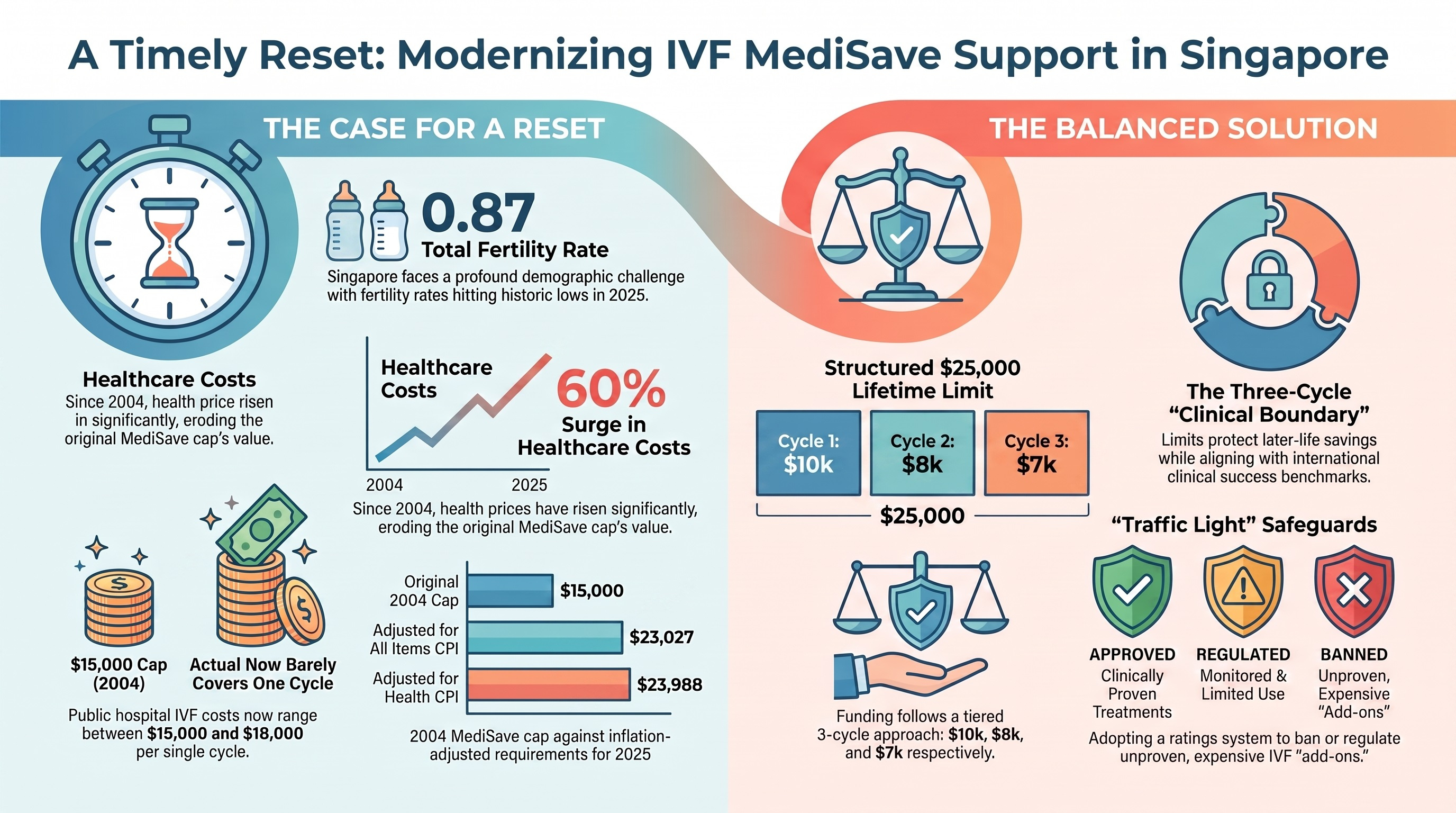
Singapore, a nation renowned for its foresight and strategic planning, faces a silent, yet profound, demographic challenge. Our total fertility rate (TFR) plummeted to a concerning 0.87 in 2025, a stark indicator of the struggles many aspiring parents face. For those navigating the emotionally and financially taxing journey of infertility, In Vitro Fertilisation (IVF) offers a beacon of hope. Yet, a critical pillar of support—the CPF MediSave lifetime withdrawal limit for IVF—has remained stubbornly fixed at S$15,000 since 2004. This outdated cap, conceived two decades ago, has been silently eroded by inflation, leaving couples to bear an increasingly heavy financial burden.
It is time for a pragmatic and timely recalibration: raise the CPF MediSave lifetime withdrawal limit for IVF to S$25,000, while simultaneously implementing stringent safeguards against exploitation of vulnerable patients, particularly from the private healthcare sector. This is not an open-ended expansion of benefits, but a crucial adjustment to restore the original purchasing power of the scheme and ensure its long-term sustainability and integrity.
The Erosion of Value: Why S$15,000 is No Longer Enough
The S$15,000 MediSave cap, established in 2004, was designed to support a course of IVF treatment. However, the economic landscape has shifted dramatically. Official Consumer Price Index (CPI) data reveals that "All Items" prices in Singapore increased by approximately 53.5% between 2004 and 2025, while "Health" prices surged by 59.1%. To maintain its original value, the 2004 cap would need to be approximately S$23,000 (based on All Items CPI) or S$24,000 (based on Health CPI) in 2025. The proposed S$25,000 ceiling is therefore not a radical increase, but a sensible adjustment to inflation, which provides a modest buffer for the complex and rising costs associated with IVF.
Contemporary IVF treatment charges underscore this urgency. Public hospitals like Singapore General Hospital estimate IVF costs between S$15,000 and S$18,000 per cycle, with KK Women’s and Children’s Hospital reporting similar costs in 2024. Private providers often charge even more. This means the entire S$15,000 lifetime MediSave limit can now barely cover a single IVF cycle, a far cry from its original intent to support multiple attempts.
A Bounded Approach: Three Cycles for Clinical Effectiveness and Fiscal Prudence
While increasing the cap is essential, it must be accompanied by a clear boundary: MediSave funding for IVF should cease after three complete cycles. The proposed allocation is S$10,000 for the first cycle, S$8,000 for the second, and S$7,000 for the third, exhausting the S$25,000 lifetime ceiling. This structured approach is grounded in clinical evidence and fiscal prudence.
Cumulative live-birth studies show that while some patients may achieve success after more than three cycles, the chances of IVF success generally decline with each subsequent attempt. For instance, a UK study found a first-cycle live-birth rate of 32.3% for women under 40, with the cumulative rate reaching 68.4% after six cycles. However, for women aged 40-42, the first-cycle rate dropped to 12.3%, and for those over 42, it remained below 4% in every cycle. This highlights that later cycles, while potentially successful for some, are not universally effective, and success probabilities vary significantly by individual factors.
Limiting MediSave support to three cycles serves three critical aims:
- Protects Later-Life Savings:In a rapidly aging society, safeguarding MediSave balances for future medical needs is paramount. Open-ended IVF funding could deplete these protected savings, leading to future financial strain.
- Promotes Clinical Effectiveness:Three cycles provide ample opportunity for clinicians to adjust treatment protocols, aligning with international best practices such as the UK's NICE guidelines, which recommend three full IVF cycles for eligible women under 40.
- Limits Costs:A clear boundary helps manage patient expectations and discourages unchecked fee inflation by providers.
It is crucial to understand that this three-cycle limit is a financing rule, not a clinical prohibition. Patients wishing to pursue further treatment can still do so through private financing or, in exceptional cases, through transparent, budget-funded assistance for those with unusually favourable prognoses and severe financial hardship.
Navigating the "Hope Technology" Trap: Safeguards Against Dubious IVF Add-ons
While expanding access to IVF is vital, we must simultaneously address the proliferation of expensive and often unproven IVF "add-ons". Infertility is an agonizing journey, making couples uniquely vulnerable to exploitation by a multi-million-dollar industry built on desperation. These optional, non-essential procedures—marketed as cutting-edge ways to boost success rates—include time-lapse embryo imaging, preimplantation genetic testing (PGT-A), endometrial scratching, and immunological treatments.
The science, however, tells a different story. A landmark 2026 meta-analysis by Lensen and colleagues, published in The Lancet Obstetrics, Gynaecology, & Women's Health, rigorously reviewed the evidence and found that most add-ons offer absolutely no proven benefit. In fact, nearly half of the 157 trials examined had to be excluded due to trustworthiness concerns, including possible data fabrication. The remaining trustworthy data was unambiguous: the vast majority of add-ons do not improve live birth rates. In some cases, such as routine PGT-A, they may even reduce the number of viable embryos available for transfer.
A notorious example is the use of time-lapse imaging (TLI) systems for purportedly selecting the best IVF embryos. However, the landmark TILT trial published in “The Lancet” in 2024—demonstrated conclusively that it does not significantly increase the live birth rate. Yet another controversial add-on is PGT-A, which has been the subject of multiple class-action lawsuits in the USA and Australia, due to allegations of misdiagnosis that have robbed IVF patients of their chances of parenthood.
Radical Transparency Needed to Protect Vulnerable Patients
Herein lies the danger of raising the MediSave lifetime withdrawal limit without strict, watertight safeguards. By freeing up a couple's disposable cash savings, this would give them more opportunities to spend unnecessarily on ancillary medical procedures. In the hands of aggressive marketing and the power dynamic of the doctor-patient relationship, that "spare cash" could easily be funneled into the clinic through the purchase of expensive, unproven IVF add-ons.
To prevent patients' CPF MediSave or "spare cash" from inadvertently fueling the consumption of dubious treatments, Singapore must implement robust safeguards. The UK’s Human Fertilisation and Embryology Authority (HFEA) uses a highly effective traffic light system to rate IVF add-ons based on clinical evidence. Singapore should adopt a similar framework immediately. Add-ons with a "red" rating—meaning safety concerns or evidence they reduce IVF success—should be banned from routine clinical use and restricted to ethical research settings. For all other add-ons, clinics must be mandated to provide plain-language, written counseling before a patient commits, clearly outlining the scientific evidence and cost.
A Balanced Path Forward for Singaporean Families
This proposed reform strikes a delicate yet necessary balance. It acknowledges the legitimate medical need for IVF and the financial strain faced by many couples, restoring the real value of MediSave support within a defined, clinically meaningful course. At the same time, it upholds the principles of MediSave stewardship, protecting long-term savings and ensuring fiscal responsibility in an increasingly aged society.
By moving beyond the outdated S$15,000 cap to S$25,000 and implementing a clear, evidence-based three-cycle limit with robust safeguards against unproven IVF add-ons, Singapore can provide more effective and equitable support for aspiring parents. This is not just about numbers; it's about empowering families, upholding ethical medical practices, and securing Singapore's future.