Rational Design and Functionalization of Melt Electrowritten 4D Scaffolds for Biomedical Applications
Published in Bioengineering & Biotechnology and Materials
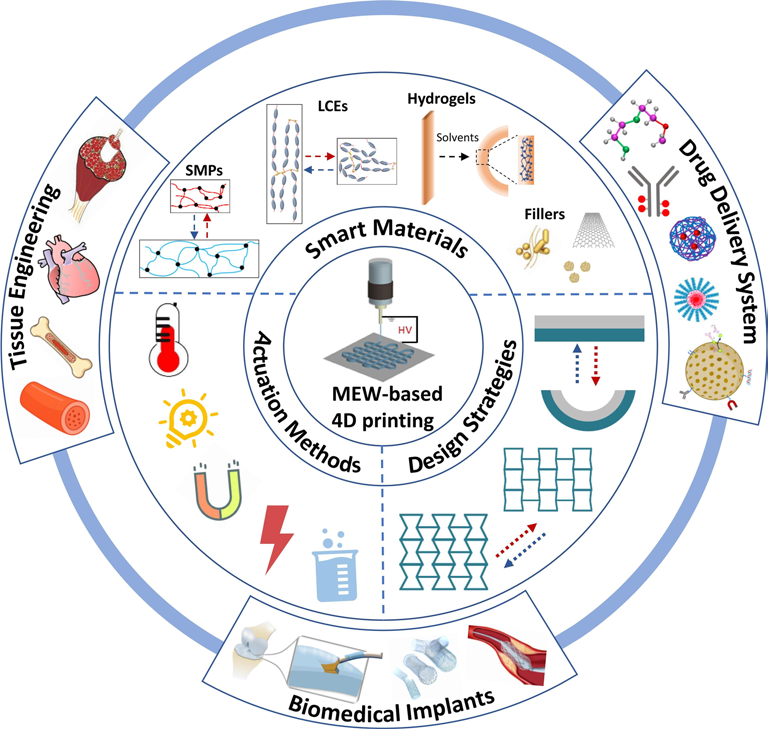
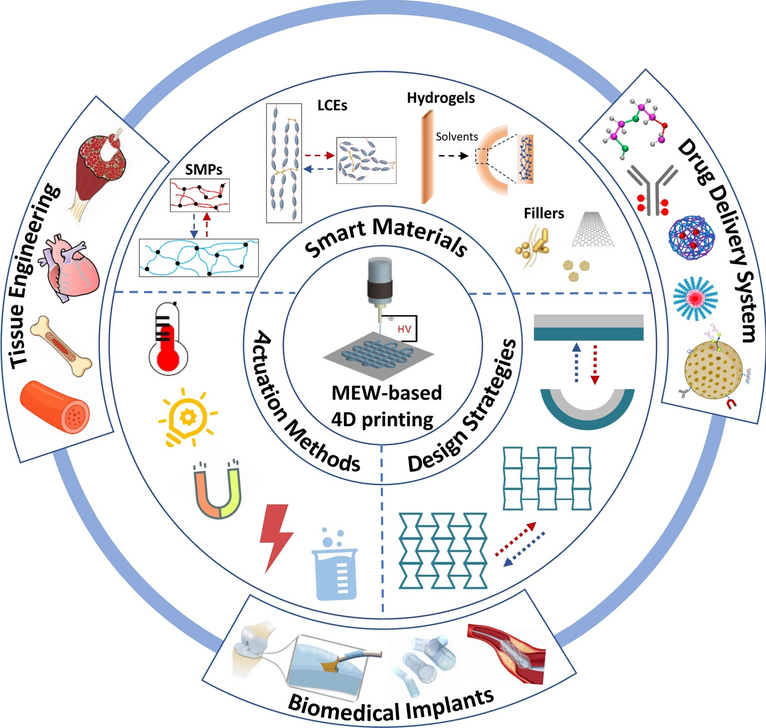

Melt electrowriting (MEW) enables the precise deposition of polymeric fibers at micro-/nanoscale, allowing for the fabrication of 3D biomimetic scaffolds. By incorporating stimuli-responsive polymers and/or functional fillers, MEW-based 4D printing creates scaffolds capable of undergoing controlled, reversible shape transformations in response to external stimuli over time. These dynamic 4D scaffolds can be tailored for minimally invasive delivery, remote actuation, and real-time responsiveness to physiological environments, making them highly relevant for biomedical applications. This review systematically elucidates the principles of MEW-based 4D printing, including material considerations, actuation methods, and structure design strategies, along with shape programming and morphing mechanisms. The versatility of MEW for rational fabrication of biomimetic scaffolds is firstly introduced. Subsequently, the critical elements underpinning MEW-based 4D printing process are overviewed, including an analysis of stimuli-responsive materials compatible with MEW, an evaluation of applicable external stimuli, and a discussion on the advancements in design strategies for 4D scaffolds. Recent progress of MEW 4D scaffolds for applications in tissue engineering, biomedical implants, and drug delivery systems are highlighted. Finally, key challenges and perspectives toward material innovation, fabrication optimization, and actuation control are discussed. This review aims to provide valuable insights for design and creation of multifunctional biomimetic dynamic scaffolds by MEW-based 4D printing.

Editor of Nano-Micro Letters, which is an Open-Access, peer-reviewed journal reported papers that have at least one dimension ranging from a few sub-nanometers to a few hundreds of micrometers. The journal is published by Springer Nature and indexed by SCI, EI, SCOPUS, Pubmed, etc. The 2025 JCR Impact Factor is 38.5. The 2025 CiteScore is 58.9.
Follow the Topic
-
Nano-Micro Letters
Nano-Micro Letters is a peer-reviewed, international, interdisciplinary and open-access journal that focus on science, experiments, engineering, technologies and applications of nano- or microscale structure and system in physics, chemistry, biology, material science, and pharmacy.