Recent Advances in Regulation Strategy and Catalytic Mechanism of Bi‑Based Catalysts for CO2 Reduction Reaction
Published in Bioengineering & Biotechnology, Chemistry, and Materials
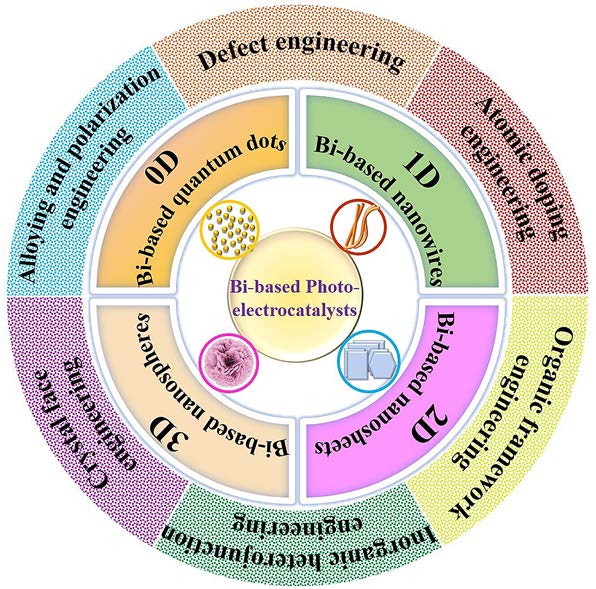
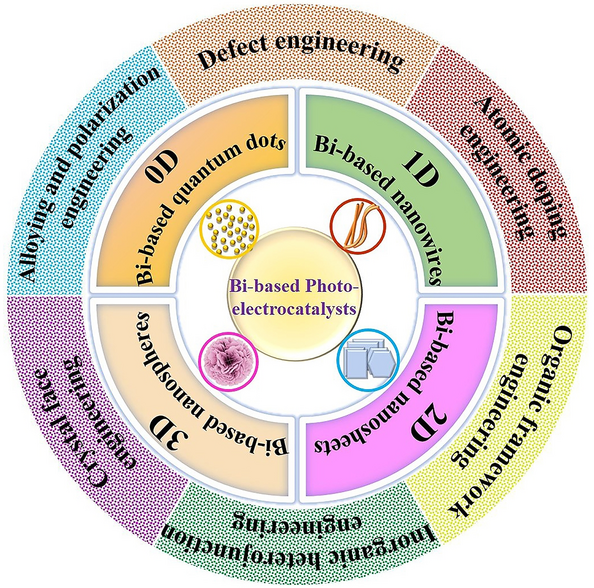

As global CO2 levels continue to rise, the need for efficient and selective CO2 reduction technologies becomes increasingly urgent. Now, researchers from the Institute of High Energy Physics and China University of Petroleum, led by Prof. Zhonghua Wu, Prof. Yunpeng Liu, and Prof. Yuechang Wei, have published a comprehensive review on the latest advances in regulation strategies and catalytic mechanisms of Bi-based catalysts for photoelectrocatalytic CO2 reduction. This work provides a roadmap for designing next-generation catalysts with enhanced activity, selectivity, and stability.
Why Bi-Based Catalysts Matter
- High Selectivity: Bi-based catalysts show strong preference for C1 products like formic acid and CO, avoiding complex multi-carbon byproducts.
- Structural Versatility: From 0D nanoparticles to 3D hierarchical structures, Bi-based materials offer tunable electronic and surface properties.
- Stability & Low Cost: Bi is non-toxic, earth-abundant, and maintains stability under reductive conditions, making it ideal for scalable applications.
Innovative Design and Features
- Six Regulation Strategies: The review systematically summarizes six key structural regulation strategies:
- Defect Engineering
- Atomic Doping Engineering
- Organic Framework Engineering
- Inorganic Heterojunction Engineering
- Crystal Face Engineering
- Alloying and Polarization Engineering
- Mechanism Insights: Each strategy is paired with detailed catalytic mechanisms, emphasizing structure–property relationships.
- Advanced Characterization: Emphasis on in situ and operando techniques, including SAXS/XRD/XAFS combined methods, to track dynamic structural evolution.
Applications and Future Outlook
- Photoelectrocatalytic CO2 Reduction: Bi-based catalysts are widely used in both photocatalytic and electrocatalytic CO2 reduction reactions (CO2RR), showing superior performance in formate and CO production.
- Multiscale Design: Integration of multiple regulation strategies enables synergistic effects, enhancing overall catalytic performance.
- Challenges and Opportunities: The review highlights the need for controllable synthesis, long-term stability, and in-depth mechanistic understanding under real operating conditions.
This comprehensive review offers valuable guidance for researchers in materials science, chemistry, and energy conversion, promoting the development of high-performance Bi-based catalysts for CO2 reduction. Stay tuned for more groundbreaking work from Prof. Wu, Prof. Liu, and Prof. Wei’s teams!

Editor of Nano-Micro Letters, which is an Open-Access, peer-reviewed journal reported papers that have at least one dimension ranging from a few sub-nanometers to a few hundreds of micrometers. The journal is published by Springer Nature and indexed by SCI, EI, SCOPUS, Pubmed, etc. The 2025 JCR Impact Factor is 38.5. The 2025 CiteScore is 58.9.
Follow the Topic
-
Nano-Micro Letters
Nano-Micro Letters is a peer-reviewed, international, interdisciplinary and open-access journal that focus on science, experiments, engineering, technologies and applications of nano- or microscale structure and system in physics, chemistry, biology, material science, and pharmacy.






Please sign in or register for FREE
If you are a registered user on Research Communities by Springer Nature, please sign in