Recycling Phosphorus Through Biochar: A Circular Approach for Calcareous Soils
Published in Sustainability, Plant Science, and Agricultural & Food Science
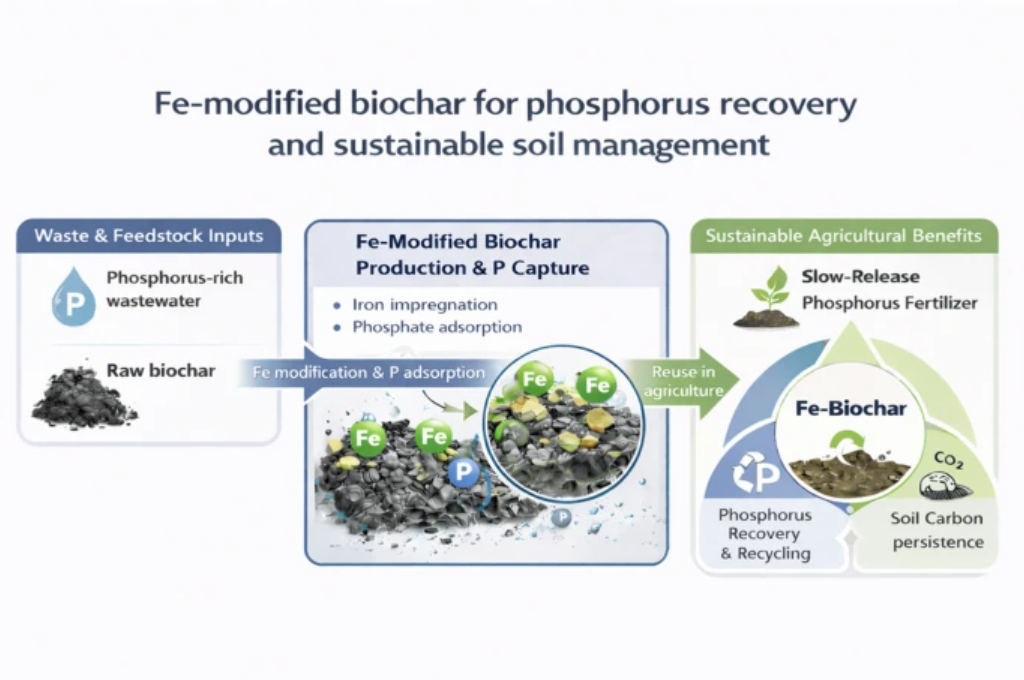
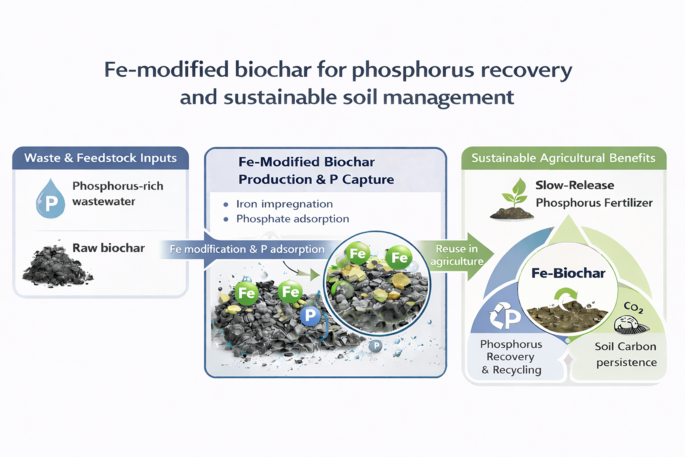

Phosphorus is essential for crop production, but managing it efficiently remains a challenge, particularly in calcareous soils where a large share of applied phosphorus can become unavailable to plants. At the same time, concerns over the long-term availability of mineral phosphorus have increased interest in recovering nutrients from waste streams and returning them to agricultural systems. A recent article published in the Journal of Soil Science and Plant Nutrition examines one possible route: using biochar as a carrier for phosphorus recovered from wastewater.
The research team produced biochars from different woody feedstocks, modified them with iron, and then enriched them with phosphorus recovered from sludge-derived wastewater. Their objective was to evaluate whether these materials could function as circular fertilizers—capturing phosphorus from a secondary source and releasing it gradually once applied to soil. The study also investigated how these materials influence soil carbon dynamics, an aspect that is attracting growing attention in soil management research.
The results showed that iron modification substantially increased the capacity of biochar to bind phosphate. When the phosphorus-loaded biochars were incubated in soil, they released phosphorus more gradually than conventional soluble fertilizers. Measurements of phosphorus availability and desorption kinetics indicated a controlled-release behavior, suggesting that the recovered nutrient remained available over a longer period rather than being released all at once. In contrast, iron-modified biochars that were simply mixed with soluble phosphorus fertilizers behaved much more like the mineral fertilizer treatments.
More organic carbon
The study also explored what happened to soil carbon after biochar application. Across treatments, total organic carbon increased, with much of the added carbon found in fractions considered less readily degradable. Isotopic analyses further indicated that biochar-derived carbon persisted in the soil throughout the experimental period. These observations support the idea that biochar-based fertilizers may influence both nutrient management and soil carbon storage, although the mechanisms and long-term outcomes require further investigation.
Like many experimental studies, this work was carried out under controlled incubation conditions rather than in long-term field trials. The findings therefore provide evidence of how these materials behave in soil systems, but they do not yet establish how they will perform across different crops, climates, management practices, or growing seasons. Further field-based research will be needed to evaluate agronomic performance and practical implementation at scale.
Taken together, the study contributes to a broader discussion on nutrient recovery and circular agriculture. By combining wastewater-derived phosphorus with iron-modified biochar, the researchers present an approach that seeks to make better use of existing resources while improving phosphorus management in soils where nutrient availability is often constrained. The work offers an example of how waste-derived materials can be reimagined as components of future fertilization strategies.
Text created with the assistance of AI.

As a Senior Publisher, I manage a portfolio of Life Sciences journals, including some influential publications in the field. I have over ten years of experience in academic publishing, with a background in neuroscience and science journalism.
Follow the Topic
-
Journal of Soil Science and Plant Nutrition
The Journal of Soil Science and Plant Nutrition is an international, peer reviewed journal devoted to publishing original research findings in the areas of soil science, plant nutrition, agriculture, and environmental science.

What are SDG Topics?
An introduction to Sustainable Development Goals (SDGs) Topics and their role in highlighting sustainable development research.
Continue reading announcement



Please sign in or register for FREE
If you are a registered user on Research Communities by Springer Nature, please sign in