Should implant selection in adolescent forearm fractures be guided by outcomes alone—or also by cost?
Published in Surgery

Advances in intramedullary fixation have expanded the surgical options for adolescent forearm fractures. While locked intramedullary nails and titanium elastic nails (TENs) have demonstrated excellent clinical outcomes, their cost and availability vary considerably across healthcare systems.
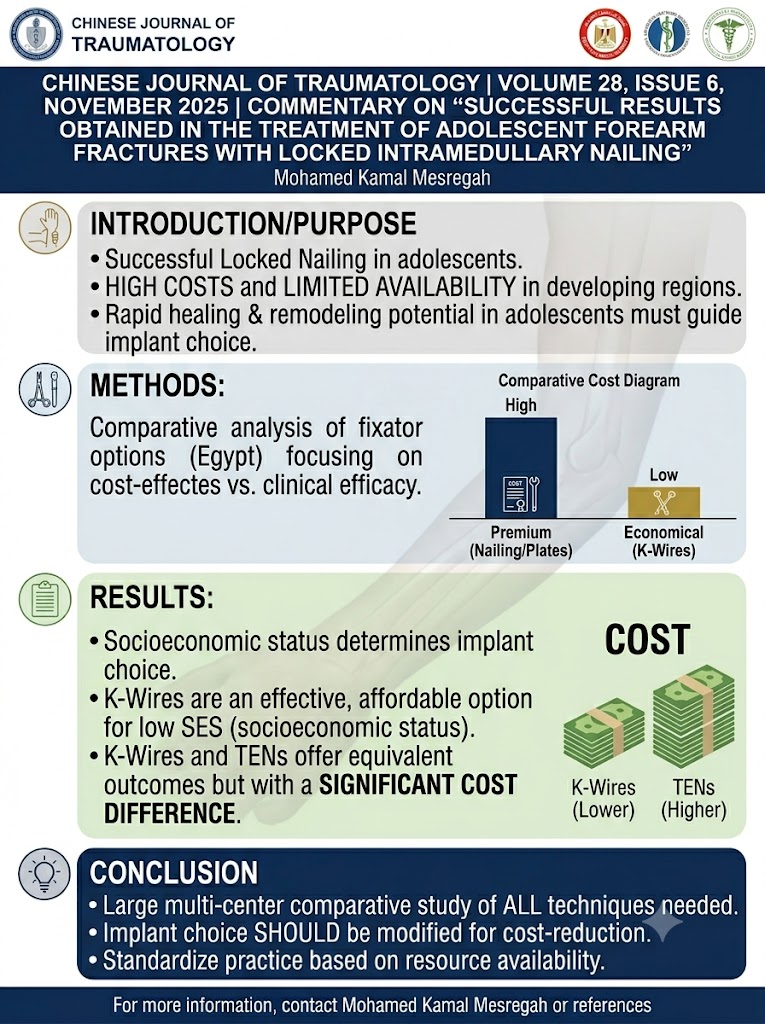
In my commentary published in the Chinese Journal of Traumatology, I discuss an often-overlooked aspect of surgical decision-making: cost-effectiveness.
Drawing on our experience in Egypt, I highlight that:
🔹 Pediatric forearm fractures possess excellent healing and remodeling potential, making multiple fixation methods clinically effective in appropriate cases.
🔹 In many low- and middle-income countries, implant cost and accessibility significantly influence treatment decisions.
🔹 Large-diameter Kirschner wires (K-wires) can provide a practical and affordable alternative for intramedullary fixation in selected patients, particularly when financial resources are limited.
🔹 Previous studies have reported comparable union rates, operative times, functional outcomes, and complication profiles among K-wires, stainless steel elastic nails, and titanium elastic nails, despite substantial differences in implant cost.
As orthopedic surgeons, our goal extends beyond achieving excellent clinical outcomes—we must also strive to deliver high-value care. Considering both effectiveness and affordability can improve access to surgical treatment while maintaining quality, particularly in resource-constrained settings.
Finally, I advocate for a large multicenter comparative study evaluating locked intramedullary nails, titanium elastic nails, and K-wire fixation to better define their relative clinical outcomes, complications, and cost-effectiveness across diverse healthcare environments.
📖 Reference
Mesregah MK. Comments on “Successful results obtained in the treatment of adolescent forearm fractures with locked intramedullary nailing”—The need for a large multi-center study to compare locked intramedullary nailing, titanium elastic intramedullary nailing and plate fixation for treatment of adolescent forearm fractures. Chinese Journal of Traumatology. 2025;28(6):515.
Article links
https://pubmed.ncbi.nlm.nih.gov/35501238/
https://www.sciencedirect.com/science/article/pii/S1008127522000438